
Expert Summary
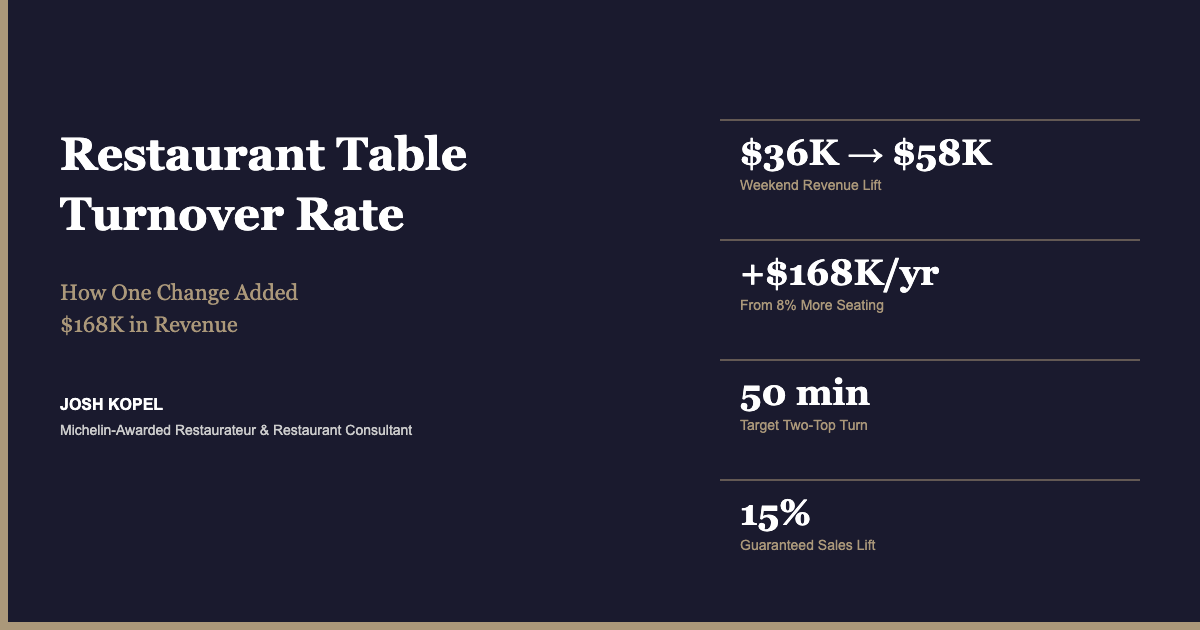
Your restaurant doesn’t sell food and beverage. It sells seats at tables for defined periods of time – just like an airline sells seats on a plane. Once I understood that, I took my fine dining restaurant from $36,000 weekends to $58,000 weekends and at my Hollywood bar, I figured out that pulling bar stools at 9 PM on weekends dramatically increased revenue because standing customers with cash in hand were higher-velocity than seated guests. Here’s exactly how to optimize your table turnover rate without sacrificing the guest experience.
I’m going to say something that might fundamentally change how you think about your restaurant: you do not sell food and beverage. You sell a seat at a table for a defined period of time.
Think about it. What industry most closely parallels the restaurant business? It’s not retail. It’s not theater. It’s the airline industry. What does Delta sell? Not travel. Not hospitality. Not convenience. Delta sells seats on a plane. And they’ve become best in the world at getting you on and off that plane as efficiently as possible.
Your restaurant works the same way. Your inventory isn’t food and beverage – it’s tables and chairs. And every minute a table sits empty during peak hours, or every minute a guest lingers after the experience is over, that’s revenue you’ll never get back. Unlike a product business, you can’t make up lost inventory tomorrow. Friday night at 7:30 PM only happens once.
This realization cost me $1,144,000 before I figured it out. That’s the ignorance tax – the money I lost every year for three years because I didn’t understand how to optimize my floor plan and maximize the capacity of my restaurant. I thought I was busy. I was nowhere close.
The Furniture Question Nobody Asks: Are You Maximizing Every Stick?
Before we get into the sophisticated stuff, let’s start with the obvious question most restaurant owners never ask: do you have every stick of furniture you need to capitalize on your busiest nights?
At my Hollywood bar, we pulled the stools away from the bar at 9 PM on weekends. During the week, they lived there permanently. But on a Saturday night, seated bar guests made it harder for standing customers to order. Standing customers with cash in hand were higher-velocity revenue. The stools were literally slowing down our highest-margin hours. One operational change, massive impact on revenue.
How much more money would you make off one more bar stool? One more table? Not on a Tuesday when you’re half full – but when you’re busier than you can handle and it’s 7:30 on a Saturday night. That’s your highest-margin inventory, and most restaurant owners aren’t maximizing it.
Hesitation Is a Hidden Expense
Here’s what I believe: on your busiest nights, you’re losing money in places you’re not tracking.
Indecision at the table. Servers hesitating instead of leading the conversation. Lag between courses. The kitchen waiting on the floor. The floor waiting on the kitchen. I don’t just see it in full service – I see it everywhere, across every tier of dining.
Every second of hesitation during peak hours is a hidden expense. It’s not on your P&L, it’s not in your POS reports, but it’s costing you more than almost any line item on your budget.
The flow of your restaurant – the single most important operational metric you have – is probably being dictated by a 19-year-old part-timer who’s going through a breakup right now. Flow is everything. It’s how you capitalize. And if you’re not deliberately engineering it, you’re leaving six figures on the table every year.
Scale On-Peak, Not Off-Peak
Here’s the paradigm shift that changed everything for me. Most restaurant owners spend their energy trying to get busier on a Tuesday. They create off-peak promotions, late-night happy hours, that Tuesday taco special that never quite takes off. It never works because you’re trying to alter customer behavior – getting people to do things they don’t want to do.
The result? You capitalize at poor margin with high overhead. You staff up for a service that underperforms. You discount to drive traffic that doesn’t stick. It’s a recipe for disaster.
Here’s where the money actually is: scale your on-peak business by influencing consumer behavior. Don’t try to change when people want to dine – optimize for when they already want to be there. That gives you the ability to capitalize at high margin with low overhead.
All I’m concerned about is momentum. I want to double down on what’s already working, then squeeze every dollar out of those peak hours before I ever think about growing a slow night.
The Airline Model for Restaurant Table Turnover
Once you accept that you’re in the seat-selling business, you can start thinking like Delta thinks. Here’s how to apply airline-level efficiency to your restaurant:
1. Optimize Your Reservation System’s Back-End Settings
For those of you using waitlist or reservation software: who set your turn times? Because I can almost guarantee they’re optimized for the convenience of your host or your general manager – neither of whom is incentivized to make sure you’re busier than possible.
The same applies to online delivery settings. Who’s setting capacity and availability? Typically it’s the people working the line, not the person paying the bills. But it should be the person paying the bills.
Go into the back end of every system you use – reservations, waitlist, delivery – and make sure they’re optimized so that when you have the most demand, you can absorb the most capacity. This is a two-minute fix that can add thousands per month.
2. Sell the Shoulders
When someone calls and asks for a 7:00 PM reservation, the conventional approach is to say, “Sure, 7 PM, you’re confirmed.” But if 7 PM is your hottest slot, that table needs to turn. What I found is that when someone has high intent – they’ve already decided to dine with you – they’ll eat at 6:15 or 7:45 without hesitation.
By actively selling people into shoulder times around your peak, you create the ability to turn your prime-time tables one extra time per night. Over a weekend, that’s several additional covers at your highest per-customer spend. Over a year, that’s transformative.
3. Strategically Overbook
This is going to make some of you uncomfortable. Good.
Every restaurant deals with no-call no-shows and last-minute cancellations. You can either set up your capacity to be “fair” and hope for the best, or you can protect your financial investment and strategically overbook.
That’s exactly what I did at my fine dining restaurant. Did it blow up sometimes? Yes. But never terribly. When it did happen, I was honest with guests: “You’re not going to be seated for 45 minutes. I know that’s disappointing. But I have great news – I’ve got all the bubbles you can drink, I can get you a cold appetizer, and I have a place for you to hang out. Your service starts now.”
The hardest part is getting them into the restaurant. Once you have them, you have everything they want. It’s very easy to make them happy.
The key to overbooking is having a recovery plan. Keep inexpensive sparkling wine on hand – it costs less than $4 a bottle but makes guests feel like VIPs while they wait. The cost of two glasses of bubbles is nothing compared to the revenue from filling that table.
4. Choreograph the Exit
Here’s the uncomfortable truth about lingering guests: if people are sitting long after the experience is over, it’s because you didn’t make it abundantly clear that the experience was over.
At my fine dining restaurant on weekends, we had to get a two-top out in 50 minutes. That’s not a suggestion – that was the operational requirement. Every second of the experience was choreographed to ensure we hit that mark.
Come in on Tuesday? Stay as long as you want. But Saturday is my opportunity to make money, and we cannot afford to have a table occupied for two hours when it could have turned twice.
This doesn’t mean rushing people. It means designing the experience so the conclusion is obvious and natural:
- Clear the table promptly. Once dessert plates are empty, they come off the table within minutes.
- Present the check proactively. Don’t wait for them to flag you down. The check arrives with a warm “no rush at all” – but its presence signals closure.
- Shift the energy. When the experience is complete, the attention shifts. Your server’s focus moves to the next table. The ambient cues change. People feel the natural end of the evening and respond accordingly.
This is not about being rude. This is about respecting both your guests’ time and your business’s capacity. The best restaurants in the world manage table turnover with surgical precision – and their guests never notice.
Bottleneck Elimination Across Every Tier
Table turnover optimization looks different depending on what tier of dining you’re in. The critical question is: are you in the manufacturing business, or the experience business?
Quick Service / Fast Casual
At my fast-casual fried chicken concept, we had what LA Weekly rated the best fried chicken sandwich in the city. But when it took 20 minutes to get it into someone’s hands, the best sandwich in the world tasted like garbage because it ruined their lunch hour. They had 60 minutes, spent 15 getting there and 15 getting back – leaving 30 minutes, of which 20 were spent waiting.
During our peak lunch window (11:30 to 1:30), we pushed everyone to kiosks for ordering. Not because we didn’t value hospitality – but because during that manufacturing window, speed IS the hospitality. Any other time, you could order from a person. But during peak, the kiosk made you faster, which made your lunch better.
When you see lines at a restaurant, what you’re seeing is inefficiency. Every person in that line is trading time – and time is the one thing they’re not willing to part with during a lunch break.
Full Service / Fine Dining
In full service, the bottlenecks are different but equally expensive. Your back-end reservation settings, your kitchen-to-floor communication timing, and your closing choreography all either accelerate or stall your turns.
At my Hollywood bar, we pulled the stools away from the bar at 9 PM on weekends. During the week, they lived there permanently. But on a Saturday night, seated bar guests made it harder for standing customers to order – and standing customers with cash in hand were higher-velocity revenue. The stools were slowing down our highest-margin hours.
The Universal Principle
Regardless of your tier: walk through your restaurant during peak hours like a customer. Where do people hesitate? Where does your team hesitate? Where does the digital experience break down? Every hesitation is a hidden expense, and every bottleneck you eliminate adds capacity during the hours that matter most.
The Digital Bottleneck: Your Website Is Killing Conversions
Your physical bottlenecks are costing you money – but your digital ones might be worse. Here’s why: every person on your restaurant’s website today is a first-timer. They’ve already decided they’re interested. They’re not there to browse – they’re there to make a buying decision.
Your website’s job isn’t to convince them to come in. They’re already inclined to come in. Your website’s job is to answer the three unspoken questions every potential guest has:
- “Does this place need to exist?” – What makes you a category of one? Why is your approach different?
- “Is it for me?” – What’s the experience like? Is this a first-date place or a get-hammered-with-friends place? What am I walking into?
- “How does it fit into my life?” – Quick lunch spot? Considered dinner? Milestone celebration? Tell me how to engage with you.
Here’s what most restaurant websites get wrong: they try to sell everything. Breakfast, lunch, dinner, Sunday brunch, catering, gift cards, online ordering. The first-timer doesn’t need all of that. They need to understand your tripwire – the ONE experience they should have first. If they need to dine for dinner before you sell them on Sunday brunch, then lead with dinner. Stop creating decision fatigue before they’ve even walked through your door.
A critical insight from neuroscience: there was a university study on people with traumatic brain injuries that prevented them from feeling emotion. These people could weigh pros and cons perfectly – but they couldn’t make a decision. The study found that a split second before every decision, there’s a triggering emotion. If your website doesn’t make people feel something, they probably won’t decide. Stop selling commodity. Start selling the experience of dining with you.
From $36K to $58K Weekends: My Own Transformation
Let me show you what all of this looks like combined. At my fine dining restaurant Preux \u0026 Proper, I took over the booking process myself (instead of delegating it to my host). Here’s what changed:
- Aggressive shoulder selling: When someone asked for 7:00, I sold them into 6:15 or 7:45 – because I understood the value of that prime-time table turning one more time
- Strategic overbooking: I added ghost tables to account for no-shows and last-minute cancellations
- 50-minute two-top turns on weekends: Every second of the experience was choreographed
- Optimized reservation back-end: Turn times set by me, not by the convenience of the host
The result: weekends went from $36,000 to $58,000. Same restaurant. Same menu. Same team. Different operational philosophy.
And when I ran a virtual reservationist service for hundreds of restaurants, I literally guaranteed complete strangers a 15% lift in top-line sales within two weeks. We hit it every time. Why? Because everyone was under-booked. The capacity was there – it just wasn’t being used.
Your 7-Day Table Turnover Action Plan
Day 1: Audit your furniture. Walk your floor plan during peak hours. Is there room for one more two-top? A bar rail? A high-boy near the entrance? Every additional seat during peak hours is pure margin over the course of a year.
Day 2: Check your back-end settings. Open your reservation system, your waitlist software, your delivery platform. Who set the turn times? Are they optimized for your maximum capacity during peak, or for the convenience of your team? Adjust them today.
Day 3: Map your bottlenecks. Walk through your restaurant during peak service like a customer. Where does the experience stall? Where does your team hesitate? Where is there a gap between kitchen and floor? Write down every friction point.
Day 4: Design your closing choreography. Define the signals that communicate “the experience is complete” – table clearing timing, check presentation, energy shifts. Train your team on the sequence.
Day 5: Audit your digital experience. Pull up your website on your phone. In 90 seconds, can a first-timer answer: what are you known for, is it for them, and how do they book? If not, simplify. One primary CTA. One clear message.
Day 6: Start selling shoulders. When your host confirms a prime-time reservation, train them to offer shoulder times first: “We have a beautiful 6:15 available – would you like that?” High-intent guests will take it.
Day 7: Test a strategic overbook. Add one or two extra reservations above your “comfortable” capacity on Friday night. Have your recovery plan ready – sparkling wine, a place to wait, and immediate service acknowledgment. Track what happens.
How much does this cost? Virtually nothing. The furniture might cost you a few hundred dollars. Everything else is free. And the ROI is measured in six figures annually.
Free Live Training
Want Me to Walk You Through These Systems Live?
Join the free 5-Day Restaurant Marketing Masterclass. In 40 minutes a day, I’ll show you how to build a marketing system that actually makes you money.
JOIN THE FREE MASTERCLASS★★★★★ Rated 5/5 by 1,000+ restaurant owners
Frequently Asked Questions
What is a good table turnover rate for a restaurant?
It depends on your tier. For fine dining, I targeted 50-minute turns on two-tops during peak weekend service. For casual dining, 45-60 minutes is standard. For fast casual, you should be measuring time-to-serve, not table time. The real question isn’t what’s “good” – it’s whether you’re maximizing turns during your highest-demand hours without sacrificing experience quality.
How do I improve table turnover without rushing guests?
You don’t rush – you choreograph. The experience has a natural arc: greeting, ordering, courses, dessert, check. When each phase transitions smoothly and the conclusion is clear, guests feel satisfied and naturally move on. If guests linger, it’s usually because you haven’t signaled that the experience is complete – not because they’re having the time of their lives.
Is it risky to strategically overbook my restaurant?
There’s risk, but the alternative – empty tables due to no-shows – is more expensive. The key is having a recovery plan: complimentary bubbles, a comfortable waiting area, and immediate acknowledgment. Most guests are understanding when you’re transparent, and the additional revenue from full tables far outweighs the occasional awkward moment.
How much revenue can better table turnover add to my restaurant?
In my own fine dining restaurant, optimizing table turnover took weekends from $36,000 to $58,000 – a 61% increase. At my Hollywood bar, removing bar stools during peak hours dramatically increased throughput. The numbers vary, but the principle holds: your highest-margin hours are your peak hours, and every additional turn during those hours generates disproportionate profit.
Should I focus on getting busier on slow nights first?
No – and this is the mistake I see most often. Scaling off-peak means altering customer behavior (getting people to do what they don’t want to do) at poor margins with high overhead. Scale your on-peak business first by influencing behavior during hours when demand already exists. Only after you’ve maxed out your peak capacity should you think about growing slow nights.