
Expert Summary
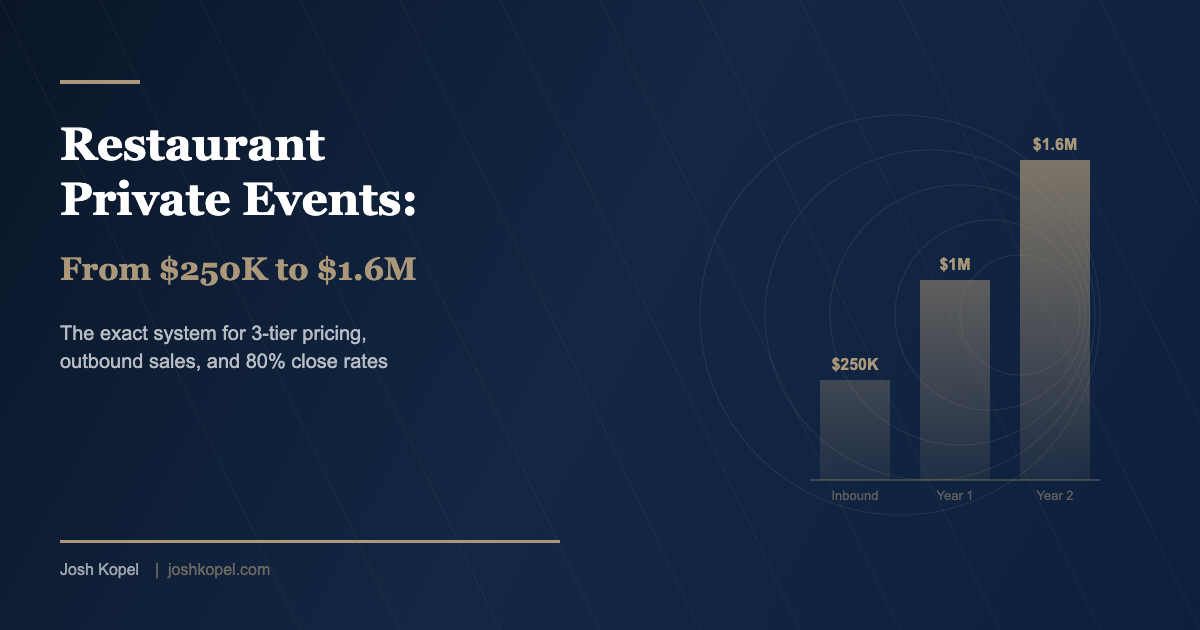
Private events aren’t a side hustle for your restaurant. They’re a separate business that shares your kitchen and staff, and they run at 30% margins compared to 10-12% for in-house dining. I took my own events business from $250K in inbound revenue to $1.6M using three-tier package pricing, outbound corporate sales, and a focus on annual recurring relationships. One client doubled event bookings and increased average event price by 50%. Here’s the exact system.
I’m going to say something that changed the entire trajectory of my restaurant business: it takes the same amount of effort to sell a $16 fried chicken sandwich as it does to sell a $10,000 private event.
Read that again. Same phone call. Same energy. Same 12 to 15-hour workday. The only difference is where you’re pointing that effort.
For years at my restaurants, we treated private events like an afterthought. Somebody would call about a holiday party, we’d scramble to put together a custom proposal, overextend the kitchen, stress out the team, and hope it went well. We were doing about $250,000 a year in inbound events. It felt decent. It wasn’t.
When I finally got serious and applied real systems to our events business, here’s what happened: within 12 months, $250K grew to $1 million. The next year, $1.6 million. And it only grew from there. Same restaurant. Same team. Same hours. Different approach.
The margins on those events ran at 30%, compared to 10-12% for our in-house dining at Preux & Proper. When you blend those revenue streams together, your overall margin jumps to 15-20% without cutting a single cost. That’s the power of diversification.
Why Private Events Are Your Restaurant’s Best-Kept Secret
Here’s the math most restaurant owners never do. Your restaurant has fixed overhead. Your kitchen is paid for whether you’re doing private events or not. Your staff already exists. Your lease doesn’t change. When you sell a private event, nearly every dollar of revenue drops closer to the bottom line because you’re not adding meaningful new expenses. You’re just using capacity you already have.
But the real unlock is understanding what private events actually are. They’re not one-off transactions. Private events are annual recurring revenue.
Think about it. If somebody has their holiday party with you and you don’t screw it up, why would they experiment next year? It becomes part of their tradition. It becomes part of their routine. And so the business compounds over time. One event becomes two events. Two events become four. A company that does their holiday party with you also needs team lunches, client dinners, seasonal celebrations, and awards banquets.
That compounding is what took us from $250K to $1.6M. We didn’t find 6x more clients. We built deeper relationships with the clients we already had, and the recurring revenue stacked year after year.
You’re Selling to the Wrong Person
This was the single biggest breakthrough in my events business, and I want you to sit with it for a minute.
Here’s what it looks like in most restaurants. John calls about booking an event for his office. You talk. You send him some menus. He comes in, walks the space, you chit chat. Seems like it went well. Then John goes back to his boss and says something like, “I met with Josh. These are the menus. This is what we can order. Josh doesn’t seem like an idiot. It’ll probably be okay.”
How does that sound? Not great, right? Because John isn’t the decision-maker. His boss is. And you never meet the boss.
The reason your close rate is lower than it should be isn’t because your food isn’t good enough or your space isn’t nice enough. It’s because the person who actually approves the expense has never spoken to you, never walked inside your four walls, and is making a decision based on whatever John can remember from your meeting.
So the question becomes: how do you help John sell for you when you’re not in the room? The answer is you give him assets so good that the vision sells itself.
The Asset Pack That Closed 80% of Our Events
Your ability to close is limited by your ability to give the prospect what they need to properly create the vision in the mind of someone who has never spoken to you. That’s the whole game.
Let me walk you through what we used to sell millions of dollars in events at Preux & Proper.
Page one: effort, not product. The first thing a prospect sees isn’t a menu. It’s a photograph that communicates effort. We’re making things. We’re artisans. We’re not showing you a finished plate on a table. We’re showing you the process, the care, the craft. And there’s a singular call to action. That’s it.
Page two: why us. This page is dedicated entirely to who we are as an organization and our perspective on catering and events. Here’s the key insight: the person who’s going to tour your space probably won’t read this page. But the person who has never been in and is going to approve the expense? They will. By page two, I’ve convinced the decision-maker they should do business with me.
Space options: paint the picture. I provide section-by-section options for the space, and here’s the important part: the photos show the room set up for events, not how it looks during regular dinner service. Most people can’t envision a world that doesn’t exist yet. That’s why they need you to show it to them.
At Preux & Proper, we didn’t have a private dining room. What we had was the left and right side of the room, which we internally called the North Semi-Private Dining Hall and the South Semi-Private Dining Hall. We chopped the space into sections so we could handle a party of 25 to 250 without disrupting regular dinner service. I preferred partial buyouts because I could keep a busy Saturday night running on one side of the room while selling out the other half for a 50-top.
Three-Tier Package Pricing: The Psychology That Prints Money
If you’re still sending individual menu items to corporate event bookers and going back and forth for 38 emails about whether they want the brussels sprouts or the asparagus, I need you to stop. That approach is wasting your time and killing your close rate.
Here’s what I learned: people don’t want choice. They want the illusion of choice. They want to be told what to do, but they still need some level of autonomy. So instead of selling individual food items, I sell experiences through packages.
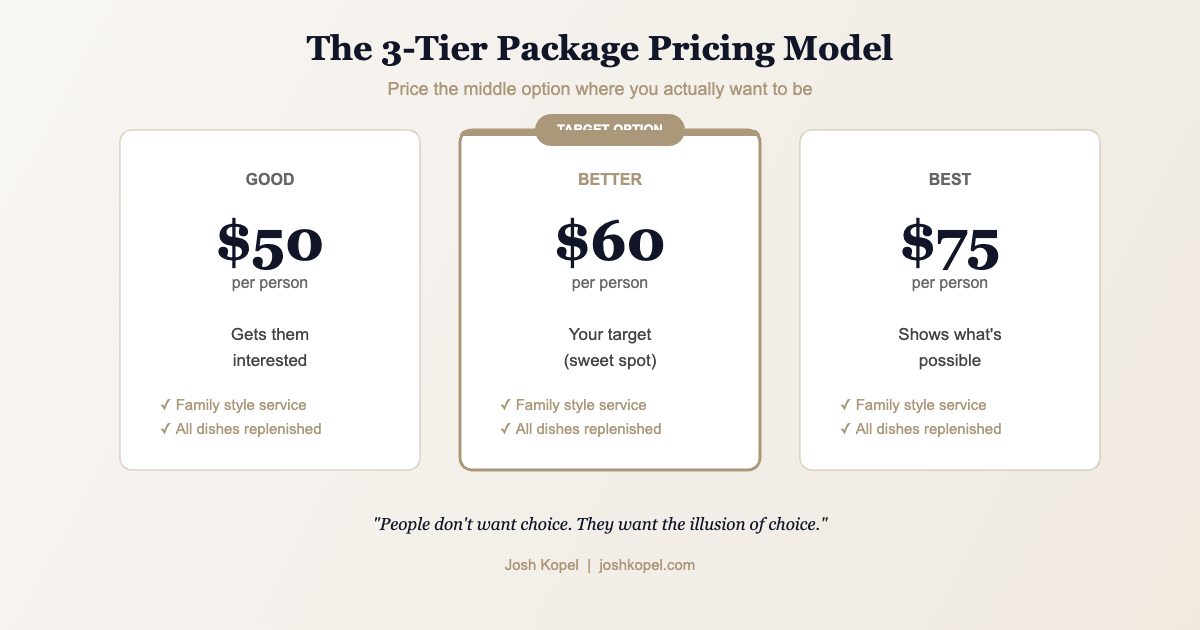
For family-style dinner, we offered three options: $50 per person, $60 per person, and $75 per person. The gap between $50 and $60 is nothing. The gap between $60 and $75 is a little scary. Where do you think I actually want them? At $60. That’s my sweet spot. The $50 option exists to make $60 feel reasonable. The $75 option exists to make $60 feel smart.
The same structure applied to butler-style tray pass: choose five items at $45 per person, choose eight at $55, with all dishes replenished as needed. Family-style buffet followed the same pattern with tiered options per section.
But here’s where I really won. Four words printed on every package page: “All dishes REPLENISHED as needed.”
What is the number one concern of somebody booking an event? Running out of food. Every single booker worries about it. So instead of having a conversation about it, instead of selling shrimp by the piece and making them guess how many they need, I eliminated the concern entirely on the first page they see.
And here’s the secret that makes this work financially: if you’ve ever hosted a corporate event, people don’t eat. They don’t drink. Nobody is going to a corporate event to get hammered and stuff themselves. They’re going so they don’t get fired. So you can feign generosity because you know how consumption actually works at these things. The promise of abundance costs you almost nothing in practice.
The Beverage Strategy That Improved Margins on Every Single Event
Our event beverage packages were priced intentionally high. Beer and wine was $20 per person per hour. Call bar packages were $30. Premium was $35. Select was $45. And I didn’t even offer a no-beverage option on the menu.
Why so expensive? Because this is where my margin lived. And because I knew nobody was actually going to drink that much.
Here’s what happened in practice: of the millions of dollars in events we sold over the years, we never sold a beer and wine package once. Not once. Because every time someone selected beer and wine, we immediately upgraded them to the call bar package.
Why? Because what I’m able to do is increase perceived value while simultaneously improving my margin. The call bar package costs me slightly more but charges significantly more. It’s a holistic win for every stakeholder: better margin for me, better experience for the guests, and a win for the booker who can tell their boss they negotiated an upgrade.
Which brings me to the most important lesson in events pricing: nobody wants to buy a $5,000 thing for $5,000. They want to buy a $6,000 thing for $5,000.
So when I upgraded the beverage package, I invoiced at full freight and then discounted it back. The client paid $5,000 for what looked like $6,000 worth of value. And the person who set the whole thing up got a win they could take credit for with their boss. Everyone walks away feeling like they got the better end of the deal.
Understanding Your Buyer: Nervous People Spending Other People’s Money
If you want to sell more events, you need to understand who’s actually buying them. And what I’ve found is that the people who professionally book corporate catering and events are very nervous people.
Think about it. Imagine setting up a holiday party for everyone you work with, and the overall performance you’re judged by at the end of the year is going to be rooted in the performance of someone who is not you. The caterer. The venue. The bartender. If any of them screw up, it’s your reputation on the line.
People are booking events for one of two reasons: either for people who give them money, or for people they’re directly related to. They don’t want to disappoint their boss, just like they don’t want to disappoint their mother-in-law.
What we sell isn’t food and beverage. It’s not events and catering. It’s confidence.
Every element of your asset pack, your pricing, your follow-up, and your service should be engineered to make the booker feel confident that they’re not going to get fired for choosing you. That’s the job.
The Outbound System: Stop Waiting for the Phone to Ring
Hoping for someone to fix your problems for you is not a great strategy. Most restaurants sit around waiting for inbound event inquiries. That’s reactive. That’s leaving your revenue in someone else’s hands. What I want is for you to control how much money you make.
I worked with a chef-owner in a very small metro area. I told him to take our asset pack, use a targeting system we built to identify prospects, and reach out to as many people as possible to see if they were hosting a holiday party. Three weeks later, he followed up and said, “Josh, it didn’t work.” So I asked him to walk me through it. Turns out he’d spent about six hours total on outreach and generated $9,000 in event sales.
Six hours. $9,000. That’s $1,500 per hour of effort. What else could he possibly do with his time that generates that kind of return?
Now imagine he 10x’d that effort. That’s the entire point.
The Miami case study. I worked with a fine dining restaurant in Miami. The owner came to me in September and said she needed to sell $500,000 in events by the end of the year. So we broke it down. At her tier, that meant roughly 100 events at $5,000 each. We subtracted out existing bookings and fence-sitters, which left 75 new events needed. We assumed a conservative 5% close rate, which meant she needed to reach out to 1,500 businesses. Over 30 business days, that’s 50 calls a day.
She hit $500,000 in about 20 business days. Not 30. Twenty. Because her targeting got better, her pitch got better, her close rate improved with iteration. She actually stopped before reaching out to all 1,500 prospects because she was already at capacity.
Hand-Raising Emails: Turn Your B2C List Into B2B Gold
How many people on your mailing list own businesses or work for companies that could host a private event? How many of them order catering regularly? You probably don’t know. Your list is a B2C list. But buried inside it are B2B prospects waiting to be identified.
That’s why we use hand-raising emails. Instead of trying to sell people on your events program directly, you give something away. Here’s what we did:
We sent an email to our list announcing that we were giving away a complimentary holiday party for up to 250 people. To enter, reply with your name, business name, business website, total number of people, and the person managing the event. The responses flooded in.
And somehow, every single time, the “winner” was the person with the fewest number of employees.
Then we sent a follow-up to everyone else: “Congratulations to Lulu, she won. For those of you who didn’t win, I want you to feel like winners too. I’m going to be reaching out directly.” And then I personally followed up with every single respondent, because now I had context. I knew their business. I knew their headcount. I knew the date of their event. The conversation practically closed itself.
This works because they already opened your emails. They already know, like, and trust you. They already told you about the thing they need to do. Now you’re just doing it together.
Speed Kills (In a Good Way): The 391% Advantage
When someone reaches out to book an event on your website, how quickly do you get back to them? If the answer is anything more than an hour, you’re losing money.
Here’s a real statistic: if you reply to someone within one minute of them filling out a form, you are 391% more likely to close that client.
One of the first things we do with clients is replace all the forms on their website with automation-backed forms. When someone fills out an inquiry, they immediately get an automated text: “Hey, this is Josh. I want to let you know we got your inquiry and we’re working on it now. I’m going to follow up with you in less than five minutes with a couple of questions.” Four minutes later, an automated email goes out with specific follow-up questions.
Why does this work so well? Because when someone reaches out with an inquiry, they don’t want to book an event with you specifically. They just want to book an event. Your goal is to stop their prospecting process. Make the inquiry they send to you the last one they send to anyone, because you seem like you’re on it.
Who to Target: Follow the Money That’s Already Being Spent
I worked at a law firm for about six months until I got fired. When I was there, the only thing I was qualified to do was order lunch. And here’s what I learned: they wanted variety, they had no budget constraints because they were billing everything back to the client, and they ordered catering five days a week. All they cared about was that it was delicious.
When I started building our corporate catering strategy, I went after law firms, accounting firms, economics firms, and large offices that I knew were billing back to clients. These businesses already have the budget. They’re already buying the thing you’re selling. You just need to be the one they buy it from.
Our targeting system creates prospecting lists based on proximity, industry, headcount, and then ranks businesses by their perceived capacity to pay. Then you just reach out. Twenty calls a day, five days a week, hundreds of calls a month. It directly translates to more money in your pocket.
What This Looks Like When It Works
This isn’t theory. The Dundee Dell in Omaha, Nebraska – literally the oldest bar in Omaha – saw private events skyrocket by over 100% compared to the previous two years after implementing this system. Marquise Steakhouse in Milton, Ontario increased their average event price by 50% and doubled event bookings.
These aren’t restaurants with massive marketing budgets or dedicated sales teams. They’re operators who built a system, created great assets, and started reaching out instead of waiting around.
Your 7-Day Private Events Action Plan
Day 1: Audit your current events setup. How many events did you do last year? What was the average ticket? What was your close rate? If you don’t know these numbers, that’s your first problem. You can’t improve what you don’t measure.
Day 2: Build your three-tier packages. Create Good, Better, Best options for family-style, tray pass, and buffet service. Price the middle option where you actually want to be. Include “all dishes replenished as needed” on every package.
Day 3: Create your asset pack. Professional photos of your space set up for events (not regular dinner service). Your story and positioning. Section-by-section space options. Sample menus and packages. This is the document that sells for you when you’re not in the room.
Day 4: Set up automated response. Replace your inquiry form with an automation-backed system that texts back within one minute and emails within five. This alone will dramatically improve your close rate.
Day 5: Build your prospect list. Identify law firms, accounting firms, and large offices within your market. Sort by proximity, headcount, and billing model. Aim for a list of at least 200 prospects to start.
Day 6: Reach out to every past events client. This is the lowest-hanging fruit. These people already know, like, and trust you. Invite them in for lunch or dinner. Ask if they have anything coming up on the horizon. One masterclass participant did this homework and showed up the next morning with $7,500 in event orders.
Day 7: Start your outbound calls. Begin with 20 calls a day. Use the hand-raising approach for your email list. Track your leading indicators: calls made, emails sent, responses received. Those are the numbers that predict revenue.
Free Live Training
Want Me to Walk You Through These Systems Live?
Join the free 5-Day Restaurant Marketing Masterclass. In 40 minutes a day, I’ll show you how to build a marketing system that actually makes you money.
JOIN THE FREE MASTERCLASS★★★★★ Rated 5/5 by 1,000+ restaurant owners
Frequently Asked Questions
How much revenue can private events add to my restaurant?
I took my own events business from $250K to $1.6M in under three years. A client in Omaha doubled their event bookings. A fine dining restaurant in Miami sold $500K in events in 20 business days through outbound outreach. The numbers vary, but the margins are consistently around 30%, which is 2-3x what most restaurants make on in-house dining. Even a modest events program that adds $40K per month at 30% margins delivers $12,000 in monthly profit from capacity you already have.
What should I charge for private events?
Price based on perceived value, not food cost. Create three-tier packages where the middle option is your target price. At Preux & Proper, our family-style tiers were $50, $60, and $75 per person. The key is making the second option feel like the obvious choice through anchoring. Include “all dishes replenished as needed” to eliminate the number one concern every booker has, and build beverage packages where upgrades improve your margin while increasing perceived value for the client.
How do I get more event bookings without waiting for the phone to ring?
Build an outbound system. Start by reaching out to every past events client you’ve ever had. Then build a prospecting list targeting law firms, accounting firms, and large offices in your area. Make 20 calls a day, five days a week. Use hand-raising emails to identify B2B prospects hiding in your B2C mailing list. A chef-owner I worked with spent six hours on outreach and generated $9,000 in event sales. That’s $1,500 per hour of effort.
What’s the most important thing for closing event bookings?
Great assets. The person you meet during the inquiry process usually isn’t the person who approves the expense. Your asset pack has to sell the vision to someone who has never spoken to you and never walked inside your restaurant. Professional photography, section-by-section space options, clear package pricing, and a story that communicates confidence. My close rate was approximately 80% because the asset pack did the heavy lifting before I ever got on a call.
How do I run private events without disrupting regular dinner service?
Divide your space into sections. At Preux & Proper, we didn’t have a dedicated private dining room. We split the main dining room into what we called the North and South Semi-Private Dining Halls and offered partial buyouts. This let us host a 50-person event on one side while running a full Saturday dinner service on the other. Build your event capacity around your kitchen’s slowest production point and staff accordingly.