Expert Summary
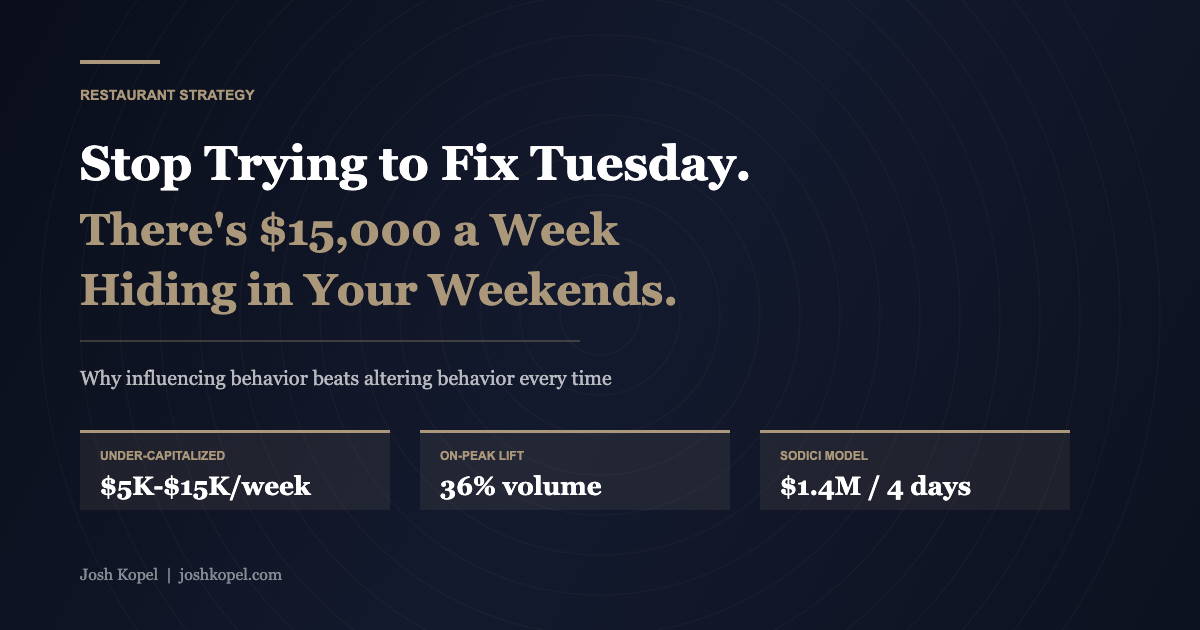
How much time and effort have you put into initiatives that ended up doing nothing for your business? That Tuesday promo that was totally going to turn around the week? When you ask someone to come in on a Tuesday, you’re not just asking them to patronize your restaurant. You’re asking them to get off the couch, put on pants, get in their car, and drive to a place they don’t want to go. You’re trying to alter behavior. And altering behavior is incredibly expensive. Instead, focus on influencing behavior – people who are already out on a Saturday are easy to redirect. Sodici Pizza does $1.4 million a year open four days a week. There’s likely $5,000 to $15,000 a week sitting in your under-capitalized Fridays, Saturdays, and Sundays.
How much time and effort have you put into initiatives that ended up doing nothing for your business? That Tuesday promo that was totally going to turn around the week? That late-night happy hour that just never took off?
Here’s why that stuff doesn’t work. When you ask someone to come in on a Tuesday, you’re not just asking them to patronize your restaurant. You’re asking them to get off the couch, put on pants, get in their car, and drive to a place they don’t want to go to eat food they didn’t want to eat when they’d rather be doing something else.
You’re trying to alter behavior. And altering behavior is incredibly expensive.
Instead, focus on influencing behavior. People who are already out on a Saturday are easy to redirect. “You’re already out – why don’t you spend some time with me?” That’s a fundamentally different proposition. High margin. Low overhead.
All of you have untapped capacity. All of you. I assure you, there’s an extra $5,000, $10,000, $15,000 a week sitting in under-capitalized revenue on Fridays, Saturdays, and Sundays. And you’re out here running a two-for-one deal on the night nobody wants to leave their house.
Altering Behavior vs. Influencing Behavior: The Most Expensive Mistake in the Restaurant Business
This is the distinction that changed how I think about every dollar I spend on marketing. There are two fundamentally different things you can do with a customer’s behavior: you can try to alter it, or you can try to influence it.
Altering behavior means convincing someone to do something they wouldn’t otherwise do. Come in on Tuesday. Try a cuisine they’ve never had. Drive 30 minutes out of their way. Every single one of those asks is fighting against gravity. It’s expensive, it’s inefficient, and the results are almost always disappointing.
Influencing behavior means redirecting someone who’s already in motion. They’re already out on Saturday night. They’re already looking for something to do. They’re already in spending mode. All you have to do is give them a reason to spend that time and money with you instead of someone else.
The cost difference between these two approaches is staggering. Altering behavior requires heavy discounting, massive marketing spend, and constant effort just to get a handful of people through the door on a night they don’t want to be there. Influencing behavior requires a great offer and a little bit of attention during hours when demand already exists.
Every restaurant owner I work with spends too much time trying to alter behavior and not enough time trying to influence it. Flip that ratio and watch what happens to your revenue.
The Math That Should Change Your Strategy Today
Let me ask you a question. What would happen to your business if everyone who came to your restaurant once a month came in twice a month?
You’d be rich. You’d be Scrooge McDucking it. You wouldn’t be worrying about Tuesday. You wouldn’t be worrying about anything.
Now let me ask another question. What’s easier – getting a stranger to come in on a Tuesday, or getting someone who already loves you to come back one more time this month on a Friday or Saturday when they’re already out?
The answer is obvious. And yet we spend all of our energy on the hard thing and almost none on the easy thing.
In Los Angeles, when it drizzles, revenue drops by two-thirds. I never cared. I made all the money I needed on Friday, Saturday, and Sunday. Tuesday and Wednesday were surplus – just extra profit. If those days did nothing, I was still fine. Because my entire strategy was built around maximizing the days when people actually wanted to be there.
That’s the mindset shift. Stop treating slow days as a problem to solve. Start treating peak days as an opportunity to maximize.
The Sodici Pizza Model: $1.4 Million on Four Days a Week
Sodici Pizza in Brownsville, Texas does $1.4 million a year at an 18% margin. It’s open four days a week. Do the math on what a quarter million in take-home means in Brownsville, Texas. And the owner, Dante, isn’t involved in day-to-day operations.
Dante didn’t get there by trying to fill seven days. He got there by maximizing the days that mattered. When we worked together to maximize the profitability of the restaurant, there just wasn’t another dollar to get from in-house dining. So instead of adding more days or more hours, he launched a catering operation. Same kitchen. Same team. Manufacturing business. High margin.
Today, Dante sits on a $2.5 million operation pushing an average net profit of 25% – a single-unit restaurant plus a catering arm. The restaurant runs four days a week with no mandatory day-to-day involvement from the owner.
That’s the goal. A wildly profitable business that you don’t have to run, that someone else is able to run for you. And it’s achievable. If it’s achievable in Brownsville, Texas, you can totally crush it too.
The lesson isn’t that you should close three days a week. The lesson is that Dante made more money by being brilliant four days a week than most restaurants make being mediocre seven days a week. Compressed focus beats scattered effort every single time.
On-Peak Promotions That Don’t Require Discounting
Here’s where most restaurant owners go wrong with promotions. They discount. Discounting is the last bastion of a desperate brand. You don’t need to discount. You need to create experiences that bring people in at full margin during the hours when they’re already inclined to spend money.
At Preux & Proper, with a per-customer average of about $125, even customers who had the best dinner of their lives weren’t coming back soon. They’d either saved up for the experience or they had options and wouldn’t repeat the same one. So I had to figure out what else I could sell them.
We launched a flights and bytes concept for happy hour. You could come in before dinner or late night after, enjoy a curated experience at a lower price point with flat margins. It wasn’t a discount. It was a different experience at a different price – less for less. The customer got something fun, I got full margin, and it drove people to the shoulders around my peak hours.
One of my clients, Tarja from Dogville, runs a casual burger concept. We created a burger flight paired with rotating complimentary beers, offered only from 4 to 6 PM on Fridays, Saturdays, and Sundays. People were already out. It was a cool, fun thing to do. On-peak volume scaled by 36%.
Notice what we didn’t do. We didn’t run this on Tuesday. We didn’t discount. We didn’t beg people to come in. We offered something exciting during hours when they were already in motion, at a price point that made both of us money.
The Pre-Loaded Year: Stop Making It Up as You Go
One of my biggest frustrations as a restaurateur was that we’d be years into the business, and it’s March, and we’re trying to figure out what we’re going to do in April. But I’ve owned this bar for six years. We already know what’s going to work.
Annual planning should be a greatest hits album. You’re not trying new things. You’re running the plays that have already proven themselves.
Here’s what a great year looks like. It’s one concept a month across 12 months. Two annual events – signature things that you are known for, that you are famous for citywide. Four quarterly activations – co-branding exercises, chef collaborations, brand partnerships. And six LTOs – limited-time offers that are deviations on your most successful items.
The most effective LTOs are typically a combination of your best-selling items in a way that’s really exciting. I’ve got a client called The Cove. Their best-selling sandwich for lunch is a Reuben, and their best-selling entree for dinner on weekends is prime rib. So we came up with a prime rib Reuben concept. People drove in for hours to eat it. Of course they did. It sounds delicious, and it falls in line with what people are already buying.
At Preux & Proper, we did Fat Tuesday as a week-long annual event. Then Sleigh Bells on Spring – it looked like Instagram threw up all over my 6,000-square-foot, two-story restaurant. We spent $20,000 on decorations. Tiny customized menu for the entire month with several activations. Those were things you had to come see me for.
For quarterlies, we did chef collaborations. July is typically a terrible month in Los Angeles, so we ran a barbecue pop-up. And here’s the key – we only ran it on the weekends. Not Monday through Thursday. Because I’m trying to drive traffic when people are already out, not when they don’t want to come in.
The Offer Creation Framework: Give Them One Great Reason
The fallacy is that if you send an email offering five things to do, people will scroll through, pick the one that resonates, and come in. That’s not what the data shows. When you offer a lot of things, people go, “That all sounds really good,” and then they delete the email because it’s overwhelming.
Instead of offering three options, offer three reasons to do one thing. And that one thing needs to be rooted in something that appeals to your audience and is your absolute best offer.
I’ve got a buddy who owns seven different concepts in Los Angeles with a mailing list of 30,000. He was mapping out all these complicated multi-offer campaigns. I said, bro, you’ve got a list of 30,000. All you need to do is give them one reason to come in this month. One great reason. Because if they all came in because the reason was so good, you’d be set.
What we’re trying to do is get to step two before we’ve completed step one. Step one is just getting everybody in once. One great offer does that.
There’s a trick to offer creation that I learned from Alex Hormozi’s work. You offer a binary choice where one option is so good that the person would feel like a fool if they didn’t take you up on it. That’s how good your offer has to be. That’s what you should be doing with every guest, every email, every campaign. Make an offer so good they can’t pass it up.
Why National Events and LTOs Should Last a Week, Not a Day
When you host your anniversary or a national food day event, the typical approach is to limit it to one service or one day. But think about your own life. You have a family. You have a career. You’re busy. One day is hard to hit.
At South City, for National Fried Chicken Day, the special didn’t run on that day. It lasted an entire week. The reason was simple – I wanted to give everyone an opportunity to get it, because people are busy.
What we did was get a lot of attention through press and social media. We had an offer that was easily redeemable and possessed scarcity, high perceived value, and urgency, with the ability to redeem it over a long enough window that busy people could actually participate.
The goal of the press hit wasn’t to get people to come in that day. The goal was to send them to a website where they could fully read the offer, redeem it, and then come into the restaurant on their own schedule within that week. That’s how you should be using press and attention – to make a best-in-class offer, and then the rest takes care of itself.
Your 7-Day Peak Revenue Maximization Plan
Day 1: Pull your POS data. Look at the last six months. What percentage of your total weekly revenue comes from Friday, Saturday, and Sunday? If it’s more than 60%, your peak days are where the money lives. Stop trying to fix the other days.
Day 2: Calculate your under-capitalized peak revenue. What would happen if you added one more turn to your Fridays, Saturdays, and Sundays? What if your per-customer average went up $3 on those days? That number will dwarf anything you could build on a slow night.
Day 3: Design one on-peak promotion. Not a discount. A less-for-less experience that gives people a reason to come in during shoulder hours at full margin. Think flights and bytes. Think burger flights. Think curated experiences, not coupons.
Day 4: Build your pre-loaded year. Map the next 12 months. Two annual signature events. Four quarterly activations. Six LTOs based on your best sellers. One great reason per month for your entire mailing list.
Day 5: Extend your next event to a full week. Whatever activation you have coming up, don’t limit it to one night. Give people seven days to participate. Busy people need flexibility, and a week-long window dramatically increases redemption.
Day 6: Audit your Tuesday spend. Add up every dollar you spend on Tuesday and Wednesday – labor, utilities, marketing, food waste from low volume. Compare that to the profit those days actually generate. Most owners are shocked by how little those days contribute.
Day 7: Redirect that energy to the weekend. Whatever time, money, and attention you’ve been putting into slow days, redirect it to your peak days. Staff better. Promote harder. Create scarcity. Make your weekend revenue the foundation of your entire business.
Make your weekly money on the weekend, and let Tuesday take care of itself. Money likes speed. Start today.
Free Live Training
Want Me to Walk You Through These Systems Live?
Join the free 5-Day Restaurant Marketing Masterclass. In 40 minutes a day, I’ll show you how to build a marketing system that actually makes you money.
JOIN THE FREE MASTERCLASS★★★★★ Rated 5/5 by 1,000+ restaurant owners
Frequently Asked Questions
Why don’t Tuesday promotions work for restaurants?
Because you’re trying to alter behavior instead of influence it. When you ask someone to come in on a Tuesday, you’re asking them to get off the couch, put on pants, get in their car, and drive somewhere they don’t want to go. That’s incredibly expensive to accomplish. People who are already out on a Saturday are easy to redirect. Focus your energy on influencing behavior during peak hours when customers are already in spending mode.
How much under-capitalized revenue is hiding in my weekends?
Most restaurants have $5,000 to $15,000 per week in under-capitalized revenue sitting in their Fridays, Saturdays, and Sundays. This comes from sub-optimal turn times, inefficient back-end settings in reservation and delivery systems, capacity that isn’t being used, and the absence of on-peak promotions that drive volume during shoulder hours.
What are on-peak promotions and how do they avoid discounting?
On-peak promotions are less-for-less experiences offered during shoulder hours at full margin. At Preux & Proper, a flights and bytes concept before and after dinner gave customers a curated experience at a lower price point without discounting the core dining experience. A client’s burger flight paired with rotating beers from 4 to 6 PM on weekends scaled on-peak volume by 36%. The key is offering a different experience at a different price, not discounting your existing one.
Can a restaurant really succeed being open only four days a week?
Absolutely. Sodici Pizza in Brownsville, Texas does $1.4 million a year at 18% margins open four days a week. The owner isn’t involved in day-to-day operations and has expanded to a $2.5 million total operation with a catering arm. The lesson is that compressed focus on peak days beats scattered effort across seven days. You make more money being brilliant four days than being mediocre seven.
What is the pre-loaded year strategy for restaurant marketing?
The pre-loaded year maps one concept per month across 12 months: two annual signature events, four quarterly activations like chef collaborations, and six LTOs based on your best sellers. Instead of figuring out what to do month by month, you plan the entire year in advance using what you already know works. Annual planning should be a greatest hits album. Give your mailing list one great reason to come in each month instead of five mediocre ones.