
Expert Summary
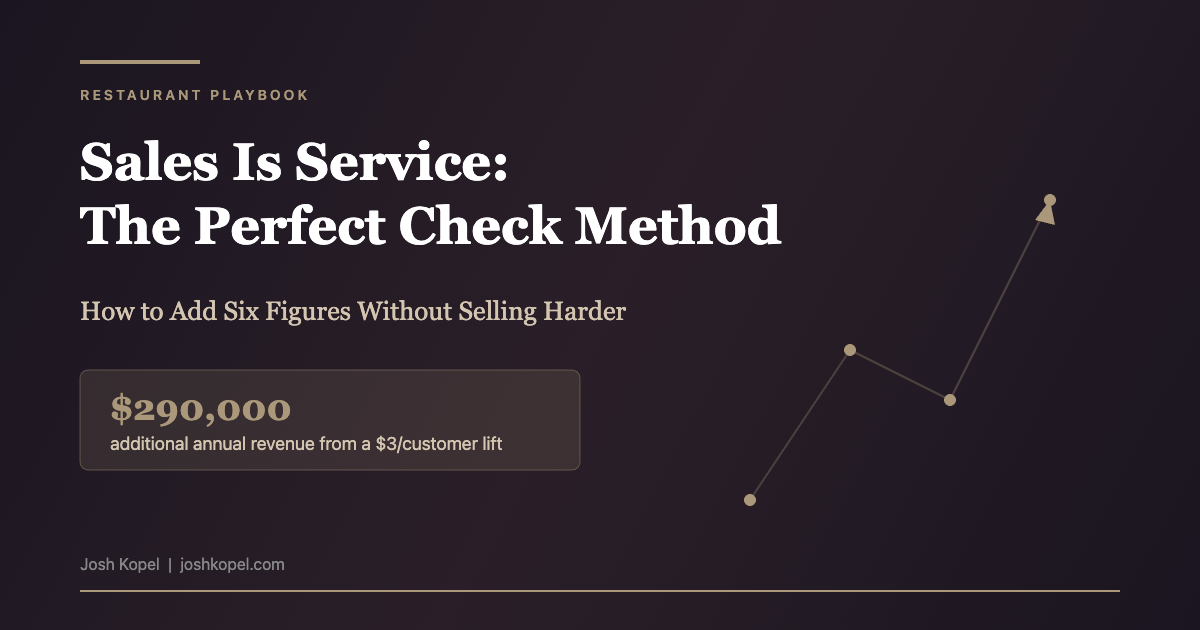
Your team isn’t selling because sales feels dirty. But sales is service. 80% of the people in your restaurant every day are first-timers who have no idea what to order. The Perfect Check method engineers the ideal experience from the menu up, then uses your best server to pilot it across the team. One client projected a $3.39 per-customer lift and hit $3 within 30 days, translating to roughly $290,000 in additional annual revenue on flat covers. Another client’s menu engineering report identified over $300,000 in hidden revenue. None of this costs a dime to execute.
Let me ask you something. How much would it cost you to do everything I’m about to describe in this article?
Zero dollars. Not a penny. Everything we’re going to talk about requires time and intention, not money. And yet, the tactics in this post have generated hundreds of thousands of dollars in additional revenue for my clients. That gap between cost and return is the entire game.
Here’s the problem. Your team can’t sell. Or they won’t sell. Or they’re afraid to sell. And the reason is simple: sales feels dirty. Nobody likes being sold to. Nobody likes to sell. Your servers don’t want to feel like that greasy car salesman pushing the extended warranty.
But here’s the reframe that changes everything. What you call upselling, I call advocacy. And advocacy isn’t selling. It’s service. That distinction is worth six figures a year.
Sales Is Service: The Foundation
When a customer sits down in your restaurant, they have incomplete information. They don’t know what to order. They don’t know what pairs well. They don’t know what you’re known for. They don’t know how your menu works. They don’t know anything about you.
And here’s the statistic that should change how you think about this forever: 80% of the people sitting in your restaurant every single day are first-timers. They have no earthly idea what to order. They have no idea how to engage with you. They don’t know how you fit into their life.
But what they want, what we all want, is to have the best imaginable version of this particular experience. They’re already in your restaurant. They’re pot committed. They want you to help them order right. They just don’t know how to define “right.”
You have to define right for them.
That’s not upselling. That’s advocacy. When you advocate for a customer’s best experience, when you guide them toward the items that will make their meal memorable, that’s service. And it’s the highest form of service you can offer.
The Perfect Check: Engineering the Ideal Experience
Here’s the most powerful tool I can give you. It’s called the Perfect Check, and it’s the math behind a perfect experience.
Most restaurant owners think about per-customer average spend as an abstract number. “It’s at $32. I’d love it to be at $48.” But then when you look at what customers actually need to order to get there, the current menu makes it impossible. There’s a limited amount of space in a human stomach. The pricing doesn’t line up. The menu isn’t structured to guide them there.
The Perfect Check flips this. Instead of hoping customers spend more, you engineer the experience so that the best version of their meal naturally hits your target spend. It’s not about selling more. It’s about selling this.
Here’s how it works. Your Perfect Check is the most idealized version of your restaurant. It’s the combination of items that creates the best possible experience for the customer. And when that combination happens to hit the per-customer average you’re trying to achieve, you’ve aligned customer satisfaction with profitability.
The beautiful part? Your Perfect Check already exists in your restaurant. You already have a server or bartender who’s crushing it. They’re selling the specials. They’re selling the right things at the right time. They’re getting people into the limited-time offers. That server’s typical check is your Perfect Check. All we need to do is figure out what they’re doing and teach everyone else to do it.
The Hell’s Kitchen Case Study: From $85 to $125
I had a client with a fine dining Italian concept in Hell’s Kitchen. Their per-customer average spend was sitting at about $85. But their best customers were spending $125 a person.
The owner’s initial reaction was, “Most people won’t spend that.” But I looked at the data, and one server was hitting that number almost every time she got in front of a table. So the question wasn’t whether customers would spend $125. They already were. The question was why only one server was making it happen.
We re-engineered the entire menu around getting people to choose one item from each section. That’s it. Not pushing more food. Not adding expensive add-ons. Just structuring the menu so the natural path through it, one selection per section, landed at $125.
The result wasn’t just higher per-customer average. It was a better experience. Customers who followed that path left happier, tipped better, and came back more often. The Perfect Check isn’t just a revenue tool. It’s a frequency tool. When people have the idealized experience, they return.
Menu Design That Sells for You: The Farm Bar Example
Let me show you what this looks like in practice with a concept called Farm Bar.
When I got hold of their menu, 90% of the people coming in ordered the cheese curds. That’s a striking attachment rate. The cheese curds were located in a section called “Appetizers.” And here’s what was happening: customers would look at the appetizer section, see the cheese curds, check that box, and move on to the next section. Binary decision made. Done.
That’s not what I wanted. The binary decision shouldn’t be “are you getting an appetizer or not?” It should be “are you getting the cheese curds or not?” Because the cheese curds are their own thing.
So I created a new section called Farm Bar Famous. It contained one item: the cheese curds. Binary choice. Do you want them or don’t you? Once that decision was made, customers moved into a section called Quick Hits, which was the appetizer section. Now they were choosing the cheese curds AND an appetizer. Instead of one or the other.
But the bigger move was what I did with burgers. Farm Bar sold a ton of burgers. The burger section was called “Handhelds” and it appeared just before the Mains section. Customers would see the burger, decide on it, and then review the rest of the menu without changing their mind. There’s extensive data on this: once people make a decision, an egoic barrier prevents them from reversing it. They’d see the burger, choose the burger, and never get to the items that actually made Farm Bar a category of one.
I moved the burger section below the Mains and renamed it from “Handhelds” to “Sandwiches.”
Why? Because nobody goes out to dinner to have a sandwich. Children eat sandwiches for dinner. There’s nothing sexy about it. And I changed the description to something like “for when you’re keeping it casual or need a lunch classic done right.” In other words: don’t do this. This is not why you’re here. Choose better.
The result: burger sales plummeted. Main sales skyrocketed at four-to-one, five-to-one over the sandwiches. Appetizer sales doubled because people were now buying cheese curds AND a separate appetizer. Per-customer average spend climbed significantly. Same menu items. Just different architecture.
Menu Engineering: Finding $300,000 in Hidden Revenue
Menu design is how you architect the layout. Menu engineering is what your team says and how you optimize attachment rates. Both matter, but engineering is where the compounding happens.
For every client, we run a detailed menu engineering report. We scrape data, do benchmarking analysis, look at the numbers to determine attachment rates, and identify the gaps where people could buy a little bit more and have an exponentially better experience.
Let me walk you through a real example. We did this analysis for a client and found multiple levers:
Competitive benchmarking lift: We pushed his pricing to P90 (90th percentile in his market). Just that adjustment alone increased per-customer average spend by 42 cents. That’s nothing, right? But on flat covers over a year, the bump was significant.
Non-alcoholic beverage attach: Most of his customers were drinking water. Not because they didn’t want a drink, but because his menu wasn’t offering anything compelling in that category. We created a Boba Arnold Palmer, 16 ounces with ice in a 24-ounce Mason jar. It absolutely crushed. Scaled his lift by 64 cents per guest, which translated to over $60,000 a year in annual revenue. And the target attachment rate wasn’t aggressive at all. We were just trying to take it from awful to mediocre.
Sampler creation: We saw a hole where people were choosing between individual items. Generally speaking, if people have to choose between this, that, or everything, they’ll choose everything. The sampler alone estimated a lift of $48,000 annually.
Premium protein upgrade: Most people were ordering the noodles without the high-end proteins. All we told the team was: whenever anyone orders soup, offer the premium filet as an add-on. Simple ask. Meaningful lift.
Dessert as experience: The issue with dessert in most restaurants is that people treat it as an afterthought, just extra calories at the end of a meal. We repositioned dessert as the conclusion of the experience. It would be a mistake for you to not have dessert with us, because it’s part of what we’re selling here.
The headline: total model lift on flat covers was over $300,000 in the trailing 12 months. These are not crazy adjustments. This is not rocket science. We’re helping people make more informed buying decisions based on what the restaurant is best in the world at.
The Ramen Lab Result: $290,000 from a $3 Lift
Lewis owns Ramen Lab. We projected a $3.39 per-customer lift based on our engineering report. Within 30 days, he’d already hit $3. That projects out to roughly $290,000 in increased annual revenue on flat covers.
Let me say that again. No new customers. No new marketing spend. No new menu items. Just restructuring what already existed so that people had a better experience and spent a little more doing it.
That’s the power of engineering your menu instead of hoping your team will sell harder.
Pilot With Your Best, Then Roll to the Rest
Don’t try to roll a new selling system to your entire team at once. It won’t work. Instead, find your best server. The one who’s already crushing it. The one whose per-customer average is significantly higher than everyone else’s. Study what they’re doing.
Chances are, they have an intuitive system. They always recommend something to start with. They pair beverages with meals. They mention dessert as part of the experience, not as an afterthought. They guide rather than list.
Document what your best server does. Codify it. Test it with one other server. Refine it. Then roll it to the team. When you teach through the lens of your own best performer, it doesn’t feel like corporate training. It feels like sharing what works.
And here’s how you get buy-in: show them the money. When your best server’s per-customer average is significantly higher than everyone else’s, that means their tips are higher too. Show the team the correlation. “This is how much more Sarah makes because she guides customers through the Perfect Check.” Motivation works through self-interest. Always has. Always will.
Breaking Limiting Beliefs: The Dead Rabbit Example
I want to break the belief that there’s some sort of ceiling on what’s possible.
Jack McGarry owns the Dead Rabbit in New York. It’s about 3,600 square feet total, split across multiple floors. Not small, but not massive. It’s essentially an Irish pub that does food business.
Jack makes a million dollars a month from that single location.
A million dollars a month. From less than 4,000 square feet. Is he superhuman? No. Are you half as smart as Jack? Then you’ve got a half-million-dollar-a-month restaurant. A quarter as smart? That’s still $250K a month.
There is no ceiling on how much money you can make. I thought I was busy at $1.8 million. Then $2.3 million. Then $3.4 million. Then $4.6 million. It just kept growing. If you’re struggling, these systems will fix it. If you’re already scaling, know that there’s massive headroom above you.
Your 7-Day Perfect Check Action Plan
Day 1: Identify your Perfect Check. Look at your POS data. Find your best server. What does their average check look like? What items are their customers ordering? That’s your Perfect Check target.
Day 2: Map the experience. Write down what the ideal meal looks like at your restaurant, section by section. What should someone order to have the best possible experience? Does that combination hit your target per-customer average?
Day 3: Audit your menu architecture. Is your menu guiding people toward the Perfect Check, or is it sending them toward burgers and water? Look at the sequence of sections. Are your hero items positioned to be chosen first?
Day 4: Identify the gaps. Where are your attachment rates weak? Non-alcoholic beverages? Appetizers? Dessert? Premium upgrades? Each gap is an opportunity to improve the experience and the spend simultaneously.
Day 5: Create binary choices. Like the Farm Bar cheese curds, separate your hero items into their own sections. Make the decision simple: do you want this or not? Then let the rest of the menu build on top of that decision.
Day 6: Pilot with your best server. Share the Perfect Check framework with your top performer. Get their input. Refine the approach. Track their results for a week.
Day 7: Roll to the team. Show them your best server’s results. Show them the tip differential. Teach advocacy, not salesmanship. “This is what our best customers order. Let’s help everyone have that experience.”
None of this costs money. All of it makes money. Money likes speed. Start today.
Free Live Training
Want Me to Walk You Through These Systems Live?
Join the free 5-Day Restaurant Marketing Masterclass. In 40 minutes a day, I’ll show you how to build a marketing system that actually makes you money.
JOIN THE FREE MASTERCLASS★★★★★ Rated 5/5 by 1,000+ restaurant owners
Frequently Asked Questions
How do I get my staff to upsell without being pushy?
Reframe it entirely. It’s not upselling. It’s advocacy. 80% of your customers are first-timers who have no idea what to order. When your server says “most guests start with our cheese curds while they look at the menu,” that’s service, not selling. Give your team permission to guide rather than push, and give them permission to accept “no” without guilt. That’s the difference between advocacy and salesmanship.
What’s a realistic increase in per-customer average spend?
A $3 to $5 lift per customer is realistic and achievable within 30 days. Lewis at Ramen Lab hit a $3 lift within 30 days, projecting to roughly $290,000 in additional annual revenue. Another client’s menu engineering report identified over $300,000 in hidden revenue through benchmarking, attachment rate optimization, and menu restructuring. The numbers compound because they apply to every single customer, every single day.
Should I change my entire menu to implement the Perfect Check?
No. Start with restructuring, not reinventing. Look at what your best customers already order and engineer the menu to guide everyone toward that experience. Sometimes it’s as simple as moving a section, renaming a category, or creating a new section for your hero item. At Farm Bar, we didn’t add or remove a single menu item. We just reorganized the architecture, and per-customer average climbed significantly.
How do I handle servers who resist the new approach?
Show them the money. When your best server’s average check is significantly higher than everyone else’s, their tips are higher too. Show the correlation. Motivation works through self-interest. Don’t ask them to adopt a new process because it’s good for the restaurant. Show them how it’s good for their wallet.
Does the Perfect Check method work for fast casual and quick service?
Absolutely. The principles are the same even without table service. At the counter or on the menu board, you’re still engineering the path through the menu. Binary choices, hero items positioned first, strategic sequencing, and clear signals about what you’re known for. The medium changes but the psychology is identical. Digital menu boards and kiosk ordering actually make this easier because you control the exact sequence customers see.