
Expert Summary
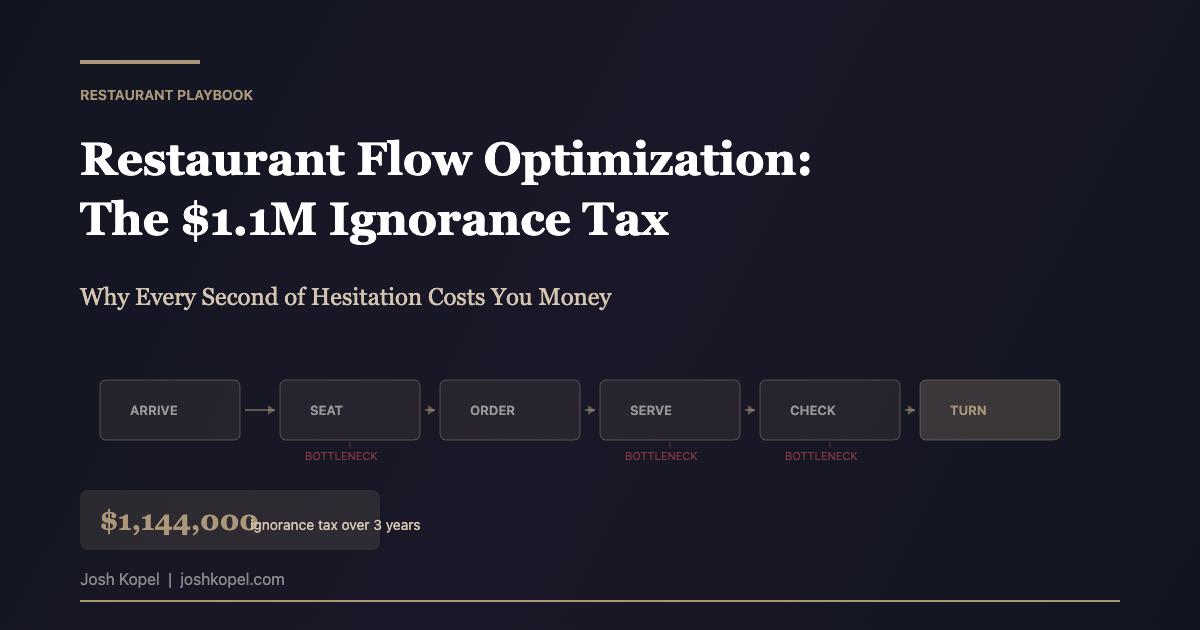
The flow of your restaurant – the single most important operational metric you have – is probably being dictated by a 19-year-old part-timer who’s going through a breakup right now. Before I figured out how to optimize flow, the ignorance tax I paid every year for three years was $1,144,000. I took my wife to Katana for our anniversary. 45 minutes. Perfect experience. Not rushed. Every second was choreographed. Here’s how to stop leaving six figures on the table and start controlling the pace of every dollar in your restaurant.
I want to start with a number that should terrify you. Before I figured out how to optimize flow in my restaurant – how to maximize the capacity of every stick of furniture I had – the ignorance tax I paid was $1,144,000.
That’s the delta between what I was actually making and what I should have been making. Every year. For three years. I was completely unaware that I wasn’t making the money. Completely healthy, completely busy – and completely leaving over a million dollars on the table.
Here’s why. The flow of your restaurant – the single most important operational metric you have – is probably being dictated by a 19-year-old part-timer who’s going through a breakup right now. Flow is everything. It’s how you capitalize. And if you’re not deliberately engineering it, you’re leaving six figures on the table every single year.
You Don’t Sell Food and Beverage. You Sell Seats for Defined Periods of Time.
What industry most closely parallels the restaurant business? It’s not retail. It’s not theater. It’s the airline industry. What does Delta sell? Not hospitality. Not travel. Not convenience. Delta sells seats on a plane. And they’ve become best in the world at getting you on and off that plane as efficiently as possible.
Your restaurant works the same way. How much more money would you make off one more bar stool? One more table? Not on a Tuesday when you’re half full – but when you’re busier than you can handle and it’s 7:30 on a Saturday night. That’s your highest-margin inventory, and you’re almost certainly not maximizing it.
We think of inventory as food and beverage. We need to think about tables and chairs. You do not sell food and beverage. You sell a seat at a table for a defined period of time.
Are You in the Manufacturing Business or the Experience Business?
Before you can optimize flow, you need to answer one question: what business are you actually in?
There’s a deli down the street from me that I talk about all the time. They have servers that take care of every table – and I put “take care of” in air quotes because they do a terrible job. They have servers because they think they’re in the experience business. But I don’t go to that deli for the experience. I go for the Reuben. That’s why I go.
If they wanted to offer me an exceptional experience based on why I actually use them, they would put a tablet on the table. They would let me order on my phone. I shouldn’t have to wait because they’re deeply understaffed, because nobody wants to work there, because they can’t make enough money – because they think they’re in the experience business when they’re actually in the manufacturing business.
At my fast casual fried chicken concept, South City, we had what LA Weekly rated the best fried chicken sandwich in the city. But when it took 20 minutes to get it into someone’s hands, the best sandwich in the world tasted like garbage. Why? Because it ruined their lunch hour. They had 60 minutes. It took 15 minutes to get there and 15 to get back. That left 30 minutes – and 20 of those were spent waiting.
So during our peak lunch window – 11:30 to 1:30 – we pushed everyone to kiosks. Not because we didn’t value hospitality. Because during that manufacturing window, speed IS the hospitality. Any other time, you could order from a person. But during peak, the kiosk made you faster, which made your lunch better.
The Katana Experience: 45 Minutes of Perfection
Let me tell you a story that changed how I think about flow forever.
I took my wife to Katana in Los Angeles for one of our wedding anniversaries. It’s a sushi concept on Sunset Boulevard that’s been around forever. We had an absolutely amazing experience. Here’s what it looked like.
We walk in. They say, “Happy anniversary.” They seat us. They ask if we want the wine list. We said water is fine. Flat, sparkling, or tap? Tap. Salt of the earth people. The server walks up, walks us through the menu, tells us the chef would prefer they take the entire order at once and then course it out. So we do.
They coursed it out perfectly. Amazing experience. At the conclusion, they pre-bussed the table. Offered dessert. We passed – we were going somewhere else for dessert. They asked if we wanted refills on water. We said no. So they removed the empty water glasses. Brought the check. I paid. They removed the check. And eventually we got up.
The reason we got up was that it was just me and my wife sitting at an empty table with a candle on it. The entire experience took 45 minutes.
Now let me ask you something. If they had dragged it out to 55 minutes – slower courses, waited longer to bring the bill – would that have created more perceived value? Would you have enjoyed it more?
No. You would not. The reason people don’t leave is because they don’t know it’s time to go. You control the pace of the experience. They do not. When you’re sitting at a perfectly manicured table with nothing on it, it’s time to go. And they know that.
I don’t want to hear that people want to sit in your restaurant for three hours. They don’t. It’s not that interesting. They have other things to do with their lives.
Hesitation Is a Hidden Expense
Here’s what I believe. On your busiest nights, you’re losing money in places you’re not tracking.
Indecision at the table. Servers hesitating instead of leading the conversation. Lag between courses. The kitchen waiting on the floor. The floor waiting on the kitchen. Every second of hesitation during peak hours is a hidden expense. It’s not on your P&L, it’s not in your POS reports, but it’s costing you more than almost any line item on your budget.
And the bottlenecks exist across every tier of dining. When I see lines at a restaurant, what I see is inefficiency. Every person in that line is trading time – and time is the one thing they’re not willing to part with during a lunch break.
At my Hollywood bar, we pulled the stools away from the bar at 9 PM on weekends. During the week, they lived there permanently. But on a Saturday night, seated bar guests made it harder for standing customers to order. Standing customers with cash in hand were higher-velocity revenue. The stools were literally slowing down our highest-margin hours.
Check Your Back-End Settings: Someone Else Is Limiting Your Revenue
For those of you using waitlist or reservation software, for those leveraging online delivery – who set your turn times? Who’s setting the capacity and availability?
I can almost guarantee those settings are optimized for the convenience of your host or your general manager – neither of whom is incentivized to make sure you’re as busy as possible. The same applies to online delivery. Typically it’s the people working the line setting those limits, not the person paying the bills. But it should be the person paying the bills.
Go into the back end of every system you use – reservations, waitlist, delivery – and make sure they’re optimized so that when you have the most demand, you can absorb the most capacity. This is a two-minute fix that can add thousands per month.
The booking landscape has also changed dramatically. At Preux & Proper on a Monday, we used to be fully committed for Friday. By 2019 into 2020, we weren’t fully committed on a Friday until Friday. People are making decisions more last minute because technology gives them visibility. If you’re not using waitlist software, if it’s not abundantly clear how quickly people will be serviced at your location, you’re leaving money on the table.
Forget Tuesdays. Scale On-Peak.
How much time and effort have you put into initiatives that ended up doing nothing for your business? That Tuesday promo that was totally going to turn around the week? That late-night happy hour that just never took off?
Here’s why that stuff doesn’t work. When you ask someone to come in on a Tuesday, you’re not just asking them to patronize your restaurant. You’re asking them to get off the couch, put on pants, get in their car, and drive to a place they don’t want to go to eat food they didn’t want to eat when they’d rather be doing something else. You’re trying to alter behavior. And altering behavior is incredibly expensive.
Instead, focus on influencing behavior. People who are already out on a Saturday are easy to redirect. “You’re already out – why don’t you spend some time with me?” That’s a fundamentally different proposition. High margin. Low overhead.
All of you have untapped capacity. All of you. I assure you, there’s an extra $5,000, $10,000, $15,000 a week sitting in under-capitalized revenue on Fridays, Saturdays, and Sundays.
In Los Angeles, when it drizzles, revenue drops by two-thirds. I never cared. I made all the money I needed on Friday, Saturday, and Sunday. Tuesday and Wednesday were surplus – just extra profit.
Less for Less: On-Peak Promotions That Don’t Require Discounting
At Preux & Proper, with a per-customer average of about $125, even customers who had the best dinner of their lives weren’t coming back soon. They’d either saved up for the experience or they had options and wouldn’t repeat the same one. So I had to figure out what else I could sell them.
We launched a flights and bytes concept for happy hour. You could come in before dinner or late night after, enjoy a curated experience at a lower price point with flat margins. It wasn’t a discount. It was a different experience at a different price – less for less. The customer got something fun, I got full margin, and it drove people to the shoulders around my peak hours.
One of my clients, Tarja from Dogville, runs a casual burger concept. We created a burger flight paired with rotating complimentary beers, offered only from 4 to 6 PM on Fridays, Saturdays, and Sundays. People were already out. It was a cool, fun thing to do. On-peak volume scaled by 36%.
Discounting is the last bastion of a desperate brand. You don’t need to discount. You need to create experiences that bring people in at full margin during the hours when they’re already inclined to spend money.
Your 7-Day Flow Optimization Action Plan
Day 1: Answer the question. Are you in the manufacturing business or the experience business? If people come to you for speed and convenience, optimize for throughput. If they come for the experience, choreograph every second of it. Most restaurants are confused about which one they are.
Day 2: Walk through your restaurant during peak. Arrive like a customer. Where do you wait? Where does your team hesitate? Where does the kitchen stall? Where does the floor stall? Write down every friction point. Those are your hidden expenses.
Day 3: Audit your back-end settings. Open your reservation system, your waitlist software, your delivery platform. Who set the turn times? Are they optimized for your maximum capacity during peak, or for the convenience of your team? Adjust them today.
Day 4: Calculate your ignorance tax. What’s the delta between what you’re making on weekends and what you could be making with optimized flow? If you’re doing $36K weekends and could be doing $58K – that gap is your ignorance tax. Put a number on it.
Day 5: Design one on-peak promotion. Not a discount. A less-for-less experience that gives people a reason to come in during shoulder hours at full margin. Think flights and bytes. Think burger flights. Think curated experiences, not coupons.
Day 6: Choreograph your closing sequence. Pre-buss. Offer dessert. If they pass, remove the water glasses. Present the check. Remove the check. The table should communicate “it’s time to go” without anyone saying a word. Practice it this weekend.
Day 7: Forget Tuesday. Calculate how much additional revenue you’d generate if you added just one more turn to your Fridays, Saturdays, and Sundays. That number will dwarf anything you could build on a slow night. Focus there. Make your weekly money on the weekend, and let Tuesday take care of itself.
Free Live Training
Want Me to Walk You Through These Systems Live?
Join the free 5-Day Restaurant Marketing Masterclass. In 40 minutes a day, I’ll show you how to build a marketing system that actually makes you money.
JOIN THE FREE MASTERCLASS★★★★★ Rated 5/5 by 1,000+ restaurant owners
Frequently Asked Questions
How do I optimize restaurant flow without rushing guests?
You don’t rush – you choreograph. I took my wife to Katana for our anniversary. The entire experience was 45 minutes. It wasn’t rushed. It was perfect. Every course arrived at the right moment. The table was cleared naturally. The check appeared seamlessly. When we were sitting at an empty table with just a candle, we knew it was time to go. Guests don’t feel rushed when the experience is complete. They feel rushed when the experience is interrupted.
What is the ignorance tax in restaurant operations?
The ignorance tax is the money you lose because you don’t know what you don’t know. Before I optimized flow at my fine dining restaurant, the gap between what I was making and what I should have been making was $1,144,000 over three years. That’s the ignorance tax. It includes under-booked peak hours, sub-optimal turn times, inefficient back-end settings, and capacity you’re not using.
Should I focus on growing Tuesday sales or maximizing weekend revenue?
Maximize weekends first. Always. Growing Tuesday sales requires altering customer behavior – getting them to do something they don’t want to do – at poor margins with high overhead. Growing weekend sales means influencing behavior during hours when people already want to be out. Most restaurants have $5,000 to $15,000 per week in under-capitalized weekend revenue. Tuesday will fill itself when you’re so busy every other night that it’s the only day people can get in.
How do I know if my restaurant is a manufacturing or experience business?
Ask why your customers come to you. If they come for speed, convenience, and a specific product – you’re manufacturing. Optimize for throughput. If they come for the ambiance, service, and occasion – you’re experience. Choreograph every second. Most fast casual and quick service concepts are manufacturing businesses pretending to be experience businesses, and it’s killing their throughput.
What are on-peak promotions and how do they work without discounting?
On-peak promotions are less-for-less experiences that bring people in during shoulder hours at full margin. At Preux & Proper, we did a flights and bytes concept before and after dinner service. A client ran burger flights with rotating beers from 4 to 6 PM on weekends and scaled on-peak volume by 36%. The key is offering a different experience at a lower price point – not discounting your existing experience. People are already out. Give them a reason to spend time with you.