
Expert Summary
A member of my entrepreneurs group told me the truth I didn’t want to hear: “You kind of bought yourself a job.” He was right. I wasn’t a restaurateur. I was a restaurant manager with equity. I was working 12 to 15 hours a day, easily the least-paid employee in the organization, and motivated almost exclusively by fear. The difference between restaurant owners who struggle and those who build wealth isn’t intelligence or talent. It’s the shift from working in your business to working on it. Here’s the framework that changed everything.
I joined a group called EO – the Entrepreneurs Organization. It was the first time as a restaurateur that I was surrounded by people who weren’t from my industry. And in one conversation, a forum mate said something that hurt. Really hurt.
“You kind of bought yourself a job.”
And he was right. I wasn’t a restaurateur. I was a restaurant manager with equity. Here’s how that happened. I didn’t graduate from the top of my class at Cornell. I was a busboy who worked his way up to manager. I got really good at managing. And as a result, I was able to find financing and open my own place.
But instead of evolving into the role of a restaurateur – which I didn’t even know what that was – I defaulted into being the manager of that concept. I was working in my business every single day. Revenue was unpredictable because nobody was doing the things a restaurateur would do. I was constantly managing behavior instead of leading. I was easily the least-paid employee within the organization, which at the time, I wore like a badge of honor.
I had sleepless nights because I wasn’t making money. I was either working for free or paying to work for free. I was completely absent with my loved ones because my phone was ringing constantly. And I was saddled with all of these jobs I was terrible at because I didn’t have enough money to pay an expert to do them.
The saddest part? Before I opened, I was so full of hope and optimism and excitement. But within months, I was almost exclusively motivated by fear.
If that sounds like your life, I’m here to solve it. Because I solved it for myself.
The Most Dangerous Lie in the Restaurant Industry
For the first half decade of my career, two weeks into each month, I would get the profit and loss statement from my bookkeeper. And without fail, the message was the same: “You’re just a couple thousand a week away from massive profitability. If you could just make a little bit more money, you’d make a lot more money.”
So I would. I’d push harder. Open another daypart. Squeeze out more covers. And then they’d move the goalpost. Every single time.
This is the most dangerous lie in our industry, and it looks exactly like truth. More work and more money look like the same thing on the front end. They look very different on the back end. You could get a lot busier tomorrow by heavily discounting and giving your product away for free. But that’s more work. That’s not more money.
The only real problem in my business was money. And it took me way too long to understand that more revenue and more money are not the same thing.
Lightning in a Bottle, Then Disaster
When I was 30, I opened a bar in Hollywood. 900 square feet. Lightning in a bottle. We cranked out of the gate and did $1.5 million a year at a 35% profit margin. I could do no wrong.
So naturally, I decided to dip my toes into fine dining. How hard could it possibly be?
I lost a quarter million dollars the first year. It almost bankrupted both companies. I fired the general manager. I took over as general manager. I fired the executive chef. I brought in a new one. It was easily the hardest period of my entire life.
The most vivid moment of my career didn’t take place in Los Angeles. It took place in Carlsbad, California. I was visiting my in-laws – who weren’t my in-laws at the time – and I went to Union Bank and took out the last $30,000 from my personal account because I needed to infuse it into the restaurant. Then I took out a $50,000 cash advance from American Express, primarily because there was no personal guarantee attached to it. I was desperate.
Because I was so tight on time and so tight on money, the restaurant that was struggling wasn’t even the restaurant of my dreams. It wasn’t what I wanted. I just wanted one last at bat to see if I could make it work.
I took that money and tried 1,000 things. Of those 1,000 things, nine worked. Those nine things are what I teach today.
You Are the Problem. You Are Also the Solution.
Here’s something shitty to say and probably shitty to hear: you are the problem in your business. But you’re also the solution. You are the bottleneck to your own growth.
I think every problem you’re facing in your business today is a solved problem. Restaurants have been around for thousands of years. Someone has already figured out every challenge you’re dealing with. I spent the first half of my career trying to solve my own problems from scratch. All of that wasted time and money – I call it the ignorance tax.
The ignorance tax is the money you lose every year because you don’t know what you don’t know. For me, it cost over a million dollars across three years. That’s real money. That’s freedom money. And I was losing it because I was being a manager instead of an owner.
What I should have been doing was pairing my existing problems with existing solutions in the market. You don’t need to figure it out on your own. You just need to stop trying to reinvent the wheel and start implementing what already works.
The Shift: From Working In to Working On
I want to transition every restaurant owner from working in their business to working on it. Here’s what that looks like.
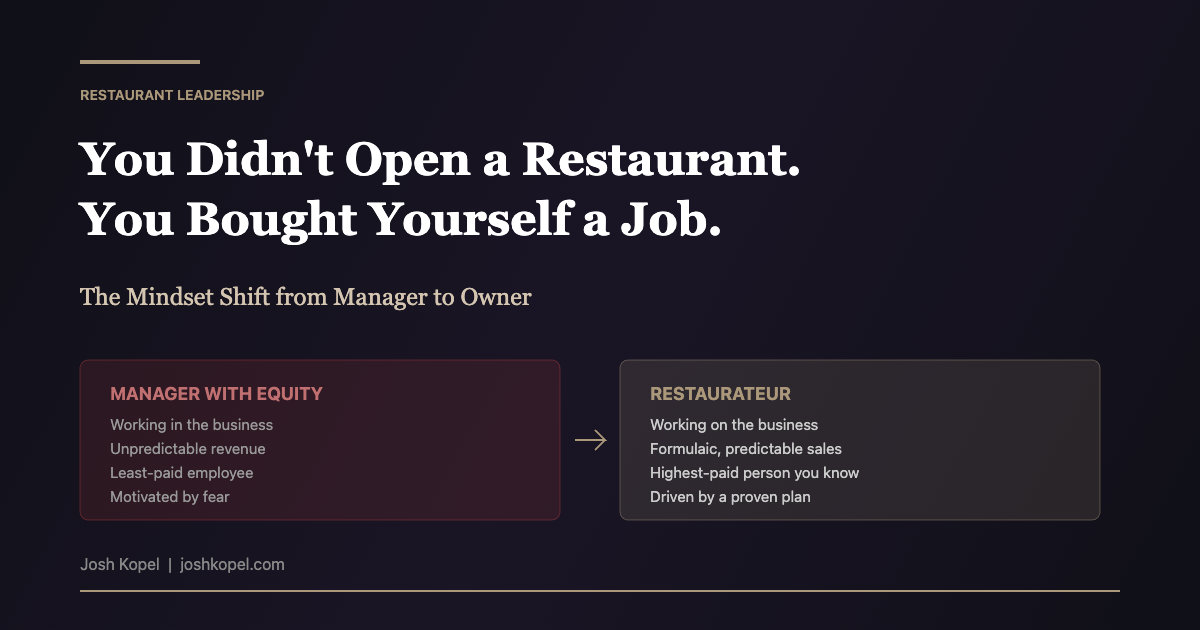
Working in: unpredictable revenue. Constantly managing behavior. Least-paid employee. Phone ringing at all hours. Absent from loved ones. Motivated by fear.
Working on: formulaic, predictable sales. Leading your team. Becoming the highest-paid person you know. Phone doesn’t ring because you’ve built and developed talent. Being the spouse and parent and friend your loved ones deserve. Only doing the things that an owner can do.
The difference isn’t intelligence. It’s not talent. It’s not working harder. I’ve proven through this entire process that I’m not exceptionally intelligent. I’m actually simple. Simple things can take you really, really far.
The difference is having a proven plan and knowing which levers to pull.
Levers, Not Hope
If you needed to bring in more money today – gun to your head – do you have proven tactics that would do exactly that at a profitable rate?
For years, I didn’t. That’s what’s frustrating and a little scary. You don’t feel like you’re in active control of your own business.
That’s why I think about the McRib. The McRib is one of the most fascinating things in business. Even though it looks like food – and I assure you it is not – all it really is, is marketing. McDonald’s doesn’t release the McRib seasonally. What they do is pull their franchisees, and when sales drop below a certain level, they release the McRib. It’s a lever. It’s a lever that McDonald’s corporate uses to support their franchisees when they need more money.
That’s all I’m trying to do for restaurant owners. Build McRibs into your business. Levers you can pull when you need more money. Hopefully easier to execute and less gross.
And those levers break down into three categories: creating the most profitable version of your restaurant today, building attention that actually converts eyeballs into butts in seats, and scaling customer frequency so your best customers come back without discounts or freebies.
Simple Doesn’t Mean Easy
Can we agree that nothing I teach is overly complicated? We’re not using complex systems. It’s all very intuitive – not just to who you are as a restaurateur, but to who you are as a consumer.
So why aren’t these systems installed in your business? Because simple doesn’t necessarily equate to easy. Getting in shape is very simple. You just eat right and work out. That doesn’t mean it’s easy.
The biggest hurdle in your business isn’t knowledge. It’s overwhelm. You’re so busy putting out fires that you never build the fire department. You’re so deep in the day-to-day that you can’t see the patterns that are costing you money.
The biggest antidote to overwhelm is focus. And the way to create focus is to stop trying to fix every problem and start doubling down on what’s already working.
What It Looks Like When You Make the Shift
Easy Street in Studio City, California started in a parking lot with a tent. It’s a single-unit burger joint owned and operated by two people without a huge management team. They generate $400,000 a month at a 34% margin from that single unit.
Chef Brad Wise’s Rare Society started as a boilermaker bar that lost money consistently for two years. Then he figured out he had a product market fit issue. Once that was solved, it became about awareness. There are now Rare Society locations up and down the West Coast – all built off the back of what was originally a failed concept.
Sodici Pizza in Brownsville, Texas does $1.4 million a year at an 18% margin. It’s open four days a week. Do the math on what a quarter million in take-home means in Brownsville, Texas. And the owner, Dante, isn’t involved in day-to-day operations.
Jack McGarry’s Dead Rabbit in New York does a million dollars a month from less than 4,000 square feet. It’s essentially an Irish pub that does food business.
These aren’t superhuman operators. They’re people who stopped being managers with equity and started being owners. They built systems. They pulled levers. They worked on the business instead of in it.
The Myth That Keeps You Trapped
The biggest myth I want to destroy is that nobody really makes money in this industry. I know hundreds, if not thousands, of owners and operators who make an absolute fortune. Freedom exists for many – financial freedom, freedom from overwhelm, freedom of time.
I thought I was busy at $1.8 million. Then $2.3 million. Then $3.4 million. Then $4.6 million. It just kept growing. There is no ceiling on how much money you can make.
If you’re struggling, these systems will fix it. If you’re already scaling, know that there’s massive headroom above you. Some of you aren’t in a terrible place. You’re in a good place. But there’s still massive room for growth. It’s much easier to get you from good to great than from broken to functional.
Your 7-Day Owner Mindset Action Plan
Day 1: Write down your two numbers. What is your target monthly revenue? What is your current monthly revenue? You can’t reverse-engineer a plan without knowing where you are and where you’re going.
Day 2: Identify your McRibs. What are the levers you can pull today – not next quarter, today – to make more money at a profitable rate? If you can’t name three, that’s your problem to solve this week.
Day 3: Audit your time. How much of your day is spent working in the business versus on it? Track it honestly for one full day. If you’re spending more than 50% of your time on manager work, you’ve bought yourself a job.
Day 4: Calculate your ignorance tax. What money are you losing because you don’t know what you don’t know? Are you underpriced? Under-booked? Missing B2B revenue entirely? Each gap has a dollar figure attached to it.
Day 5: Stop fixing Tuesday. Where is the momentum in your business right now? Stop trying to build slow nights and start maximizing your peak revenue. There’s likely $5,000 to $15,000 in under-capitalized revenue sitting in your Fridays, Saturdays, and Sundays.
Day 6: Identify your biggest bottleneck. Where are you personally the thing preventing growth? Are you the one setting prices, managing the floor, handling every event inquiry? Each of those is owner work you’re doing as a manager.
Day 7: Commit to the shift. You don’t need more knowledge. You need less overwhelm. Pick one lever from this week’s audit and pull it. Make money today. Then pull the next one tomorrow. Proper marketing works immediately. Money likes speed.
Free Live Training
Want Me to Walk You Through These Systems Live?
Join the free 5-Day Restaurant Marketing Masterclass. In 40 minutes a day, I’ll show you how to build a marketing system that actually makes you money.
JOIN THE FREE MASTERCLASS★★★★★ Rated 5/5 by 1,000+ restaurant owners
Frequently Asked Questions
How do I know if I’m a restaurant owner or just a manager with equity?
Ask yourself: if you needed to bring in more money today, gun to your head, do you have proven tactics that would generate revenue at a profitable rate? If the answer is no, you’re a manager. Owners have levers they can pull. They have systems for predictable revenue. If your income depends entirely on showing up every day and managing chaos, you’ve bought yourself a job.
What’s the fastest way to make the shift from manager to owner?
Stop trying to fix every problem and start doubling down on what’s already working. Most restaurants have $5,000 to $15,000 in under-capitalized revenue sitting in their peak hours. Focus there first. Then build B2B revenue through events and catering, which runs at 30% margins versus 10-12% for in-house dining. Speed is everything. You can make more money this week if you pull the right lever.
What is the ignorance tax and how do I calculate it?
The ignorance tax is the money you lose every year because you don’t know what you don’t know. It includes underpriced menu items, under-booked peak hours, missed B2B opportunities, and inefficient operations. For me, it cost over a million dollars across three years. To calculate yours, benchmark your pricing against your competitive set, audit your peak-hour capacity utilization, and estimate the events and catering revenue you’re not capturing.
Can you really make significant money in the restaurant industry?
Absolutely. Easy Street generates $400,000 a month at 34% margins from a single burger joint that started in a parking lot. Sodici Pizza does $1.4 million a year open four days a week. The Dead Rabbit makes a million dollars a month from less than 4,000 square feet. These aren’t exceptions. They’re owners who built systems, pulled levers, and stopped confusing more work with more money.
What should I focus on first – cutting costs or increasing revenue?
Neither. Focus on profitability per transaction. Your problem is almost certainly not your bottom line – it’s your top line and how efficiently you convert it. Start by benchmarking your pricing to make sure you’re at P90 in your market. Then engineer your menu so the best customer experience naturally hits your target per-customer average. Then build B2B revenue streams that carry 30% margins. These don’t cost money to execute. They cost time and intention.