
Expert Summary
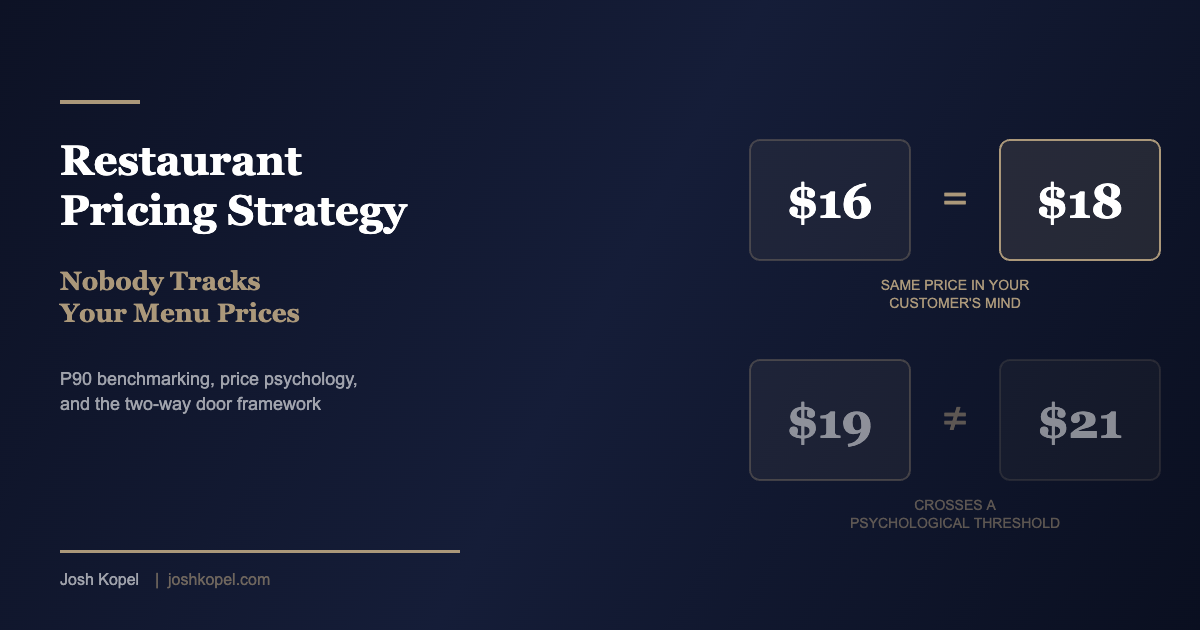
After coaching 400+ restaurant owners, I’ve found that almost every single one underprices their menu. The fear is that raising prices will drive people away. The reality? Nobody’s watching. $16 and $18 are the same number in your customer’s mind. I tested this at my own restaurant by changing prices every single week for six months. Here’s the P90 benchmarking method I use to find your real price ceiling, and why value is what you get, not what you pay.
I’m going to say something that might make you uncomfortable: you are almost certainly underpriced.
I know this because I’ve worked with over 400 restaurant owners, and the pattern is nearly universal. They’re afraid to raise prices. They’re anchored to food cost multipliers. They’re terrified of that one-star review that says “overpriced.” And as a result, they’re leaking margin on every single transaction, every single day.
Here’s the thing that set me free, and I hope it does the same for you: nobody’s watching. Nobody is tracking your menu items. Nobody is tracking your pricing. Nobody cares about your business as much as you do. Most of the people reading this don’t know what they paid for gasoline last week, or the week before that. So few of your customers have visit frequency high enough to notice an incremental change in price that it would actually have an impact.
Once you internalize that truth, everything changes.
How Do You Raise Menu Prices Without Losing Customers?
You raise menu prices without losing customers by making small, strategic moves instead of dramatic ones: benchmark against the top of your market (the P90 method below), move prices in increments guests don’t register — to most diners, $16 and $18 are the same number — start with your best-sellers where value perception is already strongest, and treat every change as reversible. Nobody tracks your menu prices the way you fear they do; guests judge the experience, not the line item. The rest of this guide breaks down each method with the real numbers from my own restaurants and coaching practice.
The Two-Way Door: Why Menu Changes Are Never Permanent
Jeff Bezos divides all decision-making into two categories. Is it a one-way door, or is it a two-way door? A one-way door is a decision you can’t undo. Signing a lease with a personal guarantee. Choosing to close a restaurant. Those are big decisions that deserve weeks of deliberation.
A two-way door is a decision you can reverse. Every pricing change you make is a two-way door. You do it, you see how it goes, and you can always undo it. If you adjust your menu this week and it doesn’t work, you adjust it back.
I want to drop the stakes around pricing because we have a tendency as restaurant owners to think with a sense of permanence. When I change my menu, it feels like a permanent change. But I would argue that we need to think like professional marketers, where everything is iteration. You’re not changing your menu once. You should be changing your menu constantly, getting it closer and closer to the most perfect version of itself.
Fear is the enemy of progress. And the fear around pricing is almost always unfounded.
$16 and $18 Are the Same Number
Let me ask you a question. Is there a difference between a $16 burger and an $18 burger?
The answer is no. In the mind of your customer, those are the same price. The decision to buy a $16 burger and the decision to buy an $18 burger are functionally identical. Nobody is sitting there calculating the difference.
Now, is there a difference between a $19 burger and a $21 burger? Yes. Those are completely different burgers. The psychological threshold between the teens and the twenties is real and measurable. Crossing that line changes how people feel about the purchase.
This means that if you’re at $12, you could be at $14. If you’re at $14, you could be at $16. If you’re at $21, you could be at $23. Within the same psychological tier, you’re leaking margin for absolutely no reason.
I talked with a gentleman in a training who was selling hot dogs to kids for $6. His margin was off by about 10%. I said, just raise the price by a dollar. He said he couldn’t. People would stop coming. I said, you really think that a parent is going to refuse to buy their kid a $7 hot dog when they would have bought the $6 one? The pennies mean nothing to your customers. But they’ll change everything for you.
The South City Price Experiment: Testing Elasticity in Real Time
At South City, my fast casual fried chicken concept, we had a digital menu board. And for the first six months we were open, I changed the price of our fried chicken sandwiches every single week.
Every. Single. Week.
Because I didn’t want to suspect where the price threshold was. I wanted to know. I wanted data, not guesses. And what I found was that the threshold was much higher than I ever would have guessed.
This is the experiment I want every restaurant owner to run. You don’t need a consultant. You don’t need fancy software. You just need to change the price, track the sales, and see what happens. Your POS system gives you the data automatically.
Most restaurant owners never do this because they’re afraid. But the only way to find your actual price elasticity is to test it. And because it’s a two-way door, there’s no risk. If sales drop, you change it back tomorrow.
P90 Benchmarking: The Method That Removes Emotion from Pricing
Never price in a vacuum. Your pricing should be anchored to what the market charges for similar products. This is what I call P90 benchmarking, and it’s one of the first things I do with every client.
Here’s how it works. You identify your competitive set. You look at their menu prices for comparable items. You arrange those prices from low to high. P90 is the 90th percentile. That’s where you want to be.
Why 90th percentile and not 100th? Because I want you to be top of market without being the outlier. The most expensive restaurant in your category might have pricing that’s disconnected from reality. But P90 positions you as premium, which is exactly where margins expand.
The psychology here is simple. Nobody is buying the pepperoni pizza they’re going to eat this weekend because it’s the second most expensive in town. That’s how restaurant owners think other people think. But that’s not how we think as consumers. When you want a pizza, you just buy the pizza you want. When you want a sandwich, you go buy the sandwich you want. Price is rarely the primary decision driver.
So if someone else in your market has already proven the price elasticity at a higher level, why aren’t you there? If they’re busy charging more for comparable product, that’s your proof that the market will bear it. I want to match them on price, and then I want to overcome them with perceived value.
When we benchmark clients, we typically find that 40-60% of menu items are underpriced. The revenue sitting in those underpriced items is staggering. For one client, just a $1.18 increase in per-customer average spend translated to over $150,000 in additional annual revenue. No new marketing. No new customers. Just optimizing the pricing of what was already there.
Your Best Sellers Are Where the Money Is
Here’s where most of the leverage lives. Your top five to ten best-selling items probably constitute 50 to 70% of your total item sales. That’s not a typo. The majority of your revenue comes from a handful of items.
If I increase the price of just those top sellers by 10 to 15%, it creates a massive tidal wave in net profit. And here’s why there’s almost no risk: people aren’t buying those items because of the price. They’re buying them because those are the things you’re known for.
Will your menu read as expensive? No. Because you’ve only changed five to seven items out of the entire menu. The rest stays the same. The overall impression of your pricing doesn’t shift. But the profitability of every transaction goes up significantly.
This is the single fastest way to make more money in your restaurant. It takes five minutes. The impact shows up immediately. And it’s a two-way door.
Value Is What You Get, Not What You Pay
After reading thousands of reviews and scraping a ton of online data, I discovered something that changed how I think about pricing forever. Nobody has ever said, “I wish I had paid less.” Not once. What they say is “it was too expensive.”
Those sound like the same thing. They’re not. “I wish I had paid less” is about price. “It was too expensive” is about value. The customer is telling you that the experience didn’t match the price. That’s a completely different problem with a completely different solution.
Value is not what you pay. Value is what you get.
So when you’re thinking about raising prices, the question isn’t “will people pay more?” The question is “am I delivering enough perceived value to justify the price?” And perceived value can be increased without spending meaningful money.
What are you actually selling? Most restaurant owners think they sell food and beverage. But your customers have food and beverage at their house. What they come to you for is eating and drinking. The experience. The effort that goes into creating an effortless experience. The transformation.
Take Day’s Pizza Garage in Tallahassee, Florida. You know what they do on the inside of every pizza box? They sign it and number it. Like a baseball card. It’s a small touch that tells you a human being made this. That costs them nothing and increases perceived value dramatically.
Shrinkflation Done Right: How to Serve Less and Charge More
How many of you are giving away a ton of to-go bags? Your portion sizes are large, and people are getting more food than they can consume in a single sitting.
Now take this from the perspective of a consumer. How many times have you gone to a restaurant and told a friend, “You’ve got to check out this place. They gave me so much more than I wanted”? Is that how we perceive value? A pile of leftovers that won’t taste the same in two days?
Nobody wants to lug your food around all day. Nobody wants to be too full. What they want is to eat just enough and have an incredible experience. Dialing back your portion sizes to what is reasonable for a human being to consume actually increases perceived value. It doesn’t diminish it.
And it simultaneously improves your food margins. That’s the double win. You serve the right amount. The customer has a better experience. And your profitability improves on every single plate.
The key is that you’re not just making it smaller. You’re making it better. A smaller portion, beautifully plated, with intention behind the presentation. That reads as premium. A huge pile of food on a big plate reads as quantity over quality. People don’t want quantity. They want quality. They want to feel like every bite was worth it.
Your Menu Is a Sales Tool, Not an Inventory Sheet
Here’s what I see when I look at most restaurant menus: a list of items and prices. That’s an inventory sheet. It’s a compass that sends people in a generalized direction.
Your menu should function as a roadmap. It should take people step by step through the experience so they have the best imaginable time with you. 80% of the people sitting in your restaurant every single day are first-timers. They have no idea what to get. They have no context. All they want to do is order right, but they don’t know how to define right. You have to define right for them.
When people ask your server “What’s good here?” or “What should I get?”, that’s a failure on the part of the menu. It should be obvious. Your menu should tell them what you’re known for, why your take is different, and guide them toward the experience that will make them a repeat customer.
And when you structure your menu around the target per-customer average you’re trying to hit, with intentional hierarchy and clear signaling, customer satisfaction actually goes up. Because people stop agonizing over what to order and start enjoying what you’ve carefully curated for them.
The Greatest Hits Album Approach
What do you think happens when your entire menu looks like your top 25% best-selling items? It becomes a greatest hits album. Everything looks good because everything is good. Because these are the things that already work.
With my clients, we typically cut at least a third of the menu. Strip away the distractions. Remove the items that, if someone ordered them as their first experience with you, they probably wouldn’t come back. Get down to the cleanest version of the best thing you have to offer.
Every menu item needs to earn its place. If it’s not one of the things you’re known for, if it’s not carrying its weight in margin, if it’s not contributing to the story you’re telling, it’s a distraction. And distractions cost you money. They complicate prep. They confuse customers. They dilute your identity.
When you do this, you become what I call a category of one. You’re not competing on variety or price. You’re competing on being the absolute best at the specific thing you do. And that’s a position where pricing power lives.
Your 7-Day Pricing Action Plan
Day 1: Benchmark your competitive set. Pull the menus of your five closest competitors. Identify comparable items. Calculate where your prices fall relative to theirs. Are you at P90? If not, that’s your opportunity.
Day 2: Identify your top sellers. Pull POS data and identify your top five to ten best-selling items. These represent the majority of your revenue. Calculate the exact margin on each one.
Day 3: Raise prices on your best sellers. Increase by 10-15%. This is a two-way door. If it doesn’t work, change it back. But I’ve done this hundreds of times, and the result is almost always the same: nobody notices, and profit jumps immediately.
Day 4: Audit your portion sizes. Walk through service during peak hours. How many to-go bags are going out the door? Where are you giving away more than a human can consume? Right-size the portions and bank the margin.
Day 5: Cut the dead weight. Look at the bottom 25% of your menu by sales volume. These items are not earning their place. Remove them. The result is a tighter, cleaner, more profitable menu.
Day 6: Upgrade your perceived value. Rewrite your menu descriptions to be evocative and story-driven. Add details about sourcing, technique, and craft. Improve plating on your highest-margin items. These changes cost nothing and support higher prices.
Day 7: Start price testing. Pick one item and test a price increase. Track demand for two weeks. If demand holds, you’ve found room. If it drops, roll it back. But test. The data is the only thing that matters, and guessing is leaving money on the table.
Money likes speed. Don’t plan this for next quarter. Do it today.
Free Live Training
Want Me to Walk You Through These Systems Live?
Join the free 5-Day Restaurant Marketing Masterclass. In 40 minutes a day, I’ll show you how to build a marketing system that actually makes you money.
JOIN THE FREE MASTERCLASS★★★★★ Rated 5/5 by 1,000+ restaurant owners
Frequently Asked Questions
How much can I realistically raise prices without losing customers?
Most restaurants can raise their top sellers by 10-15% with minimal demand loss. The key is understanding psychological price tiers. $16 and $18 are the same number to your customer, but $19 and $21 cross a threshold. Stay within the same tier and you’re safe. At South City, I changed the price of our fried chicken sandwich every week for six months and found the ceiling was much higher than expected.
What’s the fastest way to increase restaurant revenue through pricing?
Identify your top five to ten best sellers, which typically represent 50-70% of total sales. Increase their prices by 10-15%. This takes five minutes and the impact is immediate. One of my clients increased per-customer average by just $1.18 and added over $150,000 in annual revenue without spending a dime on marketing.
Should I use food cost multipliers to set menu prices?
Food cost multipliers should be your floor, not your ceiling. Your actual price should be driven by what the market will bear and the value you deliver. Use P90 benchmarking to compare your prices against your competitive set and price at the 90th percentile. If someone else is charging more for comparable quality and they’re busy, you have proof the market supports a higher price.
How do I raise prices without getting negative reviews about being expensive?
Nobody has ever said “I wish I had paid less.” They say “it was too expensive,” which means the perceived value didn’t match the price. The solution isn’t lower prices. It’s higher perceived value. Better menu descriptions, storytelling about sourcing and craft, improved plating, and service touches that communicate care. Increase value alongside price and the complaints disappear.
How often should I change my menu prices?
Think like a marketer, not a restaurant owner. Your menu should be constantly iterating toward its most profitable version. At minimum, benchmark and adjust quarterly. Test individual items monthly. And remember, every change is a two-way door. If it doesn’t work, you change it back. Nobody’s tracking your prices. The only person keeping score is you.