Expert Summary
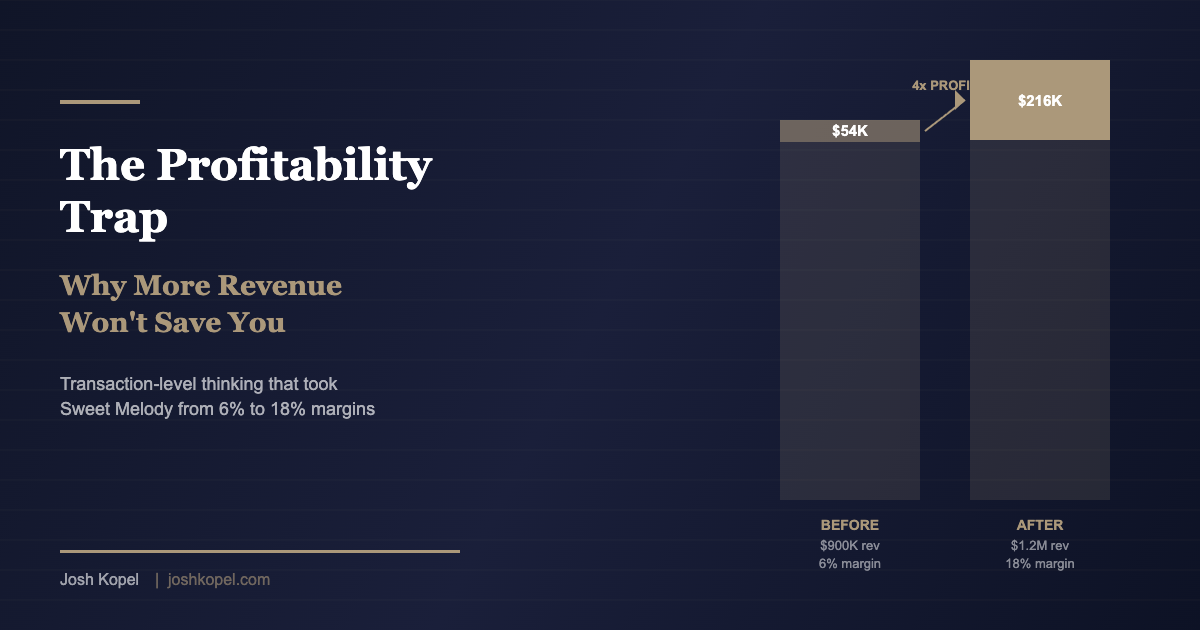
For years, my bookkeeper told me I was “just a couple thousand a week away from massive profitability.” It was a lie. Expenses rise with revenue. The goalpost always moves. The real lever is transaction-level profitability: making every button on every seat produce profit. When I applied this thinking to my client Sweet Melody, we went from $900K at 6% margins to $1.2M at 18% margins. The take-home went from $54K to $216K. Same restaurant, same team. Here’s the framework.
Two weeks into each month, I would get the profit and loss statement from my bookkeeper. And without fail, the message was the same: “You’re just a couple thousand a week away from massive profitability. If you could just make a little bit more money, you’d make a lot more money.”
So I would. I’d push harder. Run a promotion. Open another daypart. Squeeze out more covers. And then they’d move the goalpost. Every single time.
This is the most dangerous lie in the restaurant industry, and it looks exactly like truth. You hit your revenue target, but you’ve also added servers, expanded delivery, increased food costs with higher volume, run up utilities, and spiked your credit card processing fees. You hit your number and you’re somehow less profitable than when you were making less money.
I told myself this story for the first half decade of my career. It nearly destroyed me. The problem wasn’t revenue. It was never revenue. The only real problem in my business was money. And it took me way too long to understand that more revenue and more money are not the same thing.
More Work vs. More Money: The Distinction That Changes Everything
Here’s what I want you to write down and double underline: more work and more money look like the same thing on the front end. They look very different on the back end.
You could get a lot busier tomorrow by heavily discounting and giving away your product for free. But that’s more work. It’s not more money. And I know we’ve all been there, because the trap is seductive. More covers feels like progress. A full dining room feels like success. But if you’re paying to serve those customers, a full dining room is actually costing you money.
When I was 30, I opened a bar in Hollywood. 900 square feet. Lightning in a bottle. We cranked out of the gate and did $1.5 million a year at a 35% profit margin. I could do no wrong. So naturally, I decided to dip my toes into fine dining. How hard could it possibly be?
I lost a quarter million dollars the first year. It almost bankrupted both companies. I fired the general manager. I took over as general manager. I fired the executive chef. I brought in a new one. I ended up at Union Bank in Carlsbad, California, pulling the last $30,000 from my personal account and taking out a $50,000 cash advance from American Express because there was no personal guarantee attached to it. I was desperate.
The Hollywood bar was printing money at 35% margins. The fine dining restaurant was hemorrhaging cash. Same owner. Same work ethic. Same 12 to 15-hour days. The difference wasn’t effort. The difference was the profitability structure of each transaction.
Transaction-Level Thinking: Every Button on Every Seat Makes Money
This is the mental shift that changed my business and the businesses of hundreds of clients I’ve worked with since. Stop thinking about “the restaurant” as one thing. Your restaurant is actually hundreds of individual transactions happening simultaneously. Each table is a manufacturing run. Each order is a unit of production.
The question isn’t “is the restaurant profitable?” That’s too aggregate to be useful. The question is: is this specific transaction profitable?
Here’s my mantra. Every button on every seat makes money. Or it doesn’t. There’s no middle ground. A button is an order. A menu item. A beverage. A dessert. An add-on. Every single thing that gets rung up on that check needs to carry its weight in profit.
When a customer sits in your restaurant, that seat is an asset. It has fixed overhead built into it. Rent, utilities, labor, insurance. That seat costs you money to exist. The only way to justify that cost is to extract profit from every transaction at that seat. If someone orders a $15 entree and nothing else, they might not be profitable when you factor in everything. If they order the entree, a drink, and a dessert, now the math works.
This isn’t about squeezing customers. It’s about engineering profitability at the transaction level so your business actually functions.
The Sweet Melody Transformation: From $54K to $216K Take-Home
Let me tell you about Mike. His restaurant, Sweet Melody, is named after his daughter, Melody. He started serving ice cream in his garage just before the pandemic. Built it into a legitimate concept in South Florida. When we started working together, he was doing $900,000 a year at a 6% margin.
Let’s do that math. $900K at 6% is $54,000 take-home. Two employees drawing salary, and beyond that, barely anything left. Mike was trapped in the revenue illusion. His goal for the year was to increase cover count by 10%. More people through the door. More revenue. Problem solved.
I pushed back. Why would we drive more people through the door before we’ve maximized the earning potential of the people already sitting there?
We looked at his price-to-value ratio. We benchmarked against his competitive set and found he was dramatically underpriced. We identified that his best sellers constituted the majority of total item sales but were carrying thin margins. We raised prices strategically on those top items. We cleaned up the menu, removing the distractions. We trained his team on selling the right things, not just selling more things.
Within nine months, Mike was at $1.2 million in revenue at an 18% margin. That’s $216,000 take-home instead of $54,000. Same restaurant. Same location. Same team. The revenue only went up $300K. The profit went up $162K. More money, not more work.
That’s the power of transaction-level thinking. You don’t always need more revenue. You need your existing revenue to be more profitable.
Price Is a Story You Tell Yourself
One of the biggest obstacles I face when working with restaurant owners is fear around pricing. I get it. It’s scary to raise prices. But here’s what I’ve discovered after doing this hundreds of times: nobody’s watching.
Nobody is tracking your menu items. Nobody is tracking your pricing. Most of the people on this planet don’t know what they paid for gasoline last week. So few of your customers have visit frequency high enough to notice an incremental change in anything we’re discussing.
Let me ask you something. Is there a difference between a $16 burger and an $18 burger? Those are the same number. If you’re at $16, you could be at $18, and no one would blink. Now, there’s a massive difference between a $19 burger and a $21 burger. Those cross a psychological threshold. But within the same tier, you’re leaking margin for no reason.
Your top five to ten best sellers probably constitute 50 to 70% of your total item sales. If you increase the price of just those items by 10 to 15%, it creates a massive tidal wave in net profit. Will you read as expensive? No. Because you’ve only changed five to seven items on the entire menu. Are those items going to sell less? No. Because people aren’t buying them based on price. They’re buying them because those are the things you’re known for.
I ran an experiment at South City, my fast casual fried chicken concept. For the first six months we were open, I changed the price of our fried chicken sandwich every single week. Because I didn’t want to suspect where the price threshold was. I wanted to know. And what I found was that the threshold was much higher than I ever would have guessed.
Value Is What You Get, Not What You Pay
After reading thousands of reviews and scraping a ton of online data, I discovered something fascinating. Nobody has ever said, “I wish I had paid less.” They say “it was too expensive.” Those sound the same but they’re fundamentally different.
“Too expensive” means the price-to-value ratio wasn’t there. It doesn’t mean the price was too high. It means the value didn’t match the price. And that’s a solvable problem.
What are you actually selling? Most restaurant owners think they sell food and beverage. But your customers have food and beverage at their house. What they come to you for is eating and drinking. The experience. The effort that goes into creating an effortless experience. The transformation that comes from dining with you.
When you increase perceived value, you can charge more without resistance. Better menu descriptions. Storytelling about sourcing and craft. Thoughtful plating. Service touches that communicate care. None of this costs meaningful money. All of it supports higher prices.
Here’s the benchmark strategy I use with every client: identify the most expensive comparable restaurant in your category. If they’re busy and they’re doing it, you can do it too. We typically take clients up to P90, meaning the 90th percentile of pricing in their competitive set. And what happens? Nobody says anything. Nobody notices. Because we’re simultaneously increasing perceived value, so customers actually get a better experience for the higher price.
The Shrinkflation Opportunity: You’re Eating Your Own Margin
How many of you are giving away a ton of to-go bags? Portion sizes are large. People are getting more food than they can consume in one sitting.
Now think about this from the perspective of a consumer. Have you ever told a friend, “You’ve got to check out this restaurant. They gave me so much more food than I wanted”? Is that how we perceive value? A pile of leftovers that won’t taste the same in two days?
I would argue no. What people actually want is to eat just enough. To have a perfect experience. To leave satisfied, not stuffed. When you give them way more food than they can consume, they think “I overpaid for too much.” That’s not value. That’s waste.
Dialing back your portion sizes to what is reasonable for a human being to consume actually increases perceived value. It doesn’t diminish it. And it simultaneously improves your food margins. That’s the kind of double win that transforms a business.
Cut the Fat: Stop Competing Against Yourself
At Preux & Proper, my fine dining restaurant, I launched lunch three times. Three times. I kept thinking that if people loved us for dinner, they’d love us for lunch. And every time, the same thing happened.
Lunch was a completely different use case. Different customer. Different set of values. Different target price point. Different human entirely. And the worst part wasn’t that lunch lost money directly. It was that it created a leak in my funnel. People who should have been dinner customers came in for lunch, had a subpar first experience because lunch wasn’t our core business, and never came back for dinner.
When I ask you to do two things, you do no things. That’s decision fatigue in action. If your messaging says “come for brunch, lunch, and dinner,” people are likely to do none of it. If your messaging says “come for dinner this weekend,” they actually show up.
For all of you chasing multiple dayparts, multiple service styles, multiple revenue streams before your core business is maximized: you’re not diversifying. You’re diluting. Figure out your core business first. Crush it. Get it so full you can’t take any more capacity. Then and only then should you consider adding a new service.
The Blended Margin Strategy: How I Hit 15-20% Net
Once I figured out transaction-level profitability, the next evolution was revenue diversification. Not adding dayparts. Adding entirely different revenue streams that share your existing infrastructure but carry dramatically higher margins.
At my restaurants, in-house dining ran at 10 to 12% margins on most nights. Events and catering ran at 30%. Gift cards, when sold at scale with strategic discounting, were similarly high-margin. When I blended those revenue streams together, my overall margin jumped to 15-20% without cutting a single cost.
The events business went from $250K in inbound revenue to $1.6 million in under three years. Same kitchen. Same staff. Same fixed overhead. The incremental cost of an event was minimal because the infrastructure already existed.
This is why I stopped thinking about my restaurant as a dining business. My restaurant existed to promote my events and catering business, because that’s where the margin was. The dining room was the marketing engine. The events were the profit engine.
What This Looks Like When It All Comes Together
Easy Street is a single-unit burger joint in Studio City, California. It started in a parking lot with a tent. It’s owned and operated by two people without a huge management team. They generate $400,000 a month at a 34% margin from a single unit.
Sodici Pizza in Brownsville, Texas is owned by a guy named Dante. It does $1.4 million a year at an 18% margin. It’s open four days a week. Do the math on what a quarter million dollars a year in take-home means in Brownsville, Texas. And Dante’s not involved in day-to-day operations.
These aren’t massive operations. They’re restaurant owners who understood that the game isn’t about revenue. It’s about how much profit every single transaction generates.
Your 7-Day Profitability Action Plan
Day 1: Know your real margins. Pull the last month of POS data. Identify your top 10 best sellers. Calculate actual cost including food, labor, and overhead allocation. Are those transactions profitable? By how much?
Day 2: Benchmark your pricing. Pull the menus of your five closest competitors. Where do you rank on pricing? If you’re not at least P90 (90th percentile) on your best sellers, you’re leaving money on the table.
Day 3: Raise prices on your best sellers. Increase by 10-15%. These items constitute the majority of your sales and people buy them because they want them, not because of the price. This is a two-way door. If it doesn’t work, change it back tomorrow.
Day 4: Audit your portion sizes. Walk through service during peak hours. How many to-go bags are going out the door? Where are you giving away more food than a human can consume? Dial back to perfect portions and bank the margin.
Day 5: Cut the dead weight. Look at the bottom 25% of your menu by sales volume. These items are distractions. They complicate prep, confuse customers, and dilute your identity. Remove them. Make your menu a greatest hits album.
Day 6: Evaluate your dayparts. Are you running services that don’t carry their weight? Is lunch losing money? Is happy hour cannibalizing dinner? Calculate the true cost of every service you run, including the opportunity cost of diluted focus.
Day 7: Start tracking transaction-level profitability. Set up a simple system to monitor per-customer average spend by server, by daypart, by day of week. The patterns will tell you exactly where your profit leaks are.
The pennies mean nothing to your customers. But they’ll change everything for you. Money likes speed. Don’t plan this for next quarter. Do it this week.
Free Live Training
Want Me to Walk You Through These Systems Live?
Join the free 5-Day Restaurant Marketing Masterclass. In 40 minutes a day, I’ll show you how to build a marketing system that actually makes you money.
JOIN THE FREE MASTERCLASS★★★★★ Rated 5/5 by 1,000+ restaurant owners
Frequently Asked Questions
What’s a healthy restaurant profit margin?
In-house dining typically runs at 10-12% net margins. My Hollywood bar hit 35% because it was a high-volume, efficient operation. The best path to 15-20% net is blending your in-house revenue with higher-margin streams like events (30%), catering (30%), and bulk gift card sales. Transaction-level thinking gets you to profitability faster than chasing a monthly revenue number.
How do I raise prices without losing customers?
Focus on your top five to ten best sellers, which represent 50-70% of total item sales. A 10-15% increase on those items creates significant profit impact while only affecting a handful of menu items. Nobody tracks your pricing. Nobody will notice. And your best sellers aren’t purchased based on price. They’re purchased because you’re known for them. This is a two-way door. If it doesn’t work, change it back.
Should I focus on cutting costs or increasing revenue?
Neither. Focus on transaction-level profitability. Make sure every button on every seat generates profit. That might mean raising prices, trimming portions, cutting unprofitable menu items, or training your team to sell the right things. At Sweet Melody, revenue only went up $300K, but profit went up $162K. The leverage was in making existing transactions more profitable, not in chasing raw revenue or slashing costs.
How do I know if a menu item is unprofitable?
Calculate true delivered cost including ingredients, prep labor, and overhead allocation. If margin is below 25-30%, flag it. Then decide: raise the price, reduce the portion, or remove it entirely. Most restaurants find that 25-30% of their menu should be restructured or eliminated. Your menu should be a greatest hits album, not an encyclopedia.
What if I’m already busy but still not profitable?
That’s the profitability trap. Being busy and being profitable are completely different things. If your dining room is full but your margins are thin, you’re paying to serve people. Audit your transactions. Identify which customers, dayparts, and menu items are dragging down your margins. It’s better to serve fewer people profitably than more people at a loss. Sometimes revenue needs to go down before profit can go up.