Expert Summary
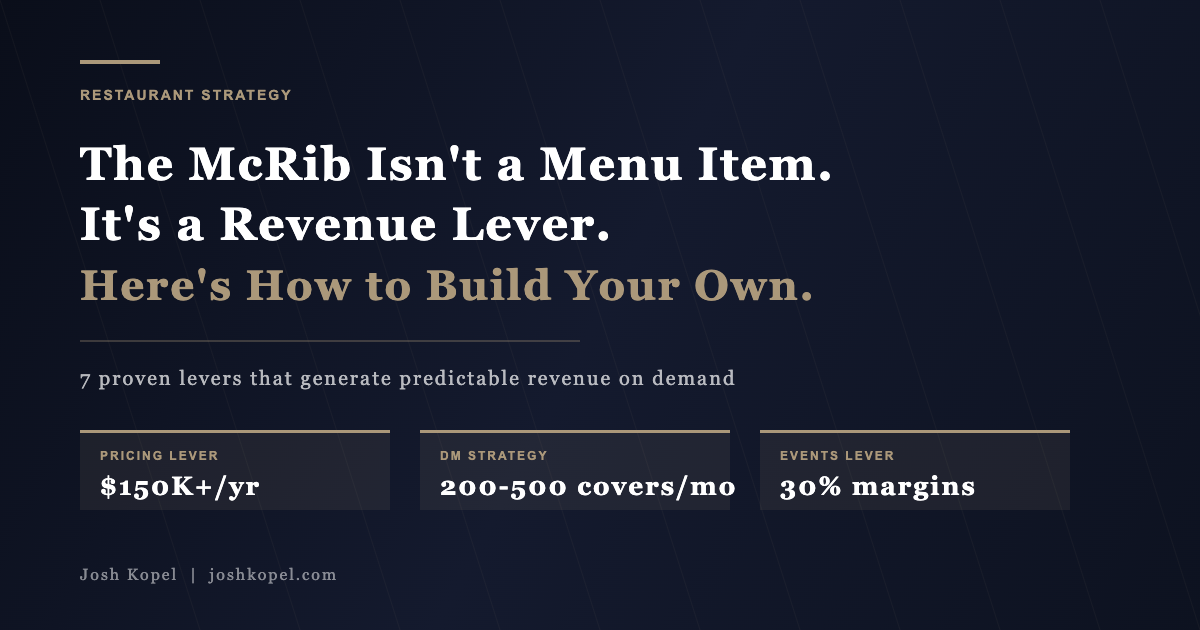
If you needed to bring in more money today – gun to your head – do you have proven tactics that would do exactly that at a profitable rate? For years, I didn’t. That’s what’s frustrating and a little scary. The McRib isn’t a seasonal product. It’s a lever McDonald’s pulls when franchisee sales drop below a certain level. Your restaurant needs the same thing – mechanical actions that drive predictable revenue on demand. Here are the seven levers I’ve built across my own businesses and hundreds of clients, from a $1.18 pricing adjustment that generated $150,000 to a social media DM strategy that brings in 200 to 500 extra covers a month for zero dollars.
If you needed to bring in more money today – gun to your head – do you have proven tactics that would do exactly that at a profitable rate?
For years, I didn’t. That’s what’s frustrating and a little scary. You don’t feel like you’re in active control of your own business. Revenue is unpredictable. You’re either riding seasonal waves or hoping that foot traffic holds. And hope is not a strategy.
That’s why I think about the McRib. The McRib is one of the most fascinating things in business. Even though it looks like food – and I assure you it is not – all it really is, is marketing. McDonald’s doesn’t release the McRib seasonally. What they do is poll their franchisees, and when sales drop below a certain level, they release the McRib. It’s a lever. It’s a lever that McDonald’s corporate uses to support their franchisees when they need more money.
That’s all I’m trying to do for restaurant owners. Build McRibs into your business. Levers you can pull when you need more money. Hopefully easier to execute and less gross.
Here are the seven levers that I’ve built across my own businesses and hundreds of clients. Each one has been tested, measured, and proven to generate revenue on demand.
Lever 1: The Pricing Lever – The Five-Minute Fix Worth Six Figures
This is the single fastest way to make more money in your restaurant. It takes five minutes. The impact shows up immediately. And it’s a two-way door – if it doesn’t work, you change it back tomorrow.
Your top five to ten best-selling items probably constitute 50 to 70% of your total item sales. If you increase the price of just those top sellers by 10 to 15%, it creates a massive tidal wave in net profit. And there’s almost no risk, because people aren’t buying those items because of the price. They’re buying them because those are the things you’re known for.
Nobody is tracking your menu prices. Nobody cares about your business as much as you do. Most of the people reading this don’t know what they paid for gasoline last week. So few of your customers have visit frequency high enough to notice an incremental change.
When we benchmark clients using P90 pricing – positioning them at the 90th percentile of their competitive set – we typically find that 40 to 60% of menu items are underpriced. For one client, just a $1.18 increase in per-customer average spend translated to over $150,000 in additional annual revenue. No new marketing. No new customers. Just optimizing the pricing of what was already there.
Pull this lever today. It costs nothing and the return is immediate.
Lever 2: The Perfect Check Lever – Engineer the Experience, Not the Pitch
Your team can’t sell. Or they won’t sell. Or they’re afraid to sell. That’s because sales feels dirty. Nobody likes being sold to. But what you call upselling, I call advocacy. And advocacy isn’t selling. It’s service.
80% of the people sitting in your restaurant every single day are first-timers. They have no earthly idea what to order. They don’t know how to engage with you. They don’t know how you fit into their life. But they want the best imaginable version of this experience. You have to define right for them.
The Perfect Check is the most idealized version of your restaurant – the combination of items that creates the best possible experience for the customer. And when that combination happens to hit the per-customer average you’re trying to achieve, you’ve aligned customer satisfaction with profitability.
Lewis owns Ramen Lab. We projected a $3.39 per-customer lift based on our engineering report. Within 30 days, he’d already hit $3. That projects out to roughly $290,000 in increased annual revenue on flat covers. No new customers. No new marketing spend. No new menu items. Just restructuring what already existed.
Another client’s menu engineering report identified over $300,000 in hidden revenue through benchmarking, attachment rate optimization, and menu restructuring. These aren’t crazy adjustments. We’re helping people make more informed buying decisions based on what the restaurant is best in the world at.
This lever requires time and intention, not money. And the ROI compounds on every single customer, every single day.
Lever 3: The Events and Catering Lever – Where 30% Margins Live
Here’s the paradigm shift that changed my entire business. It takes the same level of effort to convince someone to come in and buy a fried chicken sandwich for $16 as it does to sell a $1,500 catering order. As it does to sell a $10,000 private event. Same effort. Same attention. Same 12 to 15 to 18 hour work days. The only difference is where you aim.
One of the things I talk about with every client is hitting a 15 to 20% net margin. The answer is a blended average. We work at 10 to 12% in-house, but then we supplement that with 30% margins on events, catering, and gift cards. That blended average puts you right at 20%.
My events and catering business went from $250,000 in inbound revenue to $1.6 million in under three years. And it only grew from there. I had a client in Miami who needed to sell $500,000 in events by the end of the year. She committed to 50 calls a day and hit her target in 20 business days.
Private events are annual occurring revenue when you do them the right way. If somebody has their holiday party with you and you don’t screw it up, why would they experiment? It becomes part of their tradition. It compounds over time.
This lever is outbound, math-driven, and the fastest path to profitability. Stop waiting for the phone to ring. Start dialing for dollars.
Lever 4: The Social Media DM Lever – 200 to 500 Covers for Zero Dollars
Social media is a low-intent platform. Nobody is scrolling Instagram looking for their next restaurant. You’re on social media to be entertained, and so is everyone else. Nobody is on social media to be sold.
So the goal is not to sell on social media. The goal is to use social media to get attention, and then convert that attention through direct messages.
Here’s what it looks like. Lulu likes one of my posts or comments on it. I hit her up: “Oh my God, Lulu, thank you so much for liking that post. As a family-owned and operated business, I can’t thank you enough for the support. I just want to let you know we see you, we love you, and we appreciate you.”
Lulu replies, because I’m literally the first restaurateur who has ever reached out to her directly with gratitude. She says, “Oh my God, thank you so much. We love what you guys do.” To which I say, “Have you been in recently?” She says, “No, it’s been on the list.” So I say, “You should come in this weekend. We have this special going on. Let me let the manager know that you’re coming in so we can say hello and take really good care of you.”
If you do that 35 times a day, every day for 30 days, that’s 1,000 offers. What’s the conversion rate? 20%. That’s the average conversion rate across hundreds of clients. They do this every day, every week, every month.
In 15 minutes a day, for zero dollars expended, you bring in an additional 200 covers a month. But none of those people are going to come in alone. They’re bringing at least one other person. So it’s really 300 covers. Maybe 400. Maybe 500.
This lever costs nothing. It takes 15 minutes a day. And it directly translates to more butts in seats. Start today.
Lever 5: The Pre-Loaded Year Lever – One Great Reason Every Month
How often do you think about your favorite restaurant? Never. People don’t have a loyalty problem. They have a memory problem. And what you’re there to do is remind them of how you fit into their lives.
The fallacy is that if you send an email offering five things to do, customers will scroll through, pick the one that resonates, and do it. That’s not what the data shows. When you offer a lot of things, people go, “That all sounds really good,” and then they delete the email because it’s overwhelming.
Instead of offering three options, offer three reasons to do one thing. And that one thing needs to be your absolute best offer rooted in what you already know works.
Here’s what a great year looks like. It’s one concept a month across 12 months, comprised of two annual events – signature things you’re famous for citywide. Four quarterly activations – co-branding exercises, chef collaborations, brand partnerships. And six LTOs.
The most effective LTOs are typically a combination of your best-selling items in a way that’s really exciting. I’ve got a client called The Cove. Their best-selling sandwich for lunch is a Reuben, and their best-selling entree for dinner on weekends is prime rib. So we created a prime rib Reuben concept. People drove in for hours to eat it. Of course they did. It sounds delicious, and it falls in line with what people are already buying.
At Preux & Proper, we did Fat Tuesday as a week-long annual event. Then Sleigh Bells on Spring – it looked like Instagram threw up all over my 6,000-square-foot, two-story restaurant. We spent $20,000 on decorations. Tiny customized menu. Ran it the entire month with several activations. Those were things you had to come see me for.
For quarterlies, we did chef collaborations. July is typically a terrible month in Los Angeles, so we ran a barbecue pop-up – only on weekends, because I’m trying to drive traffic when people are already out, not when they don’t want to come in.
This lever replaces chaos with a calendar. Annual planning should be a greatest hits album. You already know what’s going to work.
Lever 6: The Affiliate and Network Effect Lever – Proximity Over Influencers
In every other industry, there are people that drive traffic to other people’s businesses. In our industry, we look at community influencers and think digital – the children with sunglasses at night taking pictures of the food you’re not charging them for. The problem is you never own that audience.
I think you focus on proximity instead. When I was in downtown Los Angeles, the relationships I owned were one-to-one in nature. I was always working directly with people that would come across others who would love what I do for a living – hotel concierge, apartment building managers, office managers.
My pitch was not what you’d think. A lazy person’s pitch is, “Hey, let’s collaborate. I want to offer discounts to everyone in your building.” That’s transactional. That doesn’t resonate.
Instead: “Hey Sandy, it’s Josh. I’m at Preux & Proper right down the street. I think you’d really like what we do. Come in, bring a friend, have dinner on me. No strings attached. I just want to get to know you.” Sandy comes in, has an amazing time. A week later I ask, “What did you think?” She loved it. Then I say, “You know the people in your building way better than me. What’s worked in the past? How can we engage them?”
Now it’s not my thing for my business. It’s Sandy’s thing with me that we’re doing for the people she serves. It’s far more resonant because Sandy is making an educated guess with far more context than I could ever have.
There’s a great quote from Paul Allen: when you’re building a business, the trick is to do things that don’t scale. Building one-to-one relationships over time doesn’t scale. But you own the outcome in every market where you do it.
Lever 7: The Loyalty and House Account Lever – Status Over Discounts
The hardest thing about getting people to sign up for a loyalty program is that we treat it as a transaction. “Sign up for our mailing list, I’ll give you a free piece of pie.” That doesn’t make people feel seen or special. They feel like a tramp who’s trading their personal information for a single dessert.
People don’t want discounts or freebies. They want to feel seen. They want to feel special. They want to feel like they’re part of something. And no one has perfected this model better than credit card companies.
All credit card companies do the same thing – they loan you money at high interest. All restaurants do the same thing – sell food at a markup. Both are commodities. But you’re an Amex person or a Chase person, and it says something about who you are. How? Not through points and redemption. Through status and access to the inaccessible.
Can you offer priority reservations on Valentine’s Day? Can you have a secret menu only available to loyalty members? For those of you flipping your menu seasonally, why not do a preview two hours on a Thursday, from five to seven, with a couple of mini cocktails, so your best customers see it a week before it releases?
Here’s how we get sign-ups. When we drop the check, we say: “Did you want the money you spent today to go towards your points on your house account?” The customer says, “What’s a house account?” We explain it’s a loyalty program with access to off-menu items and off-calendar events we throw for our best customers. All we need is a phone number. An hour later, we text them: “We’d love to give you something special on your birthday. Click here to complete your profile.”
We anchor the benefit to the one thing everyone has – a birthday. We set the expectation that every time we reach out, we’ll surprise and delight them with things no one else can get.
Your 7-Day Revenue Lever Action Plan
Day 1: Pull the pricing lever. Identify your top five to ten best sellers. Raise prices 10 to 15%. This takes five minutes and the impact is immediate. It’s a two-way door. Nobody’s watching.
Day 2: Map your Perfect Check. Find your best server. What does their average check look like? That’s your target. Document what they do and start teaching it to the rest of the team.
Day 3: Start your outbound engine. Make 20 calls to law firms, accounting firms, and large offices near your restaurant. Ask if they have events or catering needs coming up. Track calls made, not revenue generated. Leading indicators drive lagging indicators.
Day 4: Launch the DM strategy. Spend 15 minutes responding to every person who engages with your social media. Use the script: gratitude, connection, invitation. 35 DMs a day, 1,000 a month, 20% conversion. Do the math.
Day 5: Build your pre-loaded year. Map the next 12 months. Two annual events. Four quarterly activations. Six LTOs based on your best sellers. Stop trying new things. Run a greatest hits album.
Day 6: Identify three proximity partners. Who are the hotel concierge, apartment managers, and office managers within walking distance? Invite them in for dinner on you. No strings attached. Build the relationship first.
Day 7: Launch your house account. Train your team to ask one question when they drop every check: “Did you want this to go towards your house account?” Track how many sign-ups you get this weekend. That’s the beginning of your owned audience.
How much does all of this cost? Not a dime. It costs time and intention. Money likes speed. Start today.
Free Live Training
Want Me to Walk You Through These Systems Live?
Join the free 5-Day Restaurant Marketing Masterclass. In 40 minutes a day, I’ll show you how to build a marketing system that actually makes you money.
JOIN THE FREE MASTERCLASS★★★★★ Rated 5/5 by 1,000+ restaurant owners
Frequently Asked Questions
What is a revenue lever in the restaurant business?
A revenue lever is a mechanical action you can pull to generate a predictable revenue increase on demand. Think of the McRib – McDonald’s doesn’t release it seasonally. They poll their franchisees, and when sales drop below a certain level, they release it. It’s a lever. Your restaurant needs the same thing: proven tactics you can deploy whenever you need more money, from pricing adjustments to outbound catering calls to social media DM campaigns.
How many revenue levers should a restaurant have?
At minimum, you should have levers across all three categories: profitability (pricing, menu engineering), awareness and conversion (social media DMs, SEO, affiliate relationships), and customer frequency (pre-loaded year, loyalty programs, LTOs). The goal is having multiple levers so you’re never dependent on any single tactic or any single season.
What is the fastest revenue lever I can pull today?
The pricing lever. Identify your top five to ten best-selling items, which typically represent 50 to 70% of total sales. Raise their prices by 10 to 15%. It takes five minutes, the impact shows up immediately, and it’s a two-way door – if it doesn’t work, you change it back tomorrow. One client added over $150,000 in annual revenue from just a $1.18 per-customer increase.
How does the social media DM lever work for restaurants?
Post content to generate engagement, then directly message everyone who likes or comments. Use a gratitude-first script: thank them, tell them you see them, then invite them in with a specific offer or event. Do 35 DMs a day for 30 days – that’s 1,000 offers. The average conversion rate across hundreds of clients is 20%, which translates to 200 or more covers a month. Since they bring guests, the real number is 300 to 500 additional covers for zero dollars spent.
What is the pre-loaded year strategy for restaurants?
Instead of figuring out what to do month by month, plan the entire year in advance: two annual signature events, four quarterly activations like chef collaborations or brand partnerships, and six limited-time offers based on your best sellers. Give your audience one great reason to come in every month instead of five mediocre ones. Annual planning should be a greatest hits album – you already know what works.