- The “why restaurants fail” diagnosis most operators reach for is almost always wrong.
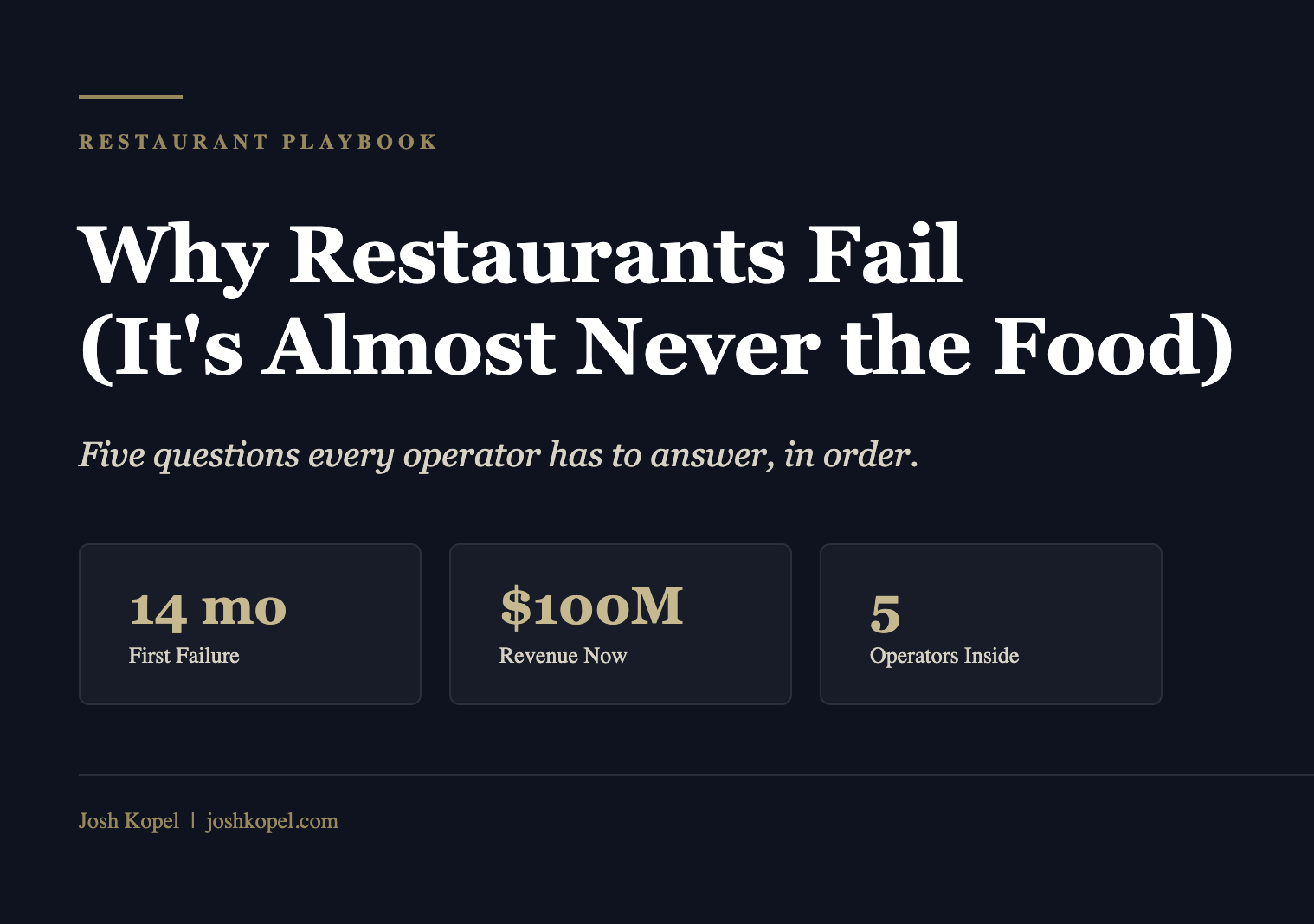
- Restaurants don’t fail on food. They fail on memorability, demand, alignment, focus, or repeatability.
- Every restaurant has to answer five questions, and they have to be answered in order.
- Most operators try to fix Growth when their actual problem is Question 1 or 2.
- The new FULL COMP playbook breaks down each question with the operator who lived it.
Dan Simons closed his first restaurant in 14 months.
He had the systems. Corporate training from TGI Fridays, Cheesecake Factory, Brinker. Operational discipline most independents would kill for.
Twenty years later, his next restaurant, Founding Farmers, does over $100M in annual revenue across eight locations with 1,500 employees.
When people ask why restaurants fail, they almost always reach for the wrong answer. They blame the menu, the chef, the location, the marketing budget. The food was fine both times for Dan. It’s almost never the food. It’s something further upstream.
Why restaurants really fail (and it’s not the food)
The myth that 90% of restaurants fail in their first year is exactly that. A myth.
The actual number, per Cornell’s landmark Parsa study on restaurant failure, sits closer to 26%. Still high. Not the apocalypse cable TV makes it out to be.
What’s more interesting is the why. Parsa’s qualitative research found the failures rarely came down to food quality. They came down to the operator’s relationship with the concept, the capital, and the customer. That tracks with everything I’ve heard sitting across from operators who built billion-dollar systems.
Here’s how Dan describes the failure of his first restaurant:
“We failed primarily because we were arrogant. We didn’t realize it, but I think that’s an important word to use. We thought we knew better for the customer.”
He didn’t ask the guest whether they actually wanted green beans that were actually green, or mac and cheese where they made the pasta from scratch. He built the restaurant he wanted to eat at.
And he and his partner ran out of capital before they found the right customer.
That’s not a food problem. That’s a strategy problem dressed up as a real estate problem.
Five questions every restaurant has to answer
Over the last year I sat down with five operators who’ve walked every stage of building a restaurant business. Scott Snyder at Badass Coffee. Josh Halpern at Big Chicken and Craveworthy. Dan Simons at Founding Farmers. Randy Sharpe at Wahlburgers. Jeff Fenster at Everbowl.
Different segments, scales, and decades. The questions were always the same five.
1. Can people remember it?
Scott Snyder, Badass Coffee. He walked in as a consultant in late 2016 thinking he had a franchise sales problem. He didn’t. He had a brand recall problem.
His test for memorability is the one I keep stealing:
“If I saw it one time and I didn’t see it again for 30 days and someone brought it up, would I know what they were talking about?”
Badass passed it. What it didn’t have was what Scott calls a “unique and ownable truth,” the thing only that brand can say. Without it, in his words, “you may be dead where you stand.”
Scott’s framework for building one: three legs of the stool. The brand has to be memorable. The product has to validate the brand. The infrastructure (people, process, systems, training) has to deliver on the promise. Miss one leg and the stool falls. For Badass, the brand was strong (Jack the donkey, the 200-year-old Hawaiian coffee story). The product backed it up. The operational infrastructure had been missing for over a decade. Scott rebuilt that third leg before the first two could pay off.
2. Do people actually want it?
Josh Halpern, Big Chicken and Craveworthy. Two units to nearly 50 in five years. Shaquille O’Neal owns the brand. Halpern is blunt about what that does and doesn’t do:
“He’s the biggest blessing and the biggest curse in the company. We have to pretend like he’s not a part of the brand to make sure that our operations are excellent.”
Celebrity drives trial. Operations bring people back.
Halpern’s framework for what actually drives return is something he learned at Clorox: three crucible moments. Point of Desire (your brand becomes the answer to “what should we eat tonight?”). Point of Decide (the register, the upsell, the milkshake add). Point of Delight (the bite of food itself). The restaurant industry owns Delight. It does an OK job at Decide. It mostly fails at Desire.
The brands that scale figure out which specific occasions they own. Halpern’s math: the average person eats out 26 times a month. He doesn’t need to be the answer 26 times. He needs to be the answer 4. So he hunts for 2 to 3 occasions where his brand is the obvious choice, then markets against those occasions on purpose.
Get Halpern’s Full Demand Framework
The full three-crucible-moments breakdown, plus how to identify the 2–3 winnable occasions for your brand.
Download Free →3. Can it survive?
Dan Simons, Founding Farmers. Systems aren’t enough. What matters is alignment between your capital, your team, your guests, and your concept.
Dan’s first restaurant had the systems. It still failed in 14 months. The lesson: when capital wants short-term returns and operators want long-term durability, the restaurant cracks under the strain. Both sides are doing their jobs. The alignment just isn’t there.
Dan structured Founding Farmers so the family farmers who supply the restaurants own more of the company than he and his partner do. The capital, the supply chain, and the operators all pull the same direction. That’s why, in his words:
“We’re still here at 18 years with 1,500 employees and $100 million in revenue.”
Alignment doesn’t replace systems. It outlasts them.
4. Can it grow profitably?
Randy Sharpe, Wahlburgers. When Randy took the CEO chair, he found “17 menus in about 98 outlets. It was insanity.” On Mark Wahlberg’s celebrity, his read is the one to remember:
“It can’t be the engine, it has to be the fuel.”
So Randy cut. By store count, 70% of the outlets generated only 10% of the profit and 80% of the pain. He cut them. He cut the grocery-store partnership diluting the brand. Today the system runs on three menus instead of seventeen.
Randy treats every LTO as an audition for permanent menu space. Introduce, measure, promote. The ones that earn it stay. The ones that don’t get cut to make room for the next test. No emotional attachment to a recipe that isn’t pulling its weight.
His one line for the whole approach: be brilliant at the basics. The boring foundation compounds.
Get Randy Sharpe’s Cut-To-Grow Playbook
How Wahlburgers went from 17 menus to 3, and the LTO audition system that keeps the menu lean.
Download Free →5. Can it scale without breaking?
Jeff Fenster, Everbowl. His framing of how he scales:
“I don’t try to change behavior. I try to remove the things that I can’t and I’m not going to change.”
Cash has legs, so Everbowl is cashless. “If there’s no cash, there’s nothing to steal.” Staff form cliques when they know each other better than the guest, so Jeff hires only “friend-makers.” On slower shifts he engineers what he calls “curated boredom,” roughly five minutes of dead time between customers, where the team makes friends with the guest instead of each other.
Jeff also designed the kitchen so the dangerous variables don’t exist. No ovens. No hoods. No grease traps. No raw chicken. Everbowl makes bowls from three-gallon drums of pre-prepped ingredients in under 50 seconds. Less to break means less to manage.
On training, Jeff tells a story about his mentor David Cohn. Jeff was complaining about staff turnover. His exact question: “Why am I spending so much on training?” Cohn’s reply: “What if they stay?” That one question rewired how Everbowl trains. Train like everyone is staying. Then they do.
The order matters more than the answers
The questions aren’t parallel. They’re sequential. Each question builds on the one before it.
The questions stack:
- You can’t build demand for a forgettable concept.
- You can’t survive without demand.
- You can’t grow profitably without surviving.
- You can’t scale what isn’t profitable.
Skip a question, the next one collapses.
This sounds obvious written down. It’s not obvious in practice. Most operators I talk to try to fix Question 4 or 5 when their actual problem is Question 1 or 2.
They optimize labor costs and inventory shrink in a restaurant nobody can remember. They chase franchise sales for a brand without a clear answer to who it’s for.
The work is to find your lowest-numbered “no” and start there. Honestly, this is harder than it sounds. Most of us would rather work on the question we’re closer to answering than the one we know we haven’t.
Where most operators actually break
Most operators don’t break at the question they think they’re working on.
The ones who think they have a marketing problem usually have a Question 1 problem. Nobody can describe what makes the restaurant different in one sentence 30 days after visiting.
The ones who think they need more trial usually have a Question 2 problem. The trial they get isn’t converting, because they haven’t won a specific occasion.
If you’re sitting with those two questions and not sure which one is biting you, the playbook is built to help you figure it out. Grab the full PDF here. It’s the field notes from all five conversations, distilled.
The work that’s actually yours
What surprised me most across these conversations was how unromantic the answers are.
The operators who built durable restaurants didn’t out-cook anyone. They out-thought everyone. They asked harder questions earlier. They cut faster when something wasn’t working. They let go of the version of the restaurant they wanted to build in favor of the version their guests actually needed.
Dan’s signoff line at the end of our conversation stuck with me:
“Hold people, then write it down.”
That’s the whole job. See your employees as humans, take care of them. Then build the system that captures what’s working, so it survives the next 50 hires.
You can fix an average concept. You can’t fix an operator who can’t see the question they need to answer.
So here’s the real question. Which of those five questions are you actually stuck on? Not which one feels good to work on. Which one is the lowest-numbered “no” in your business right now?
That’s the chapter you need.
Get The FULL COMP 2026
Restaurant Playbook — Free
Field notes from five conversations with operators who’ve answered each question at scale. No deck, no upsell, no fluff. Just the actual frameworks the people in the trenches use.
Download The PlaybookFAQs
Why do restaurants really fail?
Most restaurants don’t fail on bad food. They fail because they’re forgettable, undercapitalized, misaligned with their guest, or trying to grow before they’ve survived. The food is rarely the actual problem.
What is the actual restaurant failure rate?
The 90% first-year failure rate quoted on cable TV is a myth. Cornell’s Parsa study found the real first-year failure rate for independent restaurants sits around 26%. Cumulative three-year failure sits closer to 59%, similar to most other small business sectors.
What are the five questions every restaurant has to answer?
Can people remember it? Do people actually want it? Can it survive? Can it grow profitably? Can it scale without breaking? Each question builds on the one before it. You don’t get to the next question until you’ve answered the one before.
How do I know which question my restaurant is stuck on?
Find the lowest-numbered “no” you can honestly say. If a stranger couldn’t describe your restaurant in one sentence 30 days after visiting, you’re stuck at Question 1. If trial isn’t converting to repeat visits, you’re stuck at Question 2.
What’s in the FULL COMP 2026 Restaurant Playbook?
A breakdown of each of the five questions with the operator who built through it: Scott Snyder, Josh Halpern, Dan Simons, Randy Sharpe, and Jeff Fenster. Practical frameworks for memorability, demand, survival, profitable growth, and scale.
Is the playbook actually free?
Yes. It’s a free PDF download from offers.joshkopel.com. No paywall, no upsell inside. Square is the presenting partner for the series.