
Expert Summary
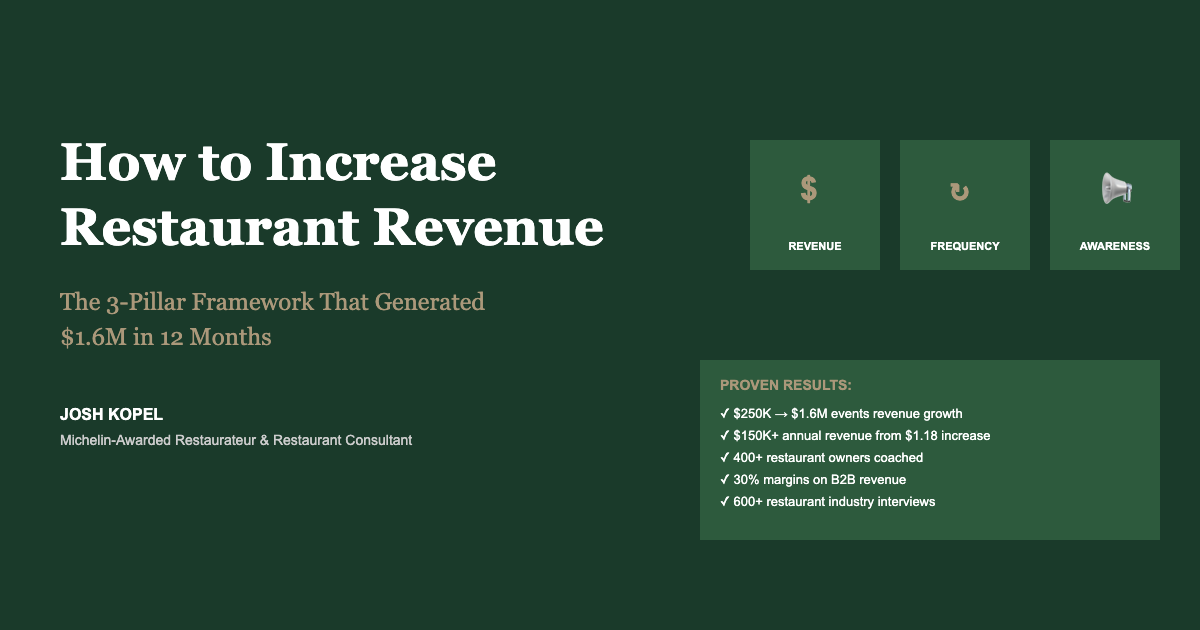
After coaching 400+ restaurant owners and interviewing 600+ industry leaders, I’ve found that sustainable revenue growth comes down to three pillars – not a hundred scattered tactics. This framework took my own events business from $250K to $1.6M and has generated over $150K in additional annual revenue for clients through a single metric shift. Here’s exactly how it works.
I used to think I had a thousand problems. Staffing. Food costs. Marketing. Lease negotiations. Vendor relationships. The list was endless, and I was drowning in it.
Then I had a realization that changed everything: I didn’t have a thousand problems. I had one problem – money. Once you have money, you can solve everything else. You can hire better people. You can afford better ingredients. You can invest in marketing that actually works.
The issue was that I had no predictable, repeatable system for generating revenue. I was a restaurant manager with equity, not a restaurant owner. And there’s a massive difference between the two.
After running my own restaurants – including a Hollywood bar doing $1.5 million a year at 35% margins – coaching over 400 restaurant owners through my Restaurant Scaling System, and recording 600+ podcast episodes with people like Will Guidara, Wolfgang Puck, and Seth Godin, I’ve distilled restaurant revenue growth into a framework I call The Three Pillars.
Every solution I’m about to share with you is a solved problem. Someone else has already figured it out. Your job isn’t to reinvent the wheel – it’s to pair your specific problem with the existing solution that fixes it.
Why Most Restaurants Are Stuck (The Profitability Paradox)
Here’s the lie most restaurant owners tell themselves: “I’m just a couple thousand a week away from massive profitability.”
I know because I told myself the same thing. And here’s what happens – you hit that number, and the goalpost moves. Your expenses rise with your revenue. You hire another person. You upgrade your ingredients. You take on a bigger space. And suddenly you’re right back where you started, chasing another couple thousand a week.
The problem isn’t your revenue number. The problem is structural. You’re working IN your business when you should be working ON it. You’re managing behavior instead of leading systems. And you’ve built an operation that produces unpredictable revenue instead of formulaic, predictable sales.
Most restaurant operators are working 12-15 hour days, sleeping terribly, completely absent from their families, and doing tasks they’re genuinely terrible at – all because they never built a system that creates money on demand.
Which brings me to the concept that changed my entire approach to business.
The McRib Lever: Building Revenue You Can Pull On Demand
McDonald’s doesn’t release the McRib because it’s fall, or because someone in marketing had a fun idea. They release the McRib when franchisee sales drop below a specific threshold. It’s not a seasonal promotion – it’s a lever. A predictable tactic they can deploy at profitable rates, on demand, every single time.
That’s what your restaurant needs: proven revenue levers you can pull whenever you need to generate money.
Most restaurants lack this entirely. Revenue is weather-dependent, season-dependent, and mood-dependent. In Los Angeles, a drizzle of rain can drop your revenue 20% for the day. If your entire business model depends on walk-ins and hope, you don’t own a business – you own a lottery ticket.
The Three Pillars framework gives you those levers. Each pillar represents a category of proven tactics you can deploy systematically – not sporadically – to generate predictable revenue growth.
The Three Pillars of Restaurant Revenue
Every dollar of revenue growth in your restaurant flows through one of three channels. Master all three, and you build a business that generates money on demand. Here they are:
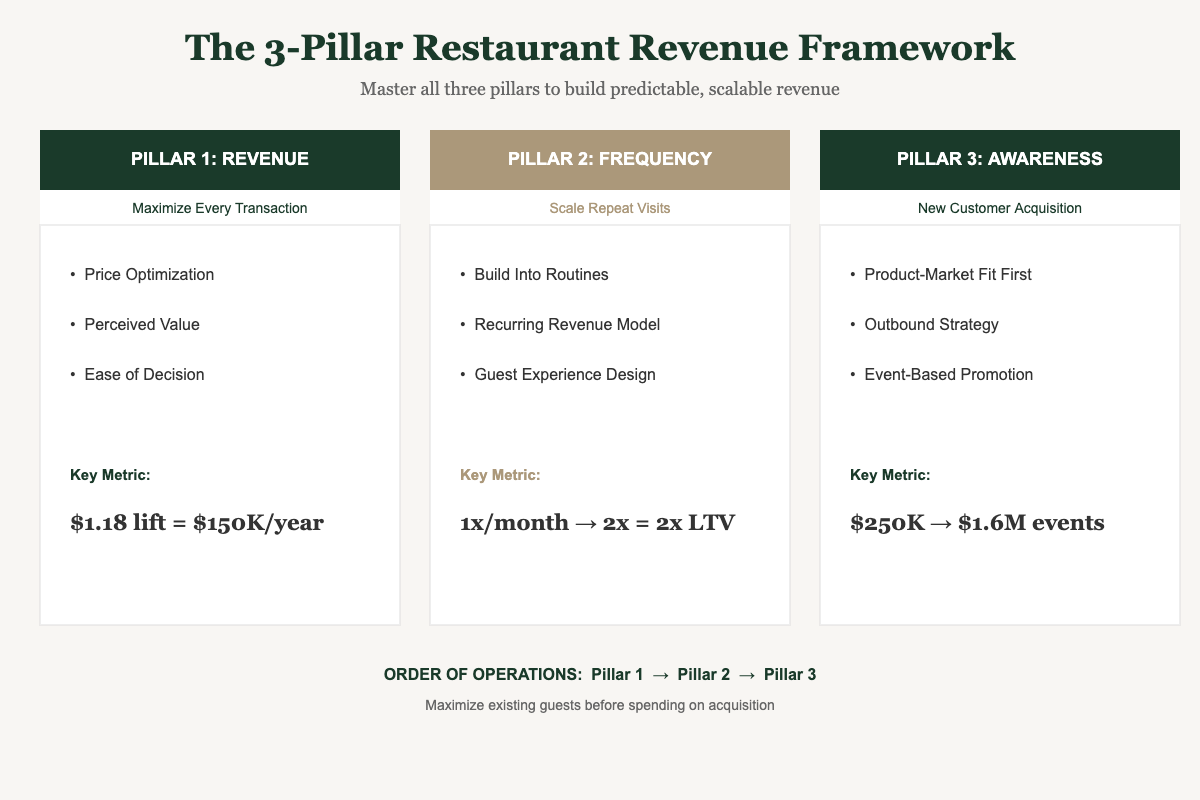
Pillar 1: Revenue – Creating the Most Profitable Version of Your Restaurant Today
This is where most people get it backwards. They chase new customers before they’ve maximized the earning potential of the guests already sitting in their restaurant.
Think about it this way: if I can get you a 10% lift in average guest spend with a 10% increase in sales and no additional cash expended, isn’t that better than trying to drive strangers through your door?
This pillar is about internal marketing – using three specific tools to extract more revenue from every transaction:
- Price: Your top 5-10 best sellers typically constitute 50-70% of your total item sales. A 10-15% price increase on just those items creates a massive tidal wave in net profit – and almost nobody notices because you’ve only changed 5-7 items on the entire menu.
- Perceived Value: Value isn’t what people pay. Value is what people get. Shift your focus from discounting to enhancing the experience of every transaction.
- Ease of Decision: Design every menu with purpose. The ideal is one thing – the thing you’re known for. In reality, you have multiple items, but you create intentional hierarchy so the customer’s path to ordering is frictionless.
One of my clients – a restaurant owner named Josh – used this pillar to increase his per-customer average spend by just $1.18. That’s it. A dollar and eighteen cents. But when you multiply that across every transaction, every day, every week, it translated to over $150,000 in additional annual revenue. No new marketing spend. No new customers. Just optimizing what was already there.
Pillar 2: Customer Frequency – Scaling Repeat Visits at High Margins
Once you’ve maximized each transaction, the next lever is getting those same customers to come back more often.
This isn’t about loyalty punch cards or generic email blasts. It’s about engineering your experience so that customers build you into their routine – the way people build their morning coffee shop into their commute.
The key insight here: if you’re not getting frequency, the problem isn’t rooted in price. It’s rooted in not having what they want. People return to restaurants that give them something they can’t get anywhere else, served in a way that respects their time and exceeds their expectations.
Frequency compounds. A customer who visits once a month at $50 per visit generates $600 a year. Get them to twice a month and you’ve doubled their lifetime value to $1,200 – without spending a dime on acquisition.
Pillar 3: Awareness – New Customer Acquisition Through Product-Market Fit
This is where most restaurant owners start, but it should be where you finish. Awareness – getting new people in the door – is the most expensive and least efficient pillar. It’s also the most important once you’ve optimized the first two.
The reason is simple: if your per-customer revenue is optimized (Pillar 1) and your repeat rate is strong (Pillar 2), then every new customer you acquire has a dramatically higher lifetime value. You’re not just filling seats – you’re filling seats with profitable, returning guests.
Without the first two pillars, new customer acquisition is like pouring water into a leaking bucket. You spend money to get them in the door, they spend less than they should, and they never come back. With the first two pillars locked in, every new customer becomes a compounding asset.
Case Study: From $250K to $1.6M in 12 Months
Let me show you what this looks like in practice with one of the most powerful revenue levers I’ve ever deployed: private events and catering.
At my own restaurants, we were doing about $250,000 a year in inbound events business. People would call, inquire, we’d respond – standard reactive approach.
When I applied the Three Pillars framework to our events business, here’s what happened:
- Pillar 1 (Revenue): We restructured our event pricing into three-tier packages instead of individual menu items, with the middle option priced where we actually wanted clients to land. We stopped going back and forth over individual dishes and started selling experiences.
- Pillar 2 (Frequency): We treated every event as annual recurring revenue. If someone booked their holiday party with us and we didn’t screw it up, they booked again the next year. That recurring base compounded every 12 months.
- Pillar 3 (Awareness): We built an outbound strategy with hand-raising emails and proactive outreach to corporate decision-makers – instead of waiting for the phone to ring.
Year one: $250K grew to $1 million. Year two: $1.6 million – and it kept climbing.
The margins on events ran at 30%, compared to 10-12% for our in-house dining operations. By blending those revenue streams, our overall margin jumped to 15-20% without cutting a single cost.
It took the same effort to build a $1.6 million events business as it did to manage the $250K inbound version. Same team. Same hours. Different system.
Why Internal Marketing Beats New Customer Acquisition Every Time
I want to drive this home because it’s the mistake I see the most: restaurant owners spending thousands on social media, influencer partnerships, and advertising to drive strangers through the door – while leaving six figures on the table from the guests already in their seats.
Internal marketing is the highest-ROI activity in your business. Here’s why:
- Zero acquisition cost. These customers are already in your restaurant. You don’t need to pay to reach them.
- Immediate impact. Price changes, menu engineering, and staff selling techniques take effect the same day you implement them.
- Compound returns. Every dollar you add to average check size multiplies across every customer, every day, for as long as you stay in business.
Start with Pillar 1. Always. Maximize the revenue from the guests you already have before you spend a dime trying to find new ones.
Are Gift Cards Profitable for Restaurants?
Yes — gift cards are one of the most profitable revenue streams a restaurant can run, for three reasons. First, you get paid today for a meal you serve later: it’s interest-free cash flow in the season you need it most. Second, a portion of sold cards is never fully redeemed, and gift-card guests routinely spend past the card’s face value when they visit. Third, most cards are gifts by definition — every card sold is a warm introduction to a guest who might never have found you otherwise, acquired at zero marketing cost.
The overlooked play is corporate bulk gift cards: businesses buy dozens or hundreds at once for employees and clients, with none of the one-at-a-time transaction cost. In The Future of Independent Restaurant Profitability, 2026, bulk gift cards sit alongside private events and corporate catering as the 30–35%-margin revenue layers that turn a 10–12% dining room into a 20% business. Sell them like a B2B product — one outreach, one invoice, recurring every holiday season.
Your 30-Day Action Plan
Here’s exactly what I’d do if I were sitting in your restaurant right now:
Week 1: Audit your menu. Identify your top 5-10 best sellers. These items represent 50-70% of your total sales volume. Calculate the exact food cost and margin on each one.
Week 2: Increase prices strategically. Raise prices on your best sellers by 10-15%. Nobody’s tracking your pricing changes – and these items aren’t purchased for price. People buy them because you’re known for them. This is a two-way door: if it doesn’t work, you can change it back tomorrow.
Week 3: Implement the Perfect Check. Talk to your best salesperson. Understand what they’re doing differently. Track two metrics – their per-customer average spend and the impact on their tips. Then show every other team member: “This is how much more YOU would make if you did what Sarah did.” Motivation works through self-interest.
Week 4: Audit your bottlenecks. Walk through your restaurant during peak hours like a customer. Where do people hesitate? Where does your team hesitate? Where does your digital experience break down? Every hesitation is a hidden expense – and every bottleneck you eliminate adds capacity during the hours that matter most.
Money likes speed. Don’t plan this for next quarter. Do it this week.
Frequently Asked Questions
How much can I realistically increase restaurant revenue without spending more on marketing?
Based on my experience coaching 400+ restaurant owners, a 10% lift in average guest spend combined with basic menu engineering typically generates $50,000-$200,000 in additional annual revenue with zero additional marketing spend. The exact number depends on your volume, but the principle holds: internal marketing delivers the highest ROI before you invest in acquisition.
What’s the fastest way to increase restaurant revenue this week?
Identify your top 5 best-selling items and increase their prices by 10-15%. These items represent the majority of your sales volume, and customers buy them because you’re known for them – not because of the price. This change takes five minutes and the impact shows up immediately.
Does the Three Pillars framework work for all restaurant types?
Yes. I’ve applied this framework across fine dining, fast casual, QSR, bars, and catering operations. The specific tactics within each pillar change based on your business model, but the architecture – maximize transaction value first, then frequency, then acquisition – is universal.
How do I increase revenue without raising prices?
Focus on Ease of Decision and Perceived Value – two of the three internal marketing tools. Redesign your menu to guide customers toward higher-margin items. Train your staff using the Perfect Check method to recommend specific items rather than asking generic questions. Right-size portions to reduce waste. These approaches increase profitability per transaction without touching your price column.
What’s the difference between increasing revenue and increasing profitability?
Revenue is the total money coming in. Profitability is what you keep. The Three Pillars framework is designed for profitability because it optimizes at the transaction level. Instead of thinking “at $70K/month I’m profitable,” you think “every button on every seat generates profit.” This transaction-level thinking prevents the trap where expenses rise as revenues rise.
Free Live Training
Want Me to Walk You Through These Systems Live?
Join the free 5-Day Restaurant Marketing Masterclass. In 40 minutes a day, I’ll show you how to build a marketing system that actually makes you money.
JOIN THE FREE MASTERCLASS★★★★★ Rated 5/5 by 1,000+ restaurant owners