
Expert Summary
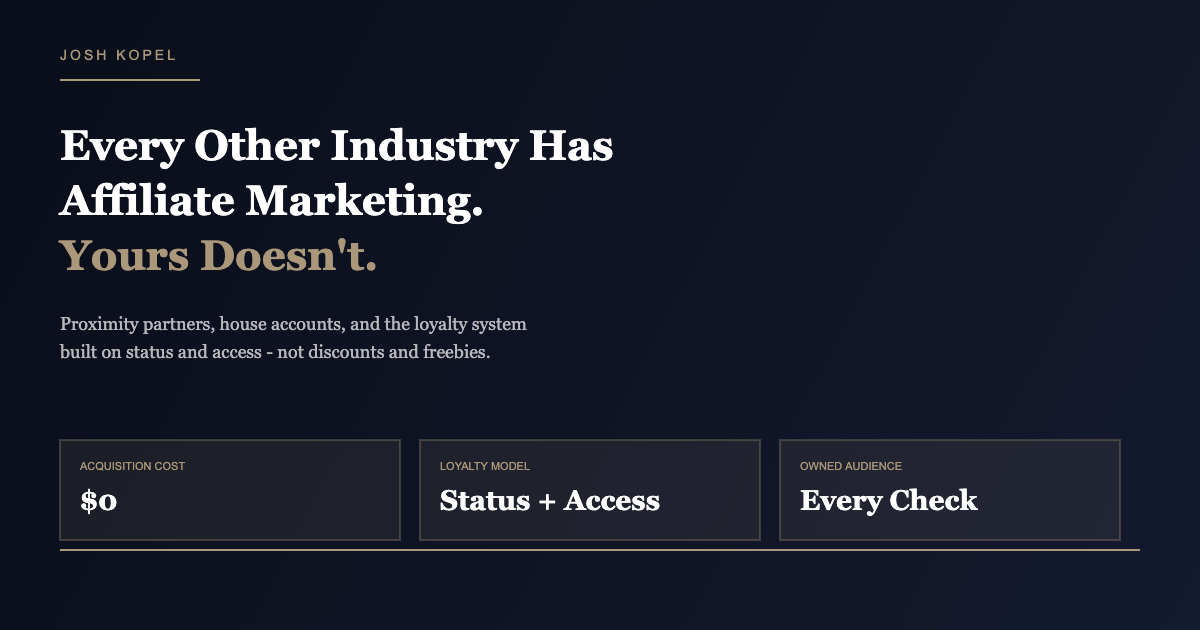
In every other industry, there are people that drive traffic to other people’s businesses. In the restaurant industry, we look at community influencers and think digital – the children with sunglasses at night taking pictures of the food you’re not charging them for. The problem is you never own that audience. I think you focus on proximity instead. Hotel concierge. Apartment building managers. Office managers. My pitch wasn’t transactional. It was “come in, have dinner on me, no strings attached.” Then Sandy tells me how to engage her residents better than I ever could. Plus the house account loyalty system built on status and access – not discounts and freebies – that turns seated customers into your owned audience.
In every other industry, there are people whose entire job is driving traffic to other people’s businesses. Real estate agents refer mortgage brokers. Financial advisors refer estate attorneys. Hotels refer tour companies. It’s called affiliate marketing, and it’s the backbone of how most industries grow.
In the restaurant industry, we look at community influencers and we think digital. We think about the children with sunglasses at night taking pictures of the food you’re not charging them for. The problem with that is you never own that audience. It’s great for attention, but then the audience goes away with the influencer.
So how do you own the audience? I think you focus on proximity.
Proximity Over Influencers: The One-to-One Approach
When I was in downtown Los Angeles, the relationships I owned were one-to-one in nature. I was always working directly with people who would come across other people who would love what I do for a living. Hotel concierge. Apartment building managers. Office managers.
And my pitch was not what you’d think. A lazy person’s pitch is, “Hey Sandy, hey Denise. Love what you’re doing. Why don’t we collaborate on something? I want to offer discounts to everyone in your building. I want to offer gift cards to everyone in your office or your apartment building.”
I don’t think that resonates, because it’s very much transactional in nature. It’s not a meaningful relationship. It’s a deal.
So here’s what I do instead. “Hey Sandy, it’s Josh. I’m at Preux & Proper right down the street from you. And I think you’d really like what we do for a living. So why don’t you come in, bring a friend, a colleague, a spouse, come in, have dinner on me. I’ll cover everything. I promise I won’t linger at the table for more than a few minutes. I just want to get to know you, because I would love for us to be able to do really cool stuff together.”
Sandy comes in. Has an amazing time. They leave. No strings attached.
Then a week later, I follow up. “Yo Sandy, what did you think?” Sandy says, “Oh my God, it was amazing.”
And then I say, “Well, you know the people in your apartment building way better than me. What’s worked in the past? How can we engage them? How can we delight them in a really authentic way based on what you know about your people?”
Now it’s not my thing, for my business. It’s Sandy’s thing with me that we’re doing for the people she serves. And in doing so, it is far more resonant because Sandy is making an educated guess with far more context than I could ever have.
Why Things That Don’t Scale Are the Things That Win
There’s this great quote from Paul Allen: when you’re building a business, the trick is to do things that don’t scale.
Building one-to-one relationships over time doesn’t scale. I can’t do it across hundreds of markets. But what I do own is the outcome in every market where I’m able to do it. I also refine the process, and I’m able to teach other people how to do it.
Think about what this looks like compounded over time. You build a relationship with the concierge at the hotel down the street. They start recommending you to every guest who asks for a dinner spot. That’s not five covers a month. Over a year, that could be hundreds of covers from a single relationship you built over one dinner.
You build a relationship with the manager of the apartment building around the corner. They include you in their resident newsletter. They mention you during move-in orientation. They bring their corporate team in for a holiday party. One relationship, multiple revenue streams.
Community advocacy is everything in a digital world where everyone is held at arm’s length. You have to get close to people. The influencer posts and moves on. The apartment manager lives there. The concierge works there five days a week. Proximity creates permanence.
The Loyalty Problem That Isn’t a Loyalty Problem
How often do you think about your favorite restaurant? Never. You never think about your favorite restaurant. And that insight changes everything about how you should think about customer frequency.
People don’t have a loyalty problem. They have a memory problem. And what you’re there to do is remind them of how you fit into their lives. Remind them of the one thing you do that nobody else does. Remind them of what you’re best in the world at.
Because if everyone who came into your restaurant once a month came in twice a month, you’d be rich. You’d be Scrooge McDucking it. You wouldn’t be worrying about slow nights. You wouldn’t be worrying about anything.
So how do you solve a memory problem? Not with discounts. Not with freebies. With status and access.
Credit Card Companies Perfected the Model. Now Steal It.
Who do I think has perfected the loyalty model outside our industry? Credit card companies.
Think about it. All credit card companies do the same thing for a living. They loan you money at high interest. All restaurants do the same thing. They sell you food and beverage at a rate that is more expensive than you could make it at home. Both are commodities.
But you are an Amex person or you are a Chase person, and it says something about who you are as a result. No one has done a better job of creating clear differentiation in a commodity business than credit card companies.
And how do they do it? Do they do it through points and point redemption? Absolutely not. They do not do it through transaction. They do it through two things: status and access to the inaccessible.
People don’t want everything. They just want the stuff that no one else can get. And we are the kings and queens of that. We can offer all of it.
Can you not offer priority reservations on Valentine’s Day? On Mother’s Day? Can you not have a secret menu that’s only available to loyalty members? For those of you flipping your menu seasonally, why wouldn’t you do a preview two hours on a Thursday, from five to seven, with a little tray pass, a couple of mini cocktails, so your best customers see the new menu a week before it releases? They’re talking about it on social media. They’re telling their friends. “Oh my God, did you go to this restaurant? Did you know they’re releasing this? We were able to go in early.”
This is what people want. And based on our margins, we can offer incredible perceived value for a very low associated cost.
The House Account: How to Build Your Owned Audience From Every Check
The problem with most loyalty programs is that your team won’t ask people for their personal information, because they don’t have anything of value to offer. “Sign up for our mailing list, I’ll give you a free piece of pie.” That doesn’t make anyone feel seen or special. Candidly, people feel like a tramp trading their personal information for a single dessert.
Here’s what works instead. When you drop the check, you say: “Hey Jason, did you want the money you spent today to go towards your points on your house account?”
Jason says, “What’s a house account? I don’t have a house account.”
You explain: “We’ve got this loyalty program. It gets you access to all of these off-menu items and all of these off-calendar events that we throw for our best customers. We can’t do it for everybody, so we just do it for the best customers. If it’s something you’re interested in, all I need is your phone number and I can sign you up today.”
When you get their phone number, an hour later a text goes out: “We’d love to give you something special on your birthday. Click here to complete your profile – first name, last name, email address, and birthday. Without those things, we can’t send you this gift on your birthday.”
It works. And it works for a very good reason. Number one, you got them in with status and access. Number two, you anchored the benefit to the one thing everybody has – a birthday. What you’ve done is set the expectation that you’re going to be reaching out, and every time you do, you’ll be surprising and delighting them with things no one else can get.
This works incredibly well in bar models too. When somebody sits down and opens a tab: “Are you on the VIP list? Do you have a house account? Because all of these dollars can go towards your points.” It crushes.
Zero Acquisition Cost. High Perceived Value. Market to Them Forever.
Think about what you’ve just built. The affiliate relationships – concierge, apartment managers, office managers – drive new customers through your door at zero acquisition cost. The house account converts those customers into your owned audience at the point of sale. And now you can market to them forever through email, text, and the pre-loaded year of events and LTOs.
You’ve created a flywheel. Proximity partners drive new faces in. The dining experience converts them. The house account captures them. Your marketing calendar brings them back. And every time they come back, they spend more because they feel like insiders. They feel seen. They feel special.
That’s the entire model. Not discounts. Not freebies. Not influencers who move on to the next restaurant next week. Real relationships with real people who live and work in your community, feeding into a loyalty system built on status and access.
And none of it costs a dime. It costs intention.
Your 7-Day Affiliate and Loyalty Action Plan
Day 1: Identify your proximity partners. Who are the hotel concierge, apartment building managers, and office managers within walking distance of your restaurant? Make a list of at least 10. These are people who interact with your potential customers every single day.
Day 2: Invite one in for dinner. Pick the highest-potential proximity partner on your list. Reach out personally. “Come in, bring a guest, dinner’s on me. No strings attached. I just want to get to know you.” Don’t pitch. Don’t ask for anything. Just build the relationship.
Day 3: Follow up and listen. After they’ve been in, follow up within a week. Ask what they thought. Then ask the magic question: “You know your people way better than I do. What’s worked in the past? How can we delight them?” Let them tell you what to do. Their idea will work better than yours.
Day 4: Design your house account. What off-menu items or off-calendar experiences can you offer that cost you very little but feel exclusive? Secret menu items. Early access to seasonal menus. Priority reservations on holidays. Write down at least five things that create status and access.
Day 5: Train the house account script. Train your team to ask one question when they drop every check: “Did you want the money you spent today to go towards your house account?” Practice it. Role play it. Make it natural. This is the single easiest way to build your mailing list.
Day 6: Set up the birthday text. Create the automated text that goes out one hour after sign-up: “We’d love to give you something special on your birthday. Click here to complete your profile.” Anchor the benefit to the one thing everyone has.
Day 7: Invite three more proximity partners. You built one relationship on Day 2. Now build three more. This is a compounding strategy – every relationship you build this week will drive traffic for years. Things that don’t scale are the things that win. Money likes speed. Start today.
Free Live Training
Want Me to Walk You Through These Systems Live?
Join the free 5-Day Restaurant Marketing Masterclass. In 40 minutes a day, I’ll show you how to build a marketing system that actually makes you money.
JOIN THE FREE MASTERCLASS★★★★★ Rated 5/5 by 1,000+ restaurant owners
Related reading: restaurant marketing solutions that actually work, the retention side in the frameworks that grow a base of regulars, and the data in The State of Restaurant Marketing 2026.
Frequently Asked Questions
What is affiliate marketing for restaurants and how is it different from influencer marketing?
Affiliate marketing for restaurants means building one-to-one relationships with people who naturally encounter your potential customers – hotel concierge, apartment building managers, office managers. Unlike influencer marketing where you never own the audience, proximity-based affiliate relationships give you ongoing access to a captive community. The influencer posts and moves on. The apartment manager lives there and recommends you every day.
How do you approach a proximity partner without being transactional?
Don’t lead with a deal or a collaboration pitch. Invite them in for dinner on you with no strings attached. After they have a great experience, ask them one question: “You know your people better than I do. What’s worked in the past? How can we delight them?” Now it’s their idea, built with their context, for the people they serve. That’s far more resonant than offering discounts to an apartment building.
Why do restaurant loyalty programs based on discounts fail?
Because people don’t want discounts and freebies. They want to feel seen and special. They want to be part of something exclusive. Credit card companies perfected this – they differentiate through status and access to the inaccessible, not through points and redemption. Your loyalty program should offer priority reservations, secret menu items, and early access to new menus, not free pie in exchange for an email address.
What is the house account system and how does it build a restaurant mailing list?
When dropping the check, ask: “Did you want the money you spent today to go towards your house account?” When they ask what that is, explain it’s a loyalty program with access to off-menu items and exclusive events for your best customers. All you need is a phone number. An hour later, a text asks them to complete their profile for a birthday gift. You’ve converted a seated customer into a list member through status and access, not a transaction.
Why should restaurants focus on things that don’t scale?
Paul Allen said the trick to building a business is to do things that don’t scale. Building one-to-one relationships with proximity partners – concierge, apartment managers, office managers – doesn’t scale across hundreds of markets. But you own the outcome in every market where you do it. One dinner with a hotel concierge can generate hundreds of covers over a year. Community advocacy creates permanence that digital influencer marketing never will.