
Expert Summary
What industry most closely parallels the restaurant business? It’s not retail. It’s not theater. It’s the airline industry. Delta sells seats on a plane. Your restaurant works the same way. Before you can optimize anything, you need to answer one question: are you in the manufacturing business or the experience business? A deli with servers is solving the wrong problem. At South City, during peak lunch, speed IS the hospitality. At Preux & Proper, every second was choreographed for a $125 experience. Most restaurants are confused about which one they are, and that confusion is killing their profitability.
What industry most closely parallels the restaurant business? It’s not retail. It’s not theater. It’s the airline industry.
What does Delta sell? Not hospitality. Not travel. Not convenience. Delta sells seats on a plane. And they’ve become best in the world at getting you on and off that plane as efficiently as possible.
Your restaurant works the same way. How much more money would you make off one more bar stool? One more table? Not on a Tuesday when you’re half full – but when you’re busier than you can handle and it’s 7:30 on a Saturday night. That’s your highest-margin inventory, and you’re almost certainly not maximizing it.
We think of inventory as food and beverage. We need to think about tables and chairs. You do not sell food and beverage. You sell a seat at a table for a defined period of time.
Once you internalize that truth, every strategic decision in your business becomes clearer. Your menu, your pricing, your service model, your staffing – all of it flows from understanding what you’re actually selling.
The Question That Changes Your Entire Strategy
Before you can optimize anything in your restaurant, you need to answer one question: what business are you actually in?
There are fundamentally two types of restaurant businesses. You’re either in the manufacturing business or the experience business. Most restaurants are confused about which one they are. And that confusion is the root cause of most of their problems.
There’s a deli down the street from me that I talk about all the time. They have servers that take care of every table – and I put “take care of” in air quotes because they do a terrible job. They have servers because they think they’re in the experience business. But I don’t go to that deli for the experience. I go for the Reuben. That’s why I go.
If they wanted to offer me an exceptional experience based on why I actually use them, they would put a tablet on the table. They would let me order on my phone. I shouldn’t have to wait because they’re deeply understaffed, because nobody wants to work there, because they can’t make enough money – because they think they’re in the experience business when they’re actually in the manufacturing business.
Most fast casual and quick service concepts are manufacturing businesses pretending to be experience businesses, and it’s killing their throughput.
Manufacturing Business: When Speed IS the Hospitality
At my fast casual fried chicken concept, South City, we had what LA Weekly rated the best fried chicken sandwich in the city. But when it took 20 minutes to get it into someone’s hands, the best sandwich in the world tasted like garbage.
Why? Because it ruined their lunch hour. They had 60 minutes. It took 15 minutes to get there and 15 to get back. That left 30 minutes – and 20 of those were spent waiting. By the time they got the sandwich, they were frustrated, rushed, and couldn’t enjoy it.
So during our peak lunch window – 11:30 to 1:30 – we pushed everyone to kiosks. Not because we didn’t value hospitality. Because during that manufacturing window, speed IS the hospitality. Any other time, you could order from a person. But during peak, the kiosk made you faster, which made your lunch better.
That’s a manufacturing business operating with manufacturing logic. The product is the draw. The speed is the service. Every second of delay is a hidden expense that degrades the customer experience.
If you’re in the manufacturing business, here’s what matters: throughput. How many people can you serve per hour? How quickly can you get the product into their hands? How do you eliminate every friction point between the customer wanting to order and the customer eating?
Your menu should be simple. Your ordering process should be frictionless. Your kitchen should be optimized for speed. Every element of your operation should be designed to move people through as efficiently as possible – not because you don’t care about them, but because speed is what they came for.
Experience Business: Choreographing Every Second
I took my wife to Katana in Los Angeles for one of our wedding anniversaries. It’s a sushi concept on Sunset Boulevard that’s been around forever. We had an absolutely amazing experience. Here’s what it looked like.
We walk in. They say, “Happy anniversary.” They seat us. They ask if we want the wine list. We said water is fine. Flat, sparkling, or tap? Tap. Salt of the earth people. The server walks up, walks us through the menu, tells us the chef would prefer they take the entire order at once and then course it out. So we do.
They coursed it out perfectly. At the conclusion, they pre-bussed the table. Offered dessert. We passed. They asked if we wanted refills on water. We said no. So they removed the empty water glasses. Brought the check. I paid. They removed the check. And eventually we got up.
The reason we got up was that it was just me and my wife sitting at an empty table with a candle on it. The entire experience took 45 minutes.
It wasn’t rushed. It was perfect. Every course arrived at the right moment. The table was cleared naturally. The check appeared seamlessly. When we were sitting at an empty table with just a candle, we knew it was time to go. And they knew that.
That’s an experience business operating with experience logic. The product matters, but it’s the choreography that creates the value. Every second is intentional. The pace is controlled. The customer feels taken care of without feeling managed.
The Danger of Mixing Business Models
The biggest strategic mistake I see in restaurants is operating one business model while thinking you’re in the other.
When the deli puts servers on the floor, they’re adding the overhead and complexity of an experience business to a manufacturing operation. Now they need more staff. They need a higher price point to cover that staff. But their customers came for a Reuben, not an experience. So the higher prices feel unjustified, the service is mediocre because they can’t afford great servers at that margin, and everyone loses.
The reverse is equally dangerous. When an experience restaurant tries to maximize throughput like a manufacturing business – rushing tables, cutting corners on service, compressing the dining experience – they destroy the very thing that justifies their pricing. The customer came for the experience. If you take that away, all they see is an overpriced meal.
At Preux & Proper, with a per-customer average of about $125, the experience had to justify that number. Everything from the greeting to the coursing to the closing sequence was choreographed. We weren’t trying to turn tables fast. We were trying to make every minute so valuable that $125 felt like a steal.
But at South City during lunch, trying to create a “dining experience” would have been insane. People had 30 minutes to eat. They wanted the best fried chicken sandwich in LA, and they wanted it now. The manufacturing model – kiosks, speed, efficiency – was the right answer for that customer at that time.
Your Business Model Can Change by Daypart
Here’s a sophistication most restaurants miss. You don’t have to be one thing all day. Your business model can shift based on the daypart and the customer’s intent.
At South City, during the peak lunch window from 11:30 to 1:30, we were a manufacturing business. Kiosks. Speed. Throughput. Every second counted because people were on the clock.
Outside of that window, you could order from a person. The pace was more relaxed. The intent was different – people weren’t racing against a lunch hour. They were enjoying a meal.
At my Hollywood bar, we pulled the stools away from the bar at 9 PM on weekends. During the week, they lived there permanently. But on a Saturday night, seated bar guests made it harder for standing customers to order. Standing customers with cash in hand were higher-velocity revenue. The stools were literally slowing down our highest-margin hours.
Same business. Different model for different times. The bar was an experience business on a Wednesday evening and a manufacturing business on a Saturday night. And we optimized accordingly.
Product Market Fit: Do They Know and Not Care, or Do They Not Know?
When it comes to awareness, you’re trying to solve for one of two things. Do you have a product market fit issue, or is it actually an awareness issue? Does everybody know but nobody cares? Or does nobody know, but if they knew, they would care?
Chef Brad Wise’s Rare Society started as a boilermaker bar that lost money consistently for two years. Then he figured out he had a product market fit issue. The concept didn’t match what the market wanted. Once that was solved, it became about awareness. There are now Rare Society locations up and down the West Coast – all built off the back of what was originally a failed concept.
If your business model doesn’t match what the market wants, no amount of marketing will fix it. Marketing amplifies what already works. It doesn’t fix what’s broken. Before you spend a dollar on awareness, make sure you’re selling the right thing to the right people in the right way.
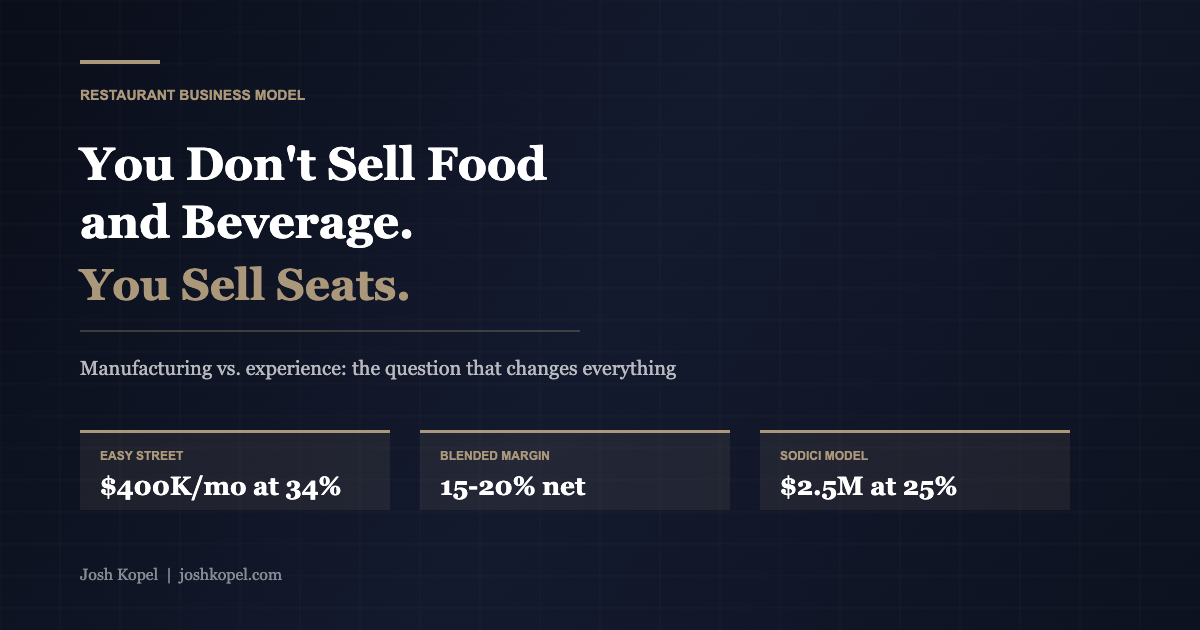
Easy Street in Studio City, California started in a parking lot with a tent. A single-unit burger joint owned and operated by two people without a huge management team. They generate $400,000 a month at a 34% margin from that single unit. Why? Because the product market fit is perfect. The business model is clear. And the execution is focused.
The Blended Model: How Three Revenue Streams Create 20% Margins
One of the things I talk about with every client is hitting a 15 to 20% net margin. And people always ask, “How do you do it if we never talk about cost controls?”
The answer is a blended average. You work at 10 to 12% in-house, but then you supplement that with 30% margins on events, catering, and gift cards. That blended average puts you right at 20%.
Think about what you don’t carry with catering and events compared to in-house dining. You’re not paying for the full theater of a restaurant experience during those transactions. The margin structure is fundamentally different. And when you stack that on top of your existing infrastructure – same kitchen, same staff, same fixed overhead – the incremental cost is minimal.
My restaurants existed only to promote my catering and events business. Because that’s where the money was. That’s where the volume was. That’s where the margin was. The dining room was the marketing engine. The events and catering were the profit engine.
Sodici Pizza in Brownsville, Texas started as a single restaurant doing $1.4 million a year open four days a week. When we maximized the in-house profitability, there wasn’t another dollar to get. So Dante launched a catering operation. Today he sits on a $2.5 million operation pushing 25% net profit – a single-unit restaurant plus a catering arm.
That’s a business model that’s been intentionally designed. In-house dining runs the brand. Events and catering run the profit. Both are necessary. Neither works alone.
Your 7-Day Business Model Clarity Plan
Day 1: Answer the question. Are you in the manufacturing business or the experience business? If people come to you for speed and convenience, you’re manufacturing. If they come for the ambiance, service, and occasion, you’re experience. Be honest about which one you actually are, not which one you wish you were.
Day 2: Audit your operations against your model. If you’re manufacturing, are you optimized for speed? If you’re experience, are you choreographing every moment? Write down every place your operations fight your actual business model.
Day 3: Evaluate by daypart. Does your lunch customer want the same thing as your dinner customer? Should your service model, your menu, or your pricing change between dayparts? Most restaurants run one model all day when they should be running two.
Day 4: Check your product market fit. Does everybody know about you but nobody cares? Or does nobody know? If the former, you have a product market fit issue that marketing can’t fix. If the latter, you have an awareness issue that’s relatively easy to solve.
Day 5: Calculate your blended margin. What percentage of your revenue comes from in-house dining vs events, catering, and gift cards? If in-house is running at 10 to 12%, what does your total margin look like when B2B revenue at 30% represents 20% of total revenue? 30%? That number changes everything.
Day 6: Identify what your restaurant is best in the world at. Not what you do. What you do better than anyone else. That’s your category of one. Every strategic decision should reinforce that position. Everything else is a distraction.
Day 7: Align everything. Menu, pricing, service model, staffing, marketing – all of it should flow from your business model. If anything is fighting your model, fix it this week. Clarity creates speed, and money likes speed. Start today.
Free Live Training
Want Me to Walk You Through These Systems Live?
Join the free 5-Day Restaurant Marketing Masterclass. In 40 minutes a day, I’ll show you how to build a marketing system that actually makes you money.
JOIN THE FREE MASTERCLASS★★★★★ Rated 5/5 by 1,000+ restaurant owners
Frequently Asked Questions
How do I know if my restaurant is a manufacturing or experience business?
Ask why your customers come to you. If they come for speed, convenience, and a specific product, you’re in the manufacturing business and should optimize for throughput. If they come for the ambiance, service, and occasion, you’re in the experience business and should choreograph every second. Most fast casual and quick service concepts are manufacturing businesses pretending to be experience businesses, and it’s killing their throughput.
Can my restaurant be both manufacturing and experience at different times?
Absolutely. At South City, during peak lunch from 11:30 to 1:30, we pushed everyone to kiosks because speed was the hospitality. Outside that window, you could order from a person. At a Hollywood bar, bar stools came out at 9 PM on weekends because standing customers were higher-velocity revenue. Your business model can and should shift based on the daypart and the customer’s intent.
What’s the difference between a product market fit issue and an awareness issue?
A product market fit issue means everybody knows about you but nobody cares. An awareness issue means nobody knows, but if they knew, they would care. Rare Society lost money for two years as a boilermaker bar before figuring out the concept didn’t match the market. Once the product market fit was fixed, awareness solved everything. Marketing amplifies what works. It doesn’t fix what’s broken.
How do restaurants achieve 15 to 20% net margins?
Through a blended average. In-house dining typically runs at 10 to 12% margins. Events and catering run at 30%. Gift cards carry even higher margins due to breakage. When you blend these revenue streams, your overall margin rises to 15 to 20% without cutting a single cost. The dining room is your marketing engine. Events and catering are your profit engine.
What does it mean to sell seats instead of food?
The airline industry is the closest parallel to the restaurant business. Delta sells seats on a plane and optimizes getting you on and off as efficiently as possible. Your restaurant sells seats at tables for defined periods of time. Food and beverage are the mechanism, but seats are the actual inventory. Understanding this changes how you think about pricing, flow, and capacity utilization.