
Expert Summary
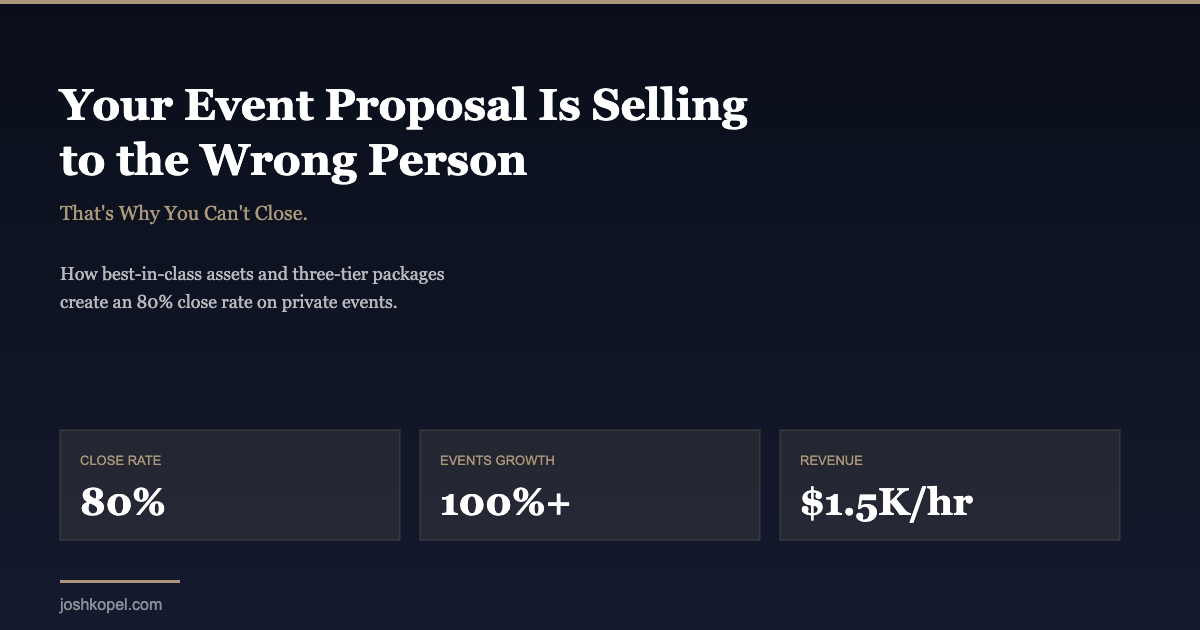
Here’s what I figured out about selling events. You’re pitching to the wrong person. John books an event for his office. You meet John. You send John some menus. But John isn’t the one who approves the expense – his boss is. And you never meet his boss. So John goes back and says, “Josh doesn’t seem like an idiot. It’ll probably be okay.” That’s why your close rate is terrible. The solution is best-in-class assets that sell for you when you’re not in the room. At Preux & Proper, my close rate was about 80% – and it wasn’t because I was a better salesman. It was because my proposal did the selling. Here’s how to build one that closes.
Let me tell you about the biggest paradigm shift in my events business. It took me years to figure this out, and when I did, it changed everything.
I think you’re selling to the wrong person.
Here’s what it looks like. John’s booking an event for his office. So you talk. You send him some menus. He comes in, you chit chat for a little bit. He walks the site. But John’s not the one that’s going to approve it. His boss is going to approve it. And you never meet his boss.
So John goes back to his boss, and he goes, “I met with Josh. These are the menus. This is what we can order. Josh doesn’t seem like an idiot. It’ll probably be okay.” How does that sound?
The reason you’re failing at conversion is that the person you think you’re selling to, you’re not. The person who walks your space and hears your pitch is rarely the person who signs the check. And if that’s the case, how do you help the person who’s selling sell for you?
You give them better assets.
Your ability to close is limited by your ability to give them what they need to properly create the vision in the mind of someone who has never spoken to you and never walked within the four walls of your restaurant. That’s the game. And best-in-class assets are how you win it.
What Best-in-Class Assets Actually Look Like
I used the same event proposal to sell millions and millions of dollars worth of events at Preux & Proper. Let me walk you through what made it work, because every single page was intentional.
Page one. What do you see? You see effort. You don’t see a finished drink – you see someone making a drink. You see artisans at work. There is a singular call to action. The entire first impression is rooted in craft and care, because the first thing a prospect has to decide is whether they want to do business with you or not. So I dedicated an entire page to that decision.
The first section is rooted in what we do as an organization – the positioning around the business itself. The second is our perspective on catering and events, the effort that goes into it, why we think we’re best in the world at what we do. Will the person you’re going to tour read all of this? Probably not. But the person that has never been in – the one that’s going to approve the expense – absolutely will.
By page two, I need to have convinced them they should do business with me. And then the next question they would ask is, “Okay, where are we going to have it?”
Create the Vision They Can’t See on Their Own
Here’s where most restaurants lose the deal. You provide section-by-section options for where to host the event. But here’s the question – is this how your dining room is normally set up? Of course not. So why do you set it up differently for the photos in your proposal?
Because they’ll never see the vision on their own.
The reason you’re a business owner, the reason you sit on top of the mountain, is because you were able to envision a world that did not otherwise exist. But most of the people you’re selling to are just trying to not get fired. They can’t envision what their event will look like in your space because they’ve never done it before.
So you show them. You chop your room into sections. At Preux & Proper, we had the North semi-private dining hall and the South semi-private dining hall. Internally, we called those the left and right side of the room. We carved the space into sections so that I could take care of a party of 25 to 250 in the same space without disrupting day-to-day operations.
Everybody’s trying to get a full buyout. I’ll take a full buyout, but I’m not a cheap date. I like partial buyouts – because I can sell out half the room for a 50-top on a Saturday night and still run a busy dinner service on the other side.
Tiny Food and the Art of Priming
When you look at the group menus in my proposal, what do you see? Individual bites. Tiny food. Fancy tiny food.
Why would I show tiny food? Because I’m always selling an experience. I’m always trying to sell an expectation. The prospect is already thinking buffet. They’re already thinking plated. So why don’t I try to pitch them on tray pass as we go through this process? I’m priming them from the very first page.
And I don’t call it tray pass. I call it Butler style tray pass hors d’oeuvres. Why? Because every word matters. Have you ever been to an event where the hors d’oeuvres technically qualify as tray pass, but they just drop the trays on a bar top? That’s not what we’re building here. All of my language is evocative because people are paying for a level of service. Butler style. That word alone changes the perception of what you’re getting.
The Illusion of Choice: Three-Tier Package Strategy
One of the things I figured out early on is that people don’t want choice. They want the illusion of choice. They want to be told what to do, but they still need some level of autonomy.
How many of you go back and forth for 38 emails on whether they’re going to do the brussels sprouts or the asparagus? Before it’s even sold. Before you even have a deposit. I got tired of that because it was a waste of time.
So I don’t sell individual food items. I sell experiences. And it starts with packages. We create a broad offering rooted in our existing menu, but all we’re talking about with the client is the three options at the top. For a family-style dinner at Preux & Proper, you had three choices. The three options were priced so that the greatest value was in the middle tier. Why? Because that’s the thing I want you to buy.
There’s been $50 and $60 – that’s nothing. There’s been $60 and $75 – that’s a little scary. But I want you at $66, and then I’m going to sell you a bunch of other things too. The second option is always the one that makes the most sense. That’s intentional.
“All Dishes Replenished as Needed” – The Line That Closes Deals
Here’s the single most important line in my entire event proposal. Can you guess the number one concern of somebody booking an event? Running out of food.
One hundred percent of event bookers agree on this. It’s the one problem that keeps them up at night. So do you even have a conversation about it? I don’t. I eliminate it out the gate.
Every package in my proposal says: all dishes replenished as needed.
Here’s what I hate about most event and catering menus. They sell shrimp by the piece. How many shrimp do I need? Would I rather get just enough shrimp? That’s less fun. But what if the boss goes to grab the last shrimp and there are no shrimp? We should not set the expectation that we don’t understand how to run an event.
And the great news? You can say “all dishes replenished as needed” because if you’ve ever hosted a corporate event, they don’t eat. They don’t eat and they don’t drink. Nobody is going to a corporate event to get plowed and stuff themselves. They’re going so they don’t get fired. So you can feign generosity because you already know how the consumption plays out.
The Beverage Package Upgrade: Where Your Real Margin Lives
Let me walk you through the beverage strategy, because this is where I wheel and deal. This is where my margin is.
Beer and wine package: $20 per person per hour. Call bar: $30. Premium: $35. Select: $45. And I don’t even offer a no-beverage option on the menu. I’m not trying to sell that.
Why is it so expensive? Because I know nobody’s going to drink. Of the years that we did this and millions of dollars in events we sold, we never sold a beer and wine package once. Not once. And the reason is simple – if people selected the beer and wine package, we immediately upgraded them to the call bar package.
Why? Because what I’m able to do is increase perceived value while simultaneously improving my margin. Nobody wants to buy a $5,000 thing for $5,000. What they want to buy is a $6,000 thing for $5,000.
So when I upgrade the package, I invoice them at full freight, and then I discount it back. Now the person setting up the event has a win they can take credit for. “We were able to convince them to upgrade us from beer and wine to the call bar package, which ultimately makes this thing worth thousands more than they’re actually charging us for it.”
That is a holistic win for every stakeholder involved – for me as the restaurant, for the client, and for the person planning the event.
Dessert Is Not an Add-On. It’s a Separate Experience.
One detail most people miss. In my proposal, coffee, tea, and dessert service are grouped together as a separate experience. It’s not part of dinner. I’m going to make you pay for it.
What if someone comes to me and says, “We don’t really need dessert. We just want coffee and tea”? You can have it. It’s only $14.50 a person. But it’s actually a better deal to get dessert, coffee, and tea together, because it’s only 50 cents more.
I do not split these things up, and the reason is I’m advocating for myself and I’m advocating for the guests. This is a better experience for them, and I need to celebrate experience, because there are 150 people coming to this event, and 149 of them have probably never been to my restaurant. This is my chance to convert them.
What It Looks Like in the Mind of the Buyer
When the proposal works, this is the thought process in the buyer’s mind. “Ooh, this looks fancy. I like what they’re doing here. I’m probably going to do business with them. This is where we’re going to sit. This is what we’re going to eat. This is the menu we chose. We don’t have to worry about running out of food. We’ll do an hour of tray pass. They threw in an hour of bubbles. We’re getting coffee, tea, and dessert service that creates a layered, amazing experience. And they upgraded us from the call bar to premium for less than we expected.”
If you guessed that my close rate was through the roof, you’d be right. On average, I closed about 80% of everything I pitched.
Think about your close rate right now. If we got you up to 80%, what does that do to your business?
Keep reading: the wider playbook on restaurant marketing, and how events fit into restaurant profitability.
Marketing Is Best-in-Class Assets
Here’s what all of this comes down to. Marketing, when it comes to events and catering, is about best-in-class assets that create the illusion of choice while mitigating decision fatigue, while painting a picture of the benefit that the buyer wants.
I’m not selling cogs. I’m not selling features. I’m selling benefits. When you drive by a gym, you don’t see banners outside that say “18 treadmills, 32 stationary bikes.” They say “rock hard abs” and “the life you’ve always wanted.” We sell the benefit, not the feature.
And these results are not flukes. The Dundee Dell in Omaha, Nebraska – literally the oldest bar in Omaha – saw private events skyrocket by over 100% compared to the previous two years after implementing these asset strategies. Marquise Steakhouse in Milton, Ontario increased the average price of their private events by 50% and doubled their event bookings.
I had a chef-owner in a small metro who spent six hours doing outbound with best-in-class assets and generated $9,000 in event sales. He thought it didn’t work. I did the math for him – he generated $1,500 per hour for the six hours he worked on it. What else could he possibly do that generates $1,500 an hour? Now imagine if he 10x’d that effort.
Your 7-Day Event Proposal Action Plan
Day 1: Audit your current proposal. Pull up whatever you’re sending to event inquiries right now. Does it answer the first question – should they do business with you? If the first thing a prospect sees is a menu and prices, you’ve already lost. Lead with who you are and why you’re best in the world at this.
Day 2: Shoot your space for events. Set up your room the way it would look for a 50-person event. Not how it looks on a Tuesday night. Take professional photos of the space configured for private events. Show them the vision they can’t see on their own.
Day 3: Build three-tier packages. Stop selling individual food items. Create three package tiers where the middle tier is the clear winner in perceived value. Price so the greatest value sits in the middle. Stop going back and forth over brussels sprouts.
Day 4: Add “all dishes replenished as needed.” Eliminate the number one fear before it comes up. You can afford to make this promise because corporate guests don’t eat and drink the way you think they will. Feign generosity with confidence.
Day 5: Restructure your beverage packages. Price them so the upgrade makes obvious sense. Invoice at full freight and discount back. Give the event planner a win they can take credit for. This is where your margin lives.
Day 6: Bundle dessert, coffee, and tea. Make it a separate experience, not an afterthought. Price the coffee-only option so close to the full bundle that dessert becomes a no-brainer. Every guest at that event is a potential future customer – give them the full experience.
Day 7: Test the proposal. Send your new proposal to one prospect. Track what happens. If you’re doing it right, the proposal does the selling for you – even when you’re not in the room. That’s the whole point. Money likes speed. Start today.
Free Live Training
Want Me to Walk You Through These Systems Live?
Join the free 5-Day Restaurant Marketing Masterclass. In 40 minutes a day, I’ll show you how to build a marketing system that actually makes you money.
JOIN THE FREE MASTERCLASS★★★★★ Rated 5/5 by 1,000+ restaurant owners
Frequently Asked Questions
Why does the event proposal matter more than the sales pitch?
Because you’re selling to the wrong person. The person you pitch isn’t usually the person who approves the expense. John meets with you and walks the space, but his boss approves the budget. Your proposal has to create the vision in the mind of someone who has never spoken to you and never been in your restaurant. Best-in-class assets sell for you when you’re not in the room.
How do three-tier event packages improve close rates?
Three-tier packages eliminate decision fatigue by giving buyers the illusion of choice without overwhelming them. People don’t want unlimited options – they want to be told what to do with some level of autonomy. Price the tiers so the middle option has the greatest perceived value. That’s the one you want them to buy. It ends the 38-email back-and-forth over side dishes and lets buyers make one simple decision.
What does “all dishes replenished as needed” actually mean for food costs?
It means less than you think. Corporate event guests don’t eat and drink the way regular diners do. Nobody goes to a work event to get stuffed and hammered – they go so they don’t get fired. You can promise replenishment because consumption at corporate events is predictable and moderate. The line eliminates the number one buyer fear – running out of food – at minimal actual cost to you.
How does the beverage package upgrade strategy work?
Price your beer and wine package at a level that makes the next tier up an obvious value upgrade. When someone selects beer and wine, immediately upgrade them to the call bar package. Invoice at full freight for the higher package, then discount it back to the original price. The buyer feels like they got a deal, you improve your margin because nobody drinks anyway, and the event planner gets a win they can take credit for with their boss.
What close rate should I expect with best-in-class event assets?
At Preux & Proper, the close rate averaged about 80% using this exact proposal system. That’s not because I was a better salesman – it’s because the assets did the selling. The proposal created the illusion of choice, mitigated decision fatigue, eliminated the biggest buyer fear, and painted a picture of the benefit. When you pair great assets with an outbound strategy and speed of response, event sales become predictable and scalable.