
Expert Summary
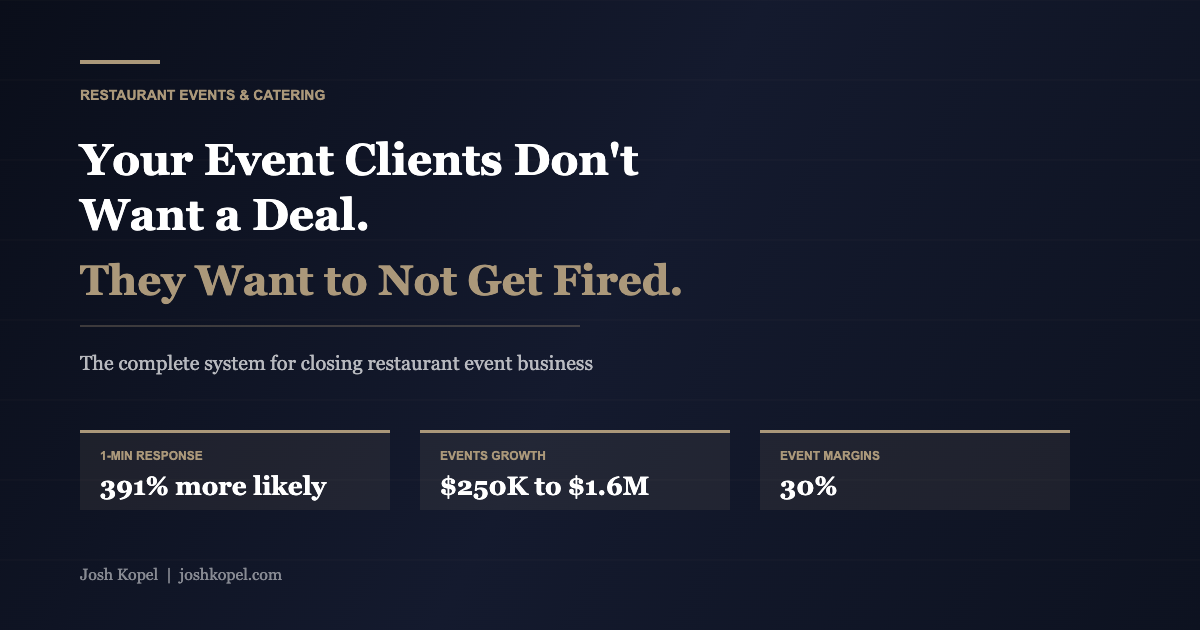
The people who professionally book catering and events are very nervous people. They’re not looking for you to give them a deal. More than anything, they’re looking to not get fired. Their performance review is going to be influenced by how the event goes – and that outcome depends on someone who is not them. What you’re selling isn’t food and beverage. It’s confidence. If you reply to an inquiry within one minute, you are 391% more likely to close that client. Here’s the complete system for closing event business – from understanding the buyer to stopping their prospecting process to the hand-raising email that turns your B2C list into B2B gold.
To sell anything effectively, you need to understand the people you’re selling to. And the people who professionally book catering and events are very nervous people.
Think about it. Imagine you’re setting up a holiday party for everybody at your company, and your overall performance review is going to be influenced by how it goes. The final sentiment at the close of the year is going to be rooted in the performance of someone that is not you – the restaurant or caterer you chose.
These people are not looking for you to give them a deal. They’re not trying to save money. More than anything, they’re looking to not get fired.
People only book for one of two use cases. Either they’re booking for people who give them money, or for people they’re directly related to. They don’t want to disappoint their boss, just like they don’t want to disappoint their mother-in-law.
What you’re selling isn’t food and beverage. It’s not events and catering. What you’re selling is confidence. And confidence comes from making the buyer feel like everything is handled, everything is going to be perfect, and they’re going to look great for choosing you.
Stop Waiting for the Phone to Ring
Here’s where most restaurants fail with catering and events. They wait for inbound inquiries. They put a “Private Events” tab on their website and hope someone fills out the form. Hoping for someone to fix your problems for you is not a great strategy.
I want you to think in terms of leverage. What are high-leverage activities you can do that will guarantee you more money? And the answer is outbound. Cold calling and cold emailing people who are more than likely going to do the thing you’re trying to sell them into.
Companies are going to order catering. They’re going to throw holiday parties. They’re going to host client dinners. The only question is whether they do it with you or with someone else. B2B is a more predictable sales cycle. You’re not trying to sell people something they don’t want. You’re trying to convince them to do something they’re already going to do – just do it with you.
I had a client in Miami who runs a fine dining restaurant. She reaches out and says, “We need to sell $500,000 worth of events by the end of the year.” And it’s September. Challenge accepted.
For her to sell $500,000 in events at her tier, she needed roughly 100 events at $5,000 each. We subtracted her current events and fence-sitters. That left 75 new events needed. At a 5% close rate, she’d need to reach 1,500 businesses. Based on the timeline, we had roughly 30 business days. So she committed to 50 calls a day.
She sold $500,000 in events in about 20 business days. Not 30. Twenty. Because her targeting got better. Her close rate improved. Her pitch improved. She iterated over time. She actually stopped before reaching 1,500 businesses because she was already at capacity.
Speed Kills the Competition: Why One Minute Changes Everything
Here’s a question. When somebody reaches out to book on your website, how quickly do you get back to them? 24 hours? 48 hours?
The goal is one hour. But here’s the real statistic. If you reply to somebody within one minute of them filling out a form, you are 391% more likely to close that client.
One of the first things we do with all of our clients is replace the forms on their website with automation-backed forms. When somebody fills out a form, it immediately replies via text: “Hey, this is Josh. I want to let you know we got your inquiry and we’re working on it now. I’m going to follow up with you in less than five minutes with a couple of follow-up questions.”
Then four minutes later, an automated email goes out with specific questions we could have asked on the form but didn’t. Why didn’t we ask them on the form? Because we’re trying to engage in an authentic way.
Here’s what I figured out about my own business. When people reach out with an inquiry, they don’t want to book an event with you specifically. They just want to book an event. Period. Your goal is to stop their prospecting process. Make the inquiry they send you the last one they make, because you seem like you’re on top of it.
This works especially well in our industry because most restaurants aren’t aware of these automations. So it feels like a high level of service without tech getting in the way.
The Hand-Raising Email: Turn Your B2C List Into B2B Gold
Here’s a strategy that has generated massive results for my clients. How many people on your mailing list own businesses or work for businesses that could host a private event? How many of them work for companies that do catering all the time?
You don’t know. You can’t sort your list that way. So we use something called a hand-raising email to pull the B2B prospects out of your B2C list.
Instead of saying “Did you know we do corporate catering?” – which is talking about yourself with no benefit – we give it away. Here’s how it works.
We send an email to the entire list: “We are so excited about our new private events program. We’ve upgraded it this year, and to celebrate, we’re going to give away a complimentary holiday party to someone on this list for up to 250 people. To enter, reply with your name, business name, business website, total number of people, and the person who’ll be managing the event.”
Then we get a flood of responses. And I don’t know how this is possible, but it seems like every single time, the winner is the person with the fewest number of employees.
Then I send out a bulk message to everyone: “Congratulations to Lulu, she won, and we’re so happy to serve her. For those of you that didn’t win, I want you to feel like winners too. I’m going to be reaching out directly.”
Then I reach out to each person individually. “Hey Adam, you lost, but you’re not a loser. You’re a winner to me. And you still have this holiday party that you need to book for 150 people on December 19. I’d love to host it for you. Why don’t we connect, and I’ll go through all the things we can do. I assure you, I can plus up the event to the point where you feel like a winner too.”
It works. It works really well. Because they already opened your emails. They already know, like, and trust you. They already told you they have an event to plan. Now you’re just going to plan it together.
Who to Target: The Law Firm Lesson
I worked at a law firm for about six months until I got fired. I’ve been fired from literally every job I’ve ever had, which is why I was forced into entrepreneurship at 24 years old. But when I worked for that law firm, the only thing I was qualified to do was order lunch for them.
Here’s what I found. Number one, they wanted variety. Number two, they had no budget – because they were always billing it back to the client.
So when I started South City fried chicken and began building our corporate catering strategy, I went straight to law firms. Then accounting firms. Then economics firms. Any large office where I knew they were billing catering back to clients.
Most law firms cater. They cater all the time. They can’t stop catering because they don’t have a budget – they bill it back. When I worked at that law firm, they ordered catering five days a week, and all they cared about was that it was delicious.
Today, we use targeting systems to create prospecting lists based on proximity, industry, headcount, and then rank them by their perceived capacity to pay. If you just started by making 20 calls a day, five days a week, you’d be making hundreds of calls a month. And it would directly translate to more money in your pocket.
The Offer That Makes Them Feel Like a Fool to Say No
There’s a trick to offer creation that I learned from Alex Hormozi’s work on million-dollar offers. You offer a binary choice where one option is so good that the person would feel like a fool if they didn’t take you up on it. That’s how good your offer has to be.
For event proposals, this means your presentation needs to make the buyer feel like everything is handled before they’ve even committed. When you respond in under a minute, when your follow-up is personalized and specific, when your proposal demonstrates that you understand exactly what they need – you’re not just offering a venue. You’re offering certainty.
Remember what these buyers want. They want to not get fired. They want to look great for choosing you. They want zero surprises. Your proposal, your communication speed, your follow-up system – all of it should reinforce one message: we’ve got this handled, and you’re going to look great.
When you pair that confidence with a best-in-class proposal that shows exactly what the experience will look like, the buyer’s decision becomes easy. They stop prospecting. They stop comparing. They book with you because the risk of choosing someone else feels higher than the risk of choosing you.
Making Event Revenue Recurring: The Annual Compounding Effect
Here’s the thing about private events and catering that most restaurant owners don’t realize. They’re annual occurring revenue when you do them the right way. If somebody has their holiday party with you and you don’t screw it up, why would they experiment? It becomes part of their tradition. It becomes part of their routine. It compounds over time.
The same applies to regular corporate catering. Law firms I’ve worked with order catering five days a week. Once you’re their vendor, switching is friction they don’t need. The key is not screwing up the first one and following up consistently.
My events and catering business went from $250,000 in inbound revenue to $1.6 million in under three years. And it only grew from there. The reason it grew was compounding – every year, the repeat clients came back, and the outbound engine kept adding new ones on top.
The Dundee Dell in Omaha, Nebraska – literally the oldest bar in Omaha – saw private events skyrocket by over 100% compared to the previous two years after implementing these strategies. Marquise Steakhouse in Milton, Ontario increased the average price of their private events by 50% and doubled their event bookings.
These aren’t flukes. These are the predictable results of having best-in-class assets, an outbound system, and the discipline to make the calls.
Your 7-Day Event Closing Action Plan
Day 1: Set up automated response. Replace the forms on your website with automation-backed forms that send an immediate text response and a follow-up email within five minutes. If you reply within one minute, you’re 391% more likely to close. Make your response the reason they stop shopping.
Day 2: Reach out to every past client. Contact every past event and catering client you’ve ever had. Invite them in for lunch or dinner. Say, “We appreciate you. Curious to know – do you have anything coming up on the horizon?” They already know, like, and trust you. Bridge the gap and restart the conversation.
Day 3: Build your targeting list. Identify law firms, accounting firms, and large offices within your delivery radius. Focus on businesses that bill catering back to clients. Create a list of at least 100 prospects to start.
Day 4: Draft your hand-raising email. Write an email to your existing mailing list offering a complimentary event to one lucky winner. This pulls B2B prospects out of your B2C list without any hard selling. You’ll know exactly who has events to plan.
Day 5: Start making calls. Commit to 20 outbound calls per day. That’s hundreds of calls per month. Track your leading indicators – calls made, emails sent – not just revenue. The math works when you work the math.
Day 6: Audit your response speed. Time how long it takes your team to respond to an inbound event inquiry right now. If it’s more than an hour, fix it. The inquiry they make with you should be the last one they make.
Day 7: Do the math. Calculate what your business looks like with a blended margin. If in-house runs at 10 to 12% and events and catering run at 30%, what does your total margin look like when B2B represents 20% of your revenue? 30%? 40%? That number is your north star.
How much does all of this cost? Not a dime. It costs time and intention. And the ROI is the fastest money you’ll ever make in the restaurant business. Money likes speed. Start today.
Free Live Training
Want Me to Walk You Through These Systems Live?
Join the free 5-Day Restaurant Marketing Masterclass. In 40 minutes a day, I’ll show you how to build a marketing system that actually makes you money.
JOIN THE FREE MASTERCLASS★★★★★ Rated 5/5 by 1,000+ restaurant owners
Frequently Asked Questions
What are corporate event bookers really looking for when they choose a venue?
They’re looking to not get fired. Their performance review will be influenced by how the event goes, and the outcome depends on you – someone who is not them. They’re not looking for a deal. They’re looking for confidence that everything will be handled perfectly and they’ll look great for choosing you. Sell certainty, not food.
How fast should I respond to event inquiries?
Within one minute if possible, and no more than one hour at the absolute maximum. Data shows that responding within one minute makes you 391% more likely to close the client. Use automation-backed forms that send an immediate text and a follow-up email within five minutes. The goal is to stop their prospecting process and make your response the last inquiry they need.
What is a hand-raising email and how does it work for event sales?
A hand-raising email pulls B2B prospects out of your B2C mailing list. You offer a complimentary event to one lucky winner and ask people to reply with their name, business, headcount, and event date. Everyone who responds has just told you they have an event to plan. Then you reach out individually to the non-winners and offer to host their events. It works because they already know, like, and trust you.
Who should I target for outbound catering and event sales?
Start with law firms, accounting firms, and large offices near your restaurant – businesses that bill catering back to clients and therefore have no real budget ceiling. Law firms in particular cater constantly, often five days a week. Build prospecting lists based on proximity, industry, and headcount, then rank by their perceived capacity to pay. Twenty calls a day translates directly to more money.
How do I make event revenue recurring instead of one-time?
Private events are annual occurring revenue when you execute them well. If a company has their holiday party with you and you don’t screw it up, it becomes tradition. They won’t experiment. The same applies to regular corporate catering – once you’re the vendor, switching is friction nobody needs. The key is nailing the first event and following up consistently throughout the year.