
Expert Summary
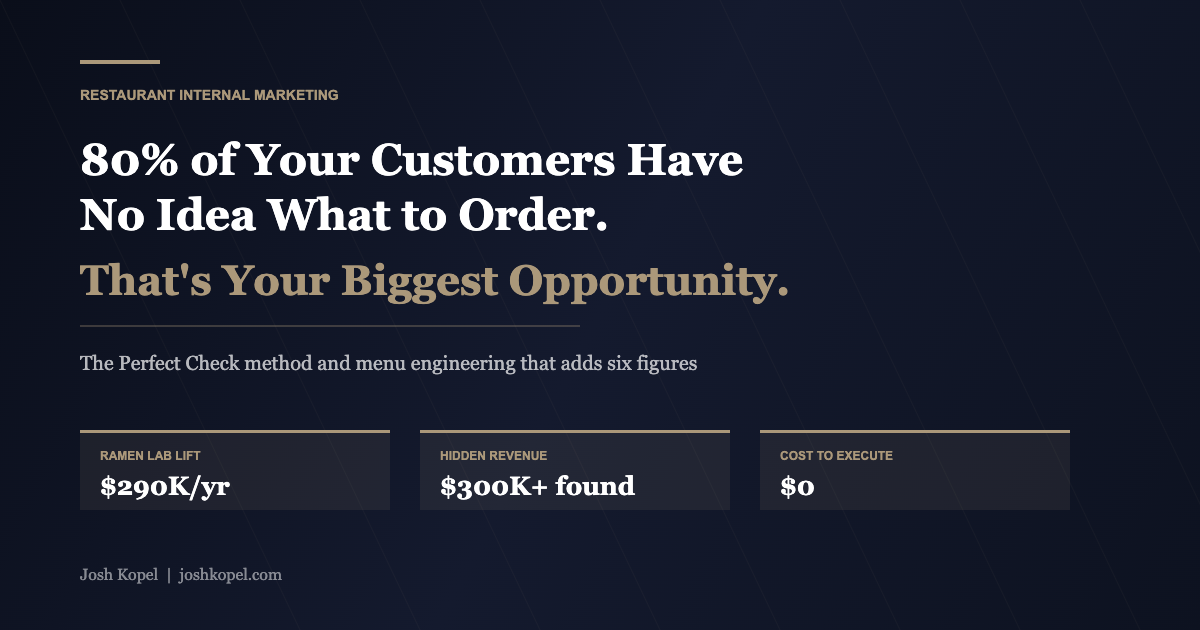
Every restaurant owner I meet wants more customers. But your biggest revenue opportunity is not outside your four walls. It’s inside them. 80% of the people sitting in your restaurant right now are first-timers who have no idea what to order, no relationship with your brand, and no reason to come back. Internal marketing is the system that changes all three of those things. From enrolling guests into a house account at the table to building a loyalty program rooted in status instead of discounts, these are the tools that turn a one-time visitor into a lifelong customer. Credit card companies figured this out decades ago. It’s time restaurants did too.
Every restaurant owner I talk to wants more customers. More butts in seats. More first-time visitors walking through the door. And I get it. New customers feel like progress.
But here’s what I’ve learned after running my own restaurants and consulting with hundreds of clients: your biggest revenue opportunity is not outside your four walls. It’s inside them.
80% of the people sitting in your restaurant every single day are first-timers. They have no idea what to order. They don’t know how to engage with you. They don’t know how you fit into their life. And when they leave, most of them disappear forever. Not because they didn’t like you. Because you gave them no reason to remember you, no way to stay connected, and no mechanism to come back.
That’s the problem internal marketing solves. Internal marketing is everything you do inside your four walls to increase the value of every customer who already showed up. It’s how you guide their experience, capture their information, and build a relationship that lasts longer than one meal.
The Difference Between Internal and External Marketing
External marketing is about awareness. It’s social media, SEO, press, partnerships. It gets strangers to notice you exist. That’s important, but it’s expensive and unpredictable.
Internal marketing is about conversion and frequency. It takes the person who’s already in your restaurant, already spending money, already having an experience, and turns them into a repeat customer. It costs almost nothing. And the ROI compounds on every single guest, every single day.
Think about it this way. If everyone who came to your restaurant once a month came in twice a month, you’d be rich. You’d be Scrooge McDucking it. You wouldn’t be worrying about Instagram algorithms or Yelp reviews or foot traffic.
Internal marketing is how you get to twice a month.
The problem is most restaurant owners spend 90% of their energy on getting new people through the door and almost none on keeping the people who already walked in. That ratio needs to flip.
Why Your Loyalty Program Isn’t Working
Let’s start with the biggest broken tool in most restaurants: the loyalty program.
Here’s what loyalty looks like at most restaurants. A server walks up and says, “Hey, if you sign up for our mailing list, I’ll give you a free piece of pie.” And the customer thinks, well, you want my name, my email, my phone number, my birthday, and all I get is a single dessert? I feel like a tramp trading my personal information for a piece of pie.
That’s because we’re treating it as a transaction. Sign up, get a freebie. It’s not compelling. It doesn’t make anyone feel seen or special. And your staff won’t ask because they know the pitch is weak. They’re embarrassed by it.
The result is a mailing list that barely grows, a loyalty program nobody uses, and a missed opportunity to build a direct relationship with the people who are already spending money with you.
So who’s figured this out? Not restaurants. Credit card companies.
The Credit Card Playbook: Status Over Discounts
All credit card companies do the same thing for a living. They loan you money at high interest. All restaurants do the same thing. They sell food and beverage at a markup. Both are commodities. But you’re an Amex person or a Chase person, and it says something about who you are.
How do they create that differentiation? Not through points and point redemption. Through status and access to the inaccessible.
People don’t want discounts. They don’t want freebies. They want to feel seen. They want to feel special. They want to feel like they’re part of something. And they want access to things that nobody else can get.
We are the kings and queens of that. We can offer all of it. Can you offer priority reservations on Valentine’s Day or Mother’s Day? Can you have a secret menu that is only available to loyalty members? For those of you flipping your menu seasonally, why not do a preview two hours on a Thursday, from five to seven, with a couple of mini cocktails, so your best customers see the new menu a week before it releases? They’re talking about it on social media. They’re telling their friends. They feel like insiders.
Based on our margins, we can offer incredible perceived value for a very low associated cost. That’s the play. Stop trying to buy loyalty with discounts. Earn it with status and access.
The House Account: The Best Enrollment Script in the Business
Here’s the problem. Your team will not ask people for their personal information because they don’t have anything of value to offer. The free pie pitch is dead. You need something better.
The best tool I’ve built for this is the house account. Here’s how it works.
When you drop the check, you say: “Hey Jason, did you want the money you spent today to go towards your points on your house account?”
Jason says, “What’s a house account? I don’t have a house account.”
You say, “We’ve got this loyalty program. It gets you access to all of these off-menu items and off-calendar events we throw for our best customers. We can’t do it for everybody, so we just do it for the best customers on our mailing list. If it’s something you’re interested in, all I need is your phone number and I can sign you up today.”
Jason gives you his phone number. An hour later, a text message goes out: “We’d love to give you something special on your birthday. Click here to complete your profile.” He enters his first name, last name, email address, and birthday.
You just converted a seated customer into a mailing list member through status and access, not through a transaction. Zero acquisition cost. High perceived value. And now you can market to that person forever.
Why the Birthday Anchor Works
There’s a reason we anchor the follow-up to birthdays. Everyone has a birthday. With the exception of dead people, it’s the one thing that is universally shared. And everyone wants to feel special on their birthday.
When you anchor the enrollment to a birthday gift, you accomplish two things. First, you give them a specific reason to complete their profile. “We can’t send you this gift without your information.” It’s logical. It’s not pushy. It’s service.
Second, you set the expectation that every time you reach out, you’ll be surprising and delighting them with things that no one else can get. That’s the tone for the entire relationship. Not “here’s a coupon.” Not “we’re running a special.” It’s “we have something for you that nobody else gets.”
That expectation changes how people interact with your emails. They open them first because they’re excited. They know you’re going to offer something of inherent value. That’s the difference between a 5% open rate and a 40% open rate.
The Bar Model: VIP Lists That Print Money
The house account works beautifully in full-service restaurants, but it works even better in bar models. When somebody sits down and opens a tab, you say: “I’m going to open a tab for you. Are you on the VIP list? Do you have a house account? Because all of these dollars you spend tonight can go towards points.”
It crushes. It absolutely crushes. Because bar customers are high frequency. They come back weekly, sometimes multiple times a week. And every time they sit down, the enrollment opportunity resets. You’re not asking them to sign up for something they’ll never use. You’re asking them to get credit for money they’re already spending.
The psychology is different from a restaurant enrollment. Bar customers are in a social mood. They’re open. They’re spending freely. And the idea that they could be getting status and access on top of what they’re already doing? That’s a no-brainer.
Once they’re on your list, bar customers become your most engaged audience. They open your emails about happy hour specials, about guest bartender nights, about limited releases. They become the core of your owned audience. And owned audience is the entire game.
Building an Owned Audience from Your Existing Traffic
Think back to the first 90 days you were open. You were busier than you’d ever been. Momentum was high. People were excited. Now let me ask you this: do you have the name, phone number, email address, and birthday of every person who walked through your door during that period?
Of course you don’t. None of us did. And that’s the tragedy. Because those people wanted to love you. They showed up during the honeymoon phase. And you let them walk out without any way to bring them back.
The best time to start building your list was the day you opened. The second best time is today.
Internal marketing starts with capturing every guest who walks through your door. Not with a fishbowl and a business card drawing. Not with a QR code on the table that nobody scans. With a human being looking another human being in the eye and saying, “Did you want this to go towards your house account?”
That’s the enrollment moment. It happens at the check drop, when the customer has just had their experience, when they’re feeling good about the meal, when they’re most receptive to deepening the relationship. The timing is intentional. Everything about this system is intentional.
The Memory Problem: Why Frequency Beats Acquisition
How often do you think about your favorite restaurant? Never. You love them. You’d go back in a heartbeat. But they don’t cross your mind because life is busy and your brain is full.
People don’t have a loyalty problem. They have a memory problem. And what you’re there to do is remind them of how you fit into their lives. Remind them of the one thing you do that nobody else does. Remind them that you exist.
That’s what the mailing list is for. Not to spam people with promotions. To stay top of mind with the people who already love you. Every email you send should reinforce one message: here’s what we’re best in the world at, here’s what you can get from us that you can’t get from anyone else, and here’s why this month is the month to come back.
One great reason per month. Not five mediocre ones. When you offer a lot of things, people go, “That all sounds really good,” and then they delete the email because it’s overwhelming. Instead of offering three options, offer three reasons to do one thing. And that one thing should be your absolute best offer rooted in what you already know works.
If everyone on your mailing list came in once because the offer was so good, you’d be set. That’s the math. One great offer. Every month. To an audience you own.
Advocacy at the Table: The Language That Changes Everything
The final piece of internal marketing is the most human one. It’s what your team says when they’re standing in front of a guest.
Your staff can’t sell. Or they won’t sell. Or they’re afraid to sell. And the reason is simple: sales feels dirty. Nobody wants to feel like that greasy car salesman pushing the extended warranty.
But here’s the reframe. What you call upselling, I call advocacy. And advocacy isn’t selling. It’s service. When 80% of your customers are first-timers who don’t know what to order, guiding them toward the best version of their experience isn’t a sales pitch. It’s the highest form of hospitality you can offer.
When your server says, “Most guests start with our cheese curds while they look at the menu,” that’s not upselling. That’s helping someone who has incomplete information make a better decision. Give your team permission to guide rather than list, and give them permission to accept “no” without guilt. That’s the difference between advocacy and salesmanship.
Internal marketing is this entire ecosystem working together. The advocacy at the table creates a better experience. The better experience creates a receptive customer. The receptive customer enrolls in the house account. The house account becomes a mailing list. The mailing list drives frequency. And frequency is where the real money lives.
Your 7-Day Internal Marketing Action Plan
Day 1: Audit your current capture rate. How many of your seated customers are you converting into mailing list members today? If you don’t know the number, it’s probably close to zero. That’s your baseline.
Day 2: Build your house account script. Write the exact language your team will use at check drop. “Did you want the money you spent today to go towards your house account?” Roleplay it. Make it natural. Make it feel like service, not a sales pitch.
Day 3: Set up the automated follow-up. When a phone number comes in, an automated text should go out within an hour asking them to complete their profile for a birthday gift. If you don’t have a system for this, get one today. This is non-negotiable infrastructure.
Day 4: Design your status and access benefits. What can you offer loyalty members that nobody else gets? Secret menu items, early access to seasonal menus, priority reservations on holidays, off-calendar tastings. Write down five things that cost you almost nothing but feel exclusive.
Day 5: Train your team. Teach advocacy, not salesmanship. Show them the language of guiding rather than listing. Show them the house account script. Roleplay it until it feels natural. The goal is that every single check drop includes the house account question.
Day 6: Plan your first loyalty-only activation. Give your mailing list one great reason to come in this month. Not a discount. An experience they can’t get anywhere else. A menu preview. A chef’s table night. A secret menu item. Make them feel like insiders.
Day 7: Track your numbers. How many house account sign-ups did you get this week? What’s your enrollment rate as a percentage of total covers? That number is the leading indicator of everything that follows. If it’s growing, your internal marketing engine is working.
None of this costs money. All of it makes money. The customers are already in your restaurant. The only question is whether they leave as strangers or as members of your community. Money likes speed. Start today.
Free Live Training
Want Me to Walk You Through These Systems Live?
Join the free 5-Day Restaurant Marketing Masterclass. In 40 minutes a day, I’ll show you how to build a marketing system that actually makes you money.
JOIN THE FREE MASTERCLASS★★★★★ Rated 5/5 by 1,000+ restaurant owners
Frequently Asked Questions
What is internal marketing for restaurants?
Internal marketing is everything you do inside your four walls to increase the value of every customer who already showed up. It includes guiding their experience through advocacy, capturing their information through house account enrollment, and building a relationship through status-based loyalty programs. The goal is to turn a one-time visitor into a repeat customer without spending a dime on advertising.
How does the house account enrollment script work?
When dropping the check, ask: “Did you want the money you spent today to go towards your points on your house account?” When they ask what that is, explain it’s a loyalty program with access to off-menu items and exclusive events for your best customers. All you need is a phone number. An hour later, an automated text goes out asking them to complete their profile for a birthday gift. You’ve converted a seated customer into a mailing list member through status, not a transaction.
Why should restaurants model their loyalty programs after credit card companies?
Credit card companies and restaurants are both commodities. They all do the same thing. But you’re an Amex person or a Chase person because those brands create differentiation through status and access to the inaccessible. Restaurants can do the same thing: secret menus, priority holiday reservations, early access to seasonal releases, off-calendar tastings. People don’t want discounts. They want to feel seen and special. Status costs you almost nothing and creates loyalty that discounts never will.
How do I get my staff to actually enroll customers in the loyalty program?
Give them something worth offering. The reason your team won’t ask for personal information is that they have nothing of value to offer in return. A free piece of pie isn’t enough. But access to off-menu items, exclusive events, and VIP treatment? That’s a pitch worth making. Train them on the exact language, roleplay it until it’s natural, and track enrollment numbers so there’s accountability.
What’s more important for revenue: new customer acquisition or customer frequency?
Customer frequency. If everyone who came to your restaurant once a month came in twice a month, you’d be rich. People don’t have a loyalty problem. They have a memory problem. Internal marketing solves the memory problem by building an owned audience you can reach directly. One great offer per month to an engaged mailing list will generate more revenue than any social media campaign or advertising spend.