
Expert Summary
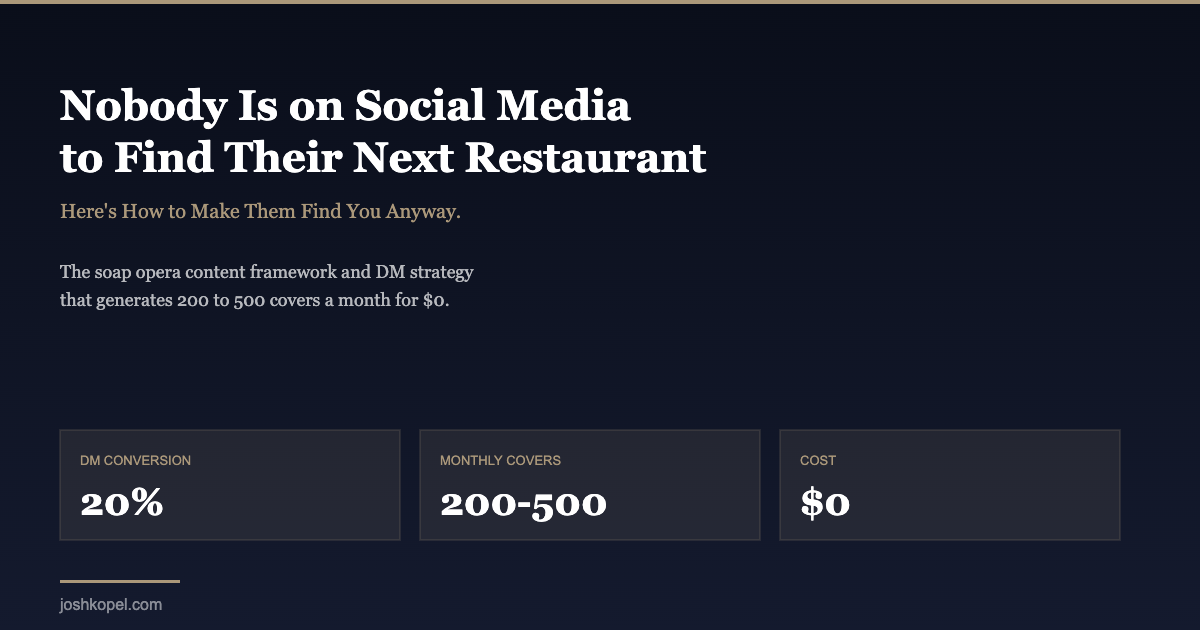
Social media is a low-intent platform. Nobody is scrolling Instagram looking for their next restaurant. You’re on social media to be entertained, and so is everyone else. Nobody is on social media to be sold. So the goal is not to sell on social media. The goal is to use social media to get attention, and then convert that attention through direct messages. The first soap operas were created by Procter & Gamble to sell soap to housewives. When viewership dropped mid-episode, they figured out the fix was telling three stories simultaneously instead of one. That’s the content model. Three stories over six weeks. Purpose. Product. People. Then 35 DMs a day at a 20% conversion rate gives you 200 to 500 additional covers a month for zero dollars.
I’m going to say something that might change how you think about social media forever. Nobody is scrolling Instagram looking for their next restaurant. None of your potential customers are sitting at their desks, scrolling through their feed, and when they see your post about tonight’s special, dropping everything to drive to your restaurant.
That’s not how it works. You are on social media to be entertained, and so is everyone else. Nobody is on social media to be sold.
Social media is a low-intent platform. In marketing, they call it top of funnel. All you can really do with it effectively is let people know who you are, that you exist, and then ultimately direct them to other areas of your ecosystem – your Google, your Yelp, your website, your reservation platform. That is what social media is actually for.
But I think the biggest hurdle for most restaurant owners is figuring out what to say on social media. Nobody wants to be that talking head. Nobody knows how to be consistent. So let me tell you a story that’s going to inform everything about how you should use social media going forward.
Procter & Gamble, Soap Operas, and the Three-Story Framework
Many people don’t know this, but the first soap operas were created by Procter & Gamble. They were created to sell soap to housewives. And when they looked at the statistics behind the way the episodes performed, they immediately came up against a really serious problem. Midway through the episode, everybody stopped watching.
But they needed everybody to watch, because they needed the housewives to see all of the commercials so they could sell them all the products they wanted to sell. So they did a deep analysis. Here’s what they found.
There’s a natural arc to a story. There’s the establishment of the characters, the establishment of the problem, the arc to resolution, the climax, and then the balance. And what they found was that as soon as the story hit the climax, everybody stopped watching. Once the tension resolved, there was no reason to stay.
So how did they solve it? They stopped telling one story and started telling three stories simultaneously. That’s what every modern drama does today. That cop show you watch on Thursday nights isn’t telling one story – it’s telling three. There are three different climaxes, and the show is able to push and pull you through the episode because as one story resolves, another one builds tension.
This is how you should think about your social media content. Not as individual posts. As campaigns.
Three Stories Over Six Weeks: Purpose, Product, People
What we try to do is tell three stories over the arc of six weeks. Each story maps to one of three categories that drive engagement, build connection, and give people a reason to care about your restaurant.
Purpose. The first story is about you. The founder. The owner-operator. Why did you start this thing? Why did you choose this building? Why did you choose this cuisine? What makes you uniquely qualified to do this? What is it that you love about the food and the neighborhood and the community? This is all about you, because people don’t support businesses. People support people.
Product. The second story is about effort. The effort that goes into creating an effortless experience. I don’t want to talk about how good a dish is. I want to do a cooking demo so people can see how good the dish is. I don’t want to tell people how excited I am about the new cocktail we’re putting on the menu. I want to show them how we make it.
Nobody is going to make that at home. The Food Network is full of shows that teach people how to cook, and everybody still goes out to eat. What we want to do is show the effort that goes into the effortless experience. A great example is the difference between telling people “Hey, we do a ton of corporate catering, you should do it with us” and showing yourself preparing for the next big catering gig. Show effort.
People. The third story is about your team and your community. I love to highlight employees. I love to highlight regulars. This is where your restaurant stops being just a place to eat and becomes the cultural hub of your neighborhood. When you do this, you don’t become everyone’s favorite restaurant. You become the arbiter of taste for your community. That’s where you want to be.
If you’re competing on food alone, it’s trench warfare. It’s a commodity game. Someone’s always going to be better. Someone’s always going to be cheaper. But if you’re competing on ideas and personalities and people are involved in your world, they’ll give you money, because the business is an extension of self.
We’re Always Marketing to a Moving Parade
Here’s an adage I come back to constantly. There are no inside jokes on social media. Inside jokes are not effective because most people are not on the inside.
We are always marketing to a moving parade. The assumption should never be that people are familiar with you. The assumption should always be that people are unfamiliar with you. This is why the best social media creators always reintroduce themselves. They have a hook, and then the most important part: “For those of you that don’t know me, my name is Josh, and this is what I do for a living.”
We do not assume understanding or familiarity. We always provide it. Because 80% of the people engaging with your content at any given time are seeing you for the first time. If you treat every post like you’re talking to regulars, you lose the first-timers. And the first-timers are the growth.
The DM Strategy: Where Social Media Actually Makes Money
Now here’s the part that actually translates to dollars. Because I know what you’re thinking. “Josh, this is great, but how many of you are able to calculate an ROI on your social media efforts?” The answer, for most of you, is zero.
I joke about this all the time. I have clients that had PR companies and social media management companies, and these companies put together these beautiful reports every month with engagement and impressions and all these numbers. And what’s so interesting about those numbers is there are no dollar signs associated with any of them. There’s always a dollar sign associated with the invoice, though.
Here’s how we thread the needle. Here’s how social media actually makes money. The only reason my clients post on social media is to create engagement. Then we direct message people who engage with us using a script that I came up with.
Here’s what it looks like. Lulu likes one of my posts or comments on it. I hit her up: “Oh my God, Lulu, thank you so much for liking that post. As a family-owned and operated business, I can’t thank you enough for the support. I just want to let you know we see you, we love you, and we appreciate you.”
Lulu replies, because I’m literally the first restaurateur who has ever reached out to her directly with gratitude. She says, “Oh my God, thank you so much. We love what you guys do.”
To which I say, “Have you been in recently?”
She says, “No, it’s been on the list.”
So I say, “You should come in this weekend. We have this special going on. Let me let the manager know that you’re coming in so we can say hello and take really good care of you.”
That’s an offer. The social media post was an offer for attention, and then I am offering for this person to come in this weekend.
The Math: 35 DMs a Day Changes Everything
If you do that 35 times a day, every day for 30 days, that’s 1,000 offers. What’s the conversion rate?
20%. That’s the average conversion rate across hundreds of clients. They do this every day, every week, every month.
What that translates to is this. In 15 minutes a day, for zero dollars expended, you bring in an additional 200 covers a month.
But is it really 200 covers? None of those people are going to come in alone. They’re bringing at least one other person with them. So it’s really 300 covers. Maybe 400. Maybe 500.
In 15 minutes a day. For zero dollars. That’s marketing. Don’t do anything that doesn’t directly translate to more money per customer or more butts in seats. That is what marketing does.
The ROI Social Media Reports Never Show You
Here’s why this approach is so fundamentally different from what most restaurants do on social media. Traditional social media marketing measures vanity metrics – likes, impressions, reach, engagement rate. None of those have dollar signs attached.
The DM strategy measures one thing: covers. How many people said yes and walked through the door? That’s the only metric that matters. And at 20% conversion across hundreds of clients, it’s the most predictable, repeatable, zero-cost customer acquisition strategy in the restaurant industry.
The content you post – purpose, product, people across six-week arcs – exists for one reason: to generate the engagement that feeds the DM machine. Every like is a lead. Every comment is a conversation starter. Every share is someone telling their network that your restaurant matters.
And when those people walk through the door because you personally invited them, because you made them feel seen and valued, the experience is already elevated before they sit down. They’re coming in with warmth and connection, not just hunger. That’s how you build frequency. That’s how you build loyalty. That’s how one DM turns into a regular.
Your 7-Day Social Media Content Action Plan
Day 1: Map your three stories. Write down one paragraph each for purpose, product, and people. What’s your origin story? What’s the effort that goes into your hero dish? Who on your team has a story worth telling? These three stories will fuel six weeks of content.
Day 2: Film your purpose story. Grab your phone. Stand in your restaurant. Tell people why you started this. Why you chose this neighborhood. What this place means to you. You don’t need production value. You need authenticity. Remember – for those who don’t know you, introduce yourself.
Day 3: Film your product story. Show the effort behind the effortless experience. A cooking demo of your signature dish. The prep that goes into a catering order. The bartender building your best cocktail. Don’t talk about how good it is. Show them.
Day 4: Film your people story. Highlight a team member. Highlight a regular. Show the community around your restaurant. This is how you become the arbiter of taste for your neighborhood, not just another place to eat.
Day 5: Launch the DM strategy. Post your purpose story. Then DM every single person who engages with it. Use the script: gratitude, connection, invitation. Track how many DMs you send and how many say yes.
Day 6: Do 35 DMs. This takes 15 minutes. Reply to every like, every comment, every share from the last 48 hours. Use the same script. Gratitude first. Then the invitation. Let the manager know they’re coming so you can take really good care of them.
Day 7: Count the covers. How many people came in this week because of a DM? That’s your ROI. No vanity metrics. No impressions report. Just butts in seats. That’s the number your social media company never showed you. Money likes speed. Start today.
Free Live Training
Want Me to Walk You Through These Systems Live?
Join the free 5-Day Restaurant Marketing Masterclass. In 40 minutes a day, I’ll show you how to build a marketing system that actually makes you money.
JOIN THE FREE MASTERCLASS★★★★★ Rated 5/5 by 1,000+ restaurant owners
For the wider system this fits into, see my guide to restaurant marketing solutions that actually work, and the channel-by-channel data in the State of Restaurant Marketing 2026 report.
Frequently Asked Questions
Why doesn’t traditional social media marketing work for restaurants?
Social media is a low-intent platform. Nobody is scrolling Instagram looking for their next restaurant. You’re on social media to be entertained, not to be sold. Traditional social media marketing measures vanity metrics like impressions and engagement that have no dollar signs attached. The DM strategy converts engagement into actual covers by personally inviting people who interact with your content.
What is the three-story content framework for restaurant social media?
Tell three stories simultaneously over six weeks: purpose, product, and people. Purpose is your origin story as the founder. Product is showing the effort behind the effortless experience – cooking demos, prep work, behind the scenes. People highlights your team and regulars. This framework comes from how Procter & Gamble solved the problem of soap opera viewers dropping off mid-episode by weaving three storylines instead of one.
How does the restaurant DM strategy work and what results does it produce?
Post content to create engagement, then DM everyone who likes or comments using a gratitude-first script. Thank them, tell them you see them, then invite them in with a specific offer. Do 35 DMs a day for 30 days – that is 1,000 offers. The average conversion rate across hundreds of clients is 20%, translating to 200 covers per month. Since guests bring others, the real number is 300 to 500 additional covers for zero dollars spent in just 15 minutes a day.
How should restaurants introduce themselves on social media?
Always assume your audience is unfamiliar with you. We are always marketing to a moving parade, and there are no inside jokes on social media. The best creators always reintroduce themselves after the hook: “For those of you that don’t know me, my name is Josh, and this is what I do for a living.” Never assume understanding or familiarity. Always provide it, because 80% of people engaging with your content at any given time may be seeing you for the first time.
What should restaurants actually measure on social media?
Covers. How many people said yes to a DM invitation and walked through the door? That is the only metric that matters. Not impressions. Not engagement rate. Not follower count. The DM strategy produces a measurable, repeatable number – 20% conversion across hundreds of clients. If your social media report doesn’t have dollar signs, it’s not measuring anything that matters to your business.