
Skip to Main Content

Josh Kopel | Award Winning Restaurant Consultant

Restaurant Menu Engineering: The $0 Rewrite That Added $300K in Annual Profit

Expert Summary

Most restaurant owners are bleeding money from their menus and don’t know it. After engineering menus for hundreds of restaurants, I’ve found that the right combination of strategic pricing, menu design, and attachment rate optimization can add $150K-$300K in annual revenue without a single new customer. Here’s the exact system I use – including the menu psychology that doubled appetizer sales for one client in two weeks.

I want to start with something that’s going to make you uncomfortable: your menu is probably costing you six figures a year.

Not because your food costs are too high. Not because your portions are too big – although they probably are. Your menu is costing you money because it’s letting your customers make bad decisions.

I know that sounds aggressive. But after engineering menus for hundreds of restaurant owners through my Restaurant Scaling System, scraping competitive data across dozens of markets, and running the numbers on attachment rates, pricing psychology, and per-customer average spend, I can tell you this: the difference between a menu that works and a menu that bleeds isn’t the food. It’s the design, the language, and the psychology behind how you present it.

Everything I’m about to share with you is a two-way door. That’s Jeff Bezos’s framework for decision-making: one-way doors are decisions you can’t undo – signing a lease, closing a location. Two-way doors are decisions you can reverse tomorrow. Every single menu change I’m going to propose is a two-way door. You try it. You see how it goes. If it doesn’t work, you change it back. Money likes speed.

The Price-to-Value Shift: Why You’re Thinking About Pricing Wrong

Here’s how most restaurant owners think about pricing: “I need to be competitive. I can’t charge more than the place down the street.”

But let me ask you something. When you want to order a pizza, are you doing a competitive analysis on who’s charging what for pepperoni pizzas? No. You just order the one you want. And for most of you in the burger, pizza, fried chicken, and booze category – nobody is making a logical decision anyway. People order from a place of indulgence. They want what they want, and they want it now.

So the first paradigm shift is this: value is not what people pay. Value is what people get.

Nobody has ever left a restaurant and said, “I wish I had paid less.” What they say is, “It was too expensive.” Those sound the same, but they’re completely different statements. One is about price. The other is about the gap between what they paid and what they experienced. That gap is the only thing you need to close.

When we stop focusing on revenue and start focusing on profitability – when we stop telling our teams to “sell more” and start telling them to “sell this” – everything changes.

Strategic Pricing: The 10-15% Rule Nobody Notices

Let me drop the stakes on this right now. Here’s what I’ve discovered after doing this hundreds of times: nobody is watching.

Nobody cares about your business as much as you do. No one is tracking your menu items. No one is tracking your pricing. Most of the people reading this right now don’t know what they paid for gasoline last week. So why are you terrified of adjusting your prices?

Here’s where to start. Your top 5-10 best sellers probably constitute 50-70% of your total item sales. If you increase those items by 10-15%, that creates a massive tidal wave in net profit. But here’s the key – you’ve only changed 5-7 items on your entire menu. You don’t read as “expensive” because the rest of the menu hasn’t moved.

Are you worried sales of those items will drop? Don’t be. These are the things you’re known for. People aren’t buying them because of the price point. They’re buying them because these are the dishes that make you, you.

Think about it in real numbers. On an $18 burger, a 10-15% increase is less than two dollars. Is someone going to walk out over $2? $16 and $18 are the same number in a customer’s mind. So why are you eating that margin?

Now, there IS a massive difference between a $19 burger and a $21 burger – those feel like two completely different products. But if you’re at $12, you can be at $14. If you’re at $14, you can be at $16. If you’re at $21, you can be at $23. These are invisible moves that transform your bottom line.

Benchmarking: How to Price to P90

When we work with clients, we benchmark against their competitive set and push pricing up to P90 – meaning 90% as expensive as the most expensive restaurant in their category. If they’re busy and they’re doing it at that price, you can do it too, because you’re going to establish more value for the same money through better menu design and storytelling.

Here’s the thing: nobody says anything. Nobody notices. And because we’re simultaneously increasing perceived value, people actually get a better experience as a result.

The Shrinkflation Strategy: How Smaller Portions Increase Value

Quick question: how many of you are giving away a ton of to-go bags?

If your portion sizes are so large that people can’t finish their meal in one sitting, you’re not providing value. You’re eating margin. Let me explain this from a consumer perspective.

How many times have you gone to a restaurant and told a friend, “You’ve got to check out this place – they gave me so much more food than I wanted!” That’s not how anyone talks about a great dining experience. What they think is: “I overpaid for too much.”

I would rather pay half and get half. Nobody wants to lug your leftovers around all day. What they want is to eat just enough – to have this amazing experience with perfect portions. Dialing back your portion sizes to what is reasonable for a human being to consume actually increases perceived value. It doesn’t diminish it. And it simultaneously improves your food margins.

That’s the delta most people miss: how we think a consumer thinks is not how we think as consumers ourselves.

Perceived Value: Selling Effort and Transformation

Here’s what kills me about most restaurant marketing. You’re all selling food and beverage. But people don’t come to you for food and beverage – they have that at their house. They come to you for eating and drinking. The experience. And that experience has two components:

  • Effort: The work that goes into creating an effortless experience. Your customers have no idea what it takes to run your restaurant. They don’t know you’ve been there since 9 AM for a 5 PM service. The whole point is to make it seem effortless – but you need to subtly communicate the effort through your menu descriptions, your sourcing stories, your plating, and the way your team delivers the food.
  • Transformation: How are their lives different because they dined with you? Whether you’re fine dining or fast casual, the best restaurants create a shift – from “I like this place” to “this is my favorite place” to “this is MY place.”

You increase perceived value through words on a page, the way you plate, the way you drop food on the table, and through the ordering process itself. It costs you nothing. But it changes the entire equation in your customer’s mind when the check drops – which is the only moment price actually becomes relevant.

Menu Design: Compass vs. Roadmap

Is your menu sending people in a generalized direction, or is it actually guiding them to the experience you designed? Because there’s a fundamental question most restaurant owners never ask: what do you want people to order?

If someone walks into your restaurant and asks, “What’s good here?” – that’s a failure of your menu. It should be obvious what you’re known for. It should be obvious on your website why people should come to you. And it should be obvious on the menu what differentiates you from everyone else.

Here’s what I want you to consider: what happens when your entire menu looks like your top 25% best-selling items? It’s a greatest hits album. Instead of trying to serve everyone everything, you double down on the momentum of what’s already working. Every item earns its place or it’s a distraction.

The Farm Bar Case Study: How Menu Sequencing Doubled Appetizer Sales

Let me show you exactly how this works with a real example. At Farm Bar, 90% of customers ordered the cheese curds. They were located in a section called “Appetizers.” Here’s what happened: people would see the cheese curds, check that box in their mind, and move on to the next section. They’d get the cheese curds and skip the other appetizers entirely.

That’s not what I wanted. So I restructured the menu:

  • Created a new section called “Farm Bar Famous” with just the cheese curds – a standalone binary choice: do you want them or not?
  • Below that: “Quick Hits” (appetizers) – so now customers chose the cheese curds AND an appetizer
  • “Farm Fresh Salads” – converted the most popular salad with the most popular protein into an entree salad
  • “Mains” – ranked by what was selling best
  • And here’s the critical move: the burger section got moved below the mains, and I renamed “Handhelds” to “Sandwiches”
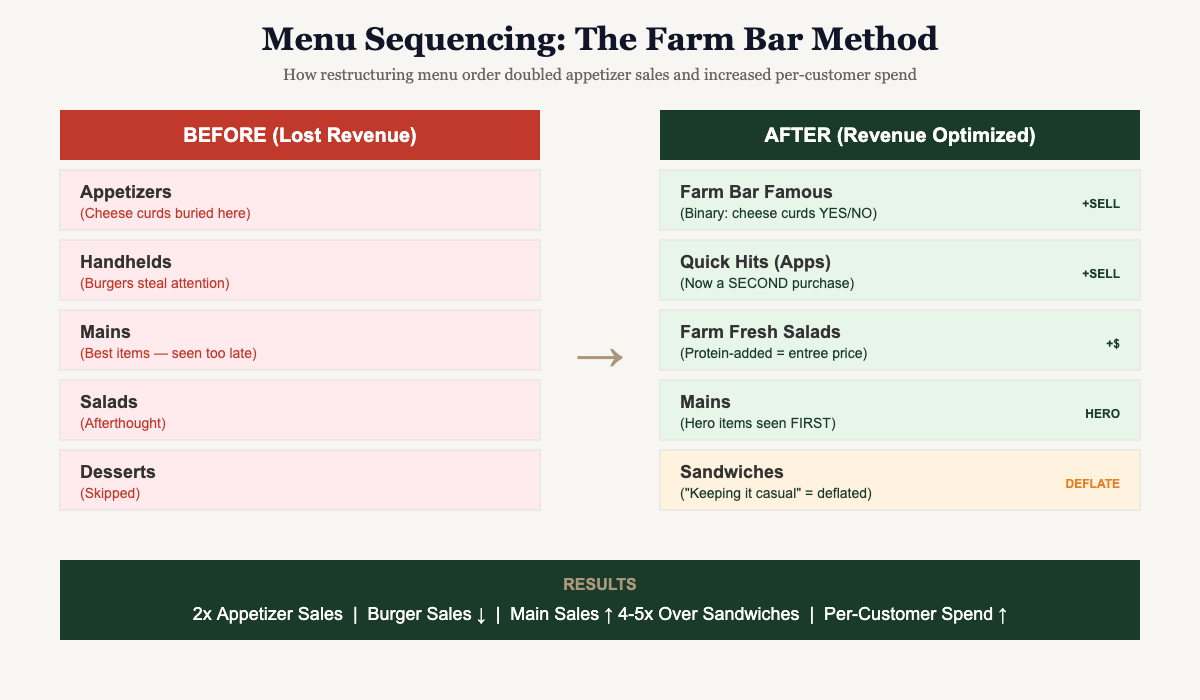
Menu sequencing diagram showing before and after restructuring using the Farm Bar method, demonstrating how reordering menu sections doubled appetizer sales
Menu Sequencing: The Farm Bar Method – Before vs. After

Why “Sandwiches”? Because nobody goes out to dinner to have a sandwich. Children eat sandwiches. The description I wrote was deliberately deflating: “For when you’re keeping it casual or need a lunch classic, done right.” In other words: this is not why you’re here. Choose better.

There’s real psychology behind this. People buy in a linear fashion. Once they’ve decided on an item, they review the rest of the menu but don’t change their mind. It’s an egoic barrier – once you’ve committed mentally, you’re locked in. So if someone saw the burger before the mains, they’d choose the burger and never order what Farm Bar was actually known for.

The results: burger sales plummeted. Main sales skyrocketed. Appetizer orders doubled. Per-customer average spend increased significantly – all from rearranging words on a page. Same food. Same kitchen. Same staff. Different menu architecture.

The Perfect Check: Engineering Your Ideal Transaction

This is one of the most powerful tools I can give you. The Perfect Check is the math behind a perfect experience.

Here’s how most owners think about it: “My per-customer average spend is $32. I’d love it to be $48.” But when you map out what someone would actually need to order to hit $48, it might not be physically possible given your menu structure. Or your menu might be actively sabotaging that goal by guiding people away from the right items.

What you need to do is engineer the price point you’re trying to hit relative to what they need to order. The Perfect Check isn’t a sales target – it’s a menu design exercise. When done right, it doesn’t feel like sales. It becomes advocacy.

I had a client in Hell’s Kitchen – fine dining Italian. Their average spend was $85 per person, but their best customers were spending $125. The owner said, “Most people won’t spend that.” I said, “Your best server is doing it almost every table she touches. So why don’t we engineer THAT as the experience?”

We re-engineered the entire menu around getting people to choose one from each section so the check naturally landed at that $125 sweet spot. It’s the same food, the same restaurant – but the menu now guides people toward the experience your best server was already delivering.

Attachment Rate Optimization: The $300K Menu Rewrite

Now let me show you how a few small adjustments compound into serious money. This is real data from Ramen Lab, one of my clients:

  • Competitive pricing adjustment (pushing to P90): +$0.42 per customer lift
  • Non-alcoholic beverage attachment (a Boba Arnold Palmer in a 24oz Mason jar): +$0.64 per customer, translating to over $60,000 annually – and we only targeted taking their attachment rate from bad to slightly less bad
  • Sampler creation (give people the option of “everything” instead of “this or that”): +$48,000 annually
  • Premium protein upgrade (train staff to offer the filet with every noodle order): immediate lift
  • Dessert repositioned as experience conclusion (not additional calories, but the finale of the meal): increased attachment rate
  • Menu re-sequencing (Farm Bar style restructuring): compounded all other gains

Total model lift on flat covers: over $300,000 in trailing 12 months.

Let me repeat that. $300,000 in additional revenue. Same number of customers. No new marketing spend. No new hires. Just making it easier for people to make better decisions.

Within 30 days of implementation, Ramen Lab hit a $3.00 per-customer lift, projecting to approximately $290,000 in increased annual revenue.

Why Your Team Won’t Sell (And How to Fix It)

Your team isn’t refusing to sell because they’re lazy. They’re refusing because sales feels dirty. Nobody likes being sold to, and nobody likes to sell.

The fix isn’t motivation speeches. It’s reframing the entire dynamic: sales is service.

Think about it – 80% of the people sitting in your restaurant on any given day are first-timers. They have no idea what to order. They don’t know how to engage with you. They don’t know how you fit into their life. But what they want – what we all want – is the best imaginable version of the experience they just committed to.

Most people won’t ask for guidance. So the menu has to do the heavy lifting, and your team fills in the gaps. When your server says, “You can order whatever you want, but I’m going to tell you – this is what you should get. This is what we’re known for. It would be a mistake to come in here for the first time and not try it” – that’s not salesmanship. That’s advocacy.

Here’s how to implement it: find your best salesperson. Understand what they’re doing differently. Track their per-customer average spend. Then show every other team member: “This is how much more YOU would make in tips if you did what she did.” Motivation works through self-interest. Roll it out using your best people first as a pilot, then scale across the team.

The Proof: What Happens When You Do All of This

Let me give you three snapshots of what this system produces:

Sweet Melody (Mike): Started serving ice cream out of his garage before the pandemic. When we started working together: $900,000/year at a 6% margin ($54,000 take-home). After implementing the full system: $1.2 million/year at an 18% margin ($216,000 take-home). That’s 4x his income with zero additional cover count.

Dodici Pizza (Dante): $1.4 million/year at an 18% margin. Open four days a week. Owner not involved in daily operations. A quarter million dollars a year in take-home in Brownsville, Texas. That’s what happens when you engineer profitability into every transaction.

Dead Rabbit (Jack McGarry): A single-unit Irish pub in New York, roughly 3,600 square feet. Revenue: $1 million per month. I share this not because you’ll hit that number tomorrow, but to break the belief that there’s a ceiling. Are you half as smart as Jack? Then you can build a restaurant that does half a million a month. The ceiling doesn’t exist.

Your Action Plan: Menu Engineering in 7 Days

Day 1-2: Benchmark your market. Pull up every competitor in your category. What’s the most expensive restaurant charging? Push your pricing to P90 – 90% of their top price. Start with your 5-10 best sellers.

Day 3: Build your Perfect Check. What’s the ideal per-customer spend? What does someone need to order to get there? Does your menu currently make that order flow natural, or does it fight against it?

Day 4-5: Restructure your menu. Lead with what you’re known for. Create binary choices that increase attachment rates. Move low-margin distractions below your hero items. Cut at least a third of the menu – strip away distractions to get to the cleanest version of the best thing you have to offer.

Day 6: Train your team. Introduce the Perfect Check. Identify your best server. Track their numbers. Show the rest of the team what’s possible through self-interest – more sales means more tips.

Day 7: Launch and iterate. This is a two-way door. If something doesn’t work, change it back. But don’t wait to find out. Money likes speed.

How much does all of this cost? $0. You don’t need to spend money. You need to spend time and intention.

Free Live Training

Want Me to Walk You Through These Systems Live?

Join the free 5-Day Restaurant Marketing Masterclass. In 40 minutes a day, I’ll show you how to build a marketing system that actually makes you money.

JOIN THE FREE MASTERCLASS

★★★★★ Rated 5/5 by 1,000+ restaurant owners

Frequently Asked Questions

What is restaurant menu engineering?

Menu engineering is the strategic design of your menu to maximize profitability per transaction. It combines pricing psychology, item placement, menu sequencing, attachment rate optimization, and staff selling techniques to guide customers toward your highest-margin, best-experience items – without feeling like a sales pitch.

How much revenue can menu engineering add to my restaurant?

Based on my work with hundreds of restaurants, a comprehensive menu engineering overhaul typically adds $150,000-$300,000 in annual revenue on flat covers – meaning the same number of customers spending more per visit. One client saw a $3.00 per-customer lift within 30 days, projecting to $290,000 annually.

Will customers notice if I raise my menu prices?

After doing this hundreds of times, I can tell you: nobody notices. Nobody is tracking your menu prices. Most people don’t know what they paid for gasoline last week. A 10-15% increase on your best sellers – the items people buy because they love them, not because of the price – creates massive profit impact with zero customer pushback.

Should I cut items from my menu?

Almost certainly, yes. With most clients, we cut at least a third of the menu. Every item needs to earn its place. If someone orders the wrong thing on their first visit – a generic burger instead of the dish you’re known for – the game is lost. They won’t come back. A focused menu ensures every customer gets your best, every time.

How do I get my staff to sell more without it feeling pushy?

Reframe selling as advocacy, not salesmanship. Your staff isn’t pushing products – they’re guiding first-time guests toward the best possible experience. The Perfect Check tool gives them a clear picture of what to recommend and why. When they see that better recommendations mean better tips, self-interest does the rest.

Complexity Is A Killer: Chris Schultz on Cutting the Noise to Unlock Real Growth

What if the real reason your restaurant isn’t growing… is because you’re doing too much?

Chris Schultz has built a career scaling cult brands without stripping away what made them special. Now, in his second appearance on the show—this time as CEO of Velvet Taco—he’s doubling down on a contrarian idea: most operators aren’t missing opportunities, they’re drowning in them.

In this conversation, we get into why great leaders grow through subtraction, how to identify the signals your team is giving you, and why saying no is the real unlock for growth.

If you’re chasing every new idea and still not seeing results, this episode will show you what to cut before it’s too late.

To learn more about Velvet Taco and their approach to building a cult brand at scale, visit velvettaco.com and if you enjoyed this conversation, you could also listen to Chris’s previous appearance on the show on Spotify and Apple Podcasts.

_________________________________________________________


Today’s episode was brought to you by Square. If you want restaurant tech that actually supports how you run your restaurant, find out how Square can help at
square.com/goodstuff.

Free 5-Day Restaurant Marketing Masterclass – This is a live training where you’ll learn the exact campaigns Josh has built and tested in real restaurants to attract new guests, increase visit frequency, and generate sales on demand. Save your spot at restaurantbusinessschool.com

Leadership Extends Beyond Titles: Warren Rustand on Living With Purpose and Discipline

Warren Rustand is the most successful human I know. 

Warren is a basketball hall of famer, he’s served US presidents, been the CEO of 10 companies and mentor to countless CEO’s and, candidly, he’s been an amazing father, husband and friend. 

Today, Warren will give you the tactics, tools and strategies he’s used to live the life of his dreams.

For more on Warren or to buy his book visit https://warrenrustand.com

_________________________________________________________

Free 5-Day Restaurant Marketing Masterclass – This is a live training where you’ll learn the exact campaigns Josh has built and tested in real restaurants to attract new guests, increase visit frequency, and generate sales on demand. Save your spot at restaurantbusinessschool.com

How to Increase Restaurant Revenue: The Framework Behind My $250K-to-$1.6M Growth

Expert Summary

After coaching 400+ restaurant owners and interviewing 600+ industry leaders, I’ve found that sustainable revenue growth comes down to three pillars – not a hundred scattered tactics. This framework took my own events business from $250K to $1.6M and has generated over $150K in additional annual revenue for clients through a single metric shift. Here’s exactly how it works.

I used to think I had a thousand problems. Staffing. Food costs. Marketing. Lease negotiations. Vendor relationships. The list was endless, and I was drowning in it.

Then I had a realization that changed everything: I didn’t have a thousand problems. I had one problem – money. Once you have money, you can solve everything else. You can hire better people. You can afford better ingredients. You can invest in marketing that actually works.

The issue was that I had no predictable, repeatable system for generating revenue. I was a restaurant manager with equity, not a restaurant owner. And there’s a massive difference between the two.

After running my own restaurants – including a Hollywood bar doing $1.5 million a year at 35% margins – coaching over 400 restaurant owners through my Restaurant Scaling System, and recording 600+ podcast episodes with people like Will Guidara, Wolfgang Puck, and Seth Godin, I’ve distilled restaurant revenue growth into a framework I call The Three Pillars.

Every solution I’m about to share with you is a solved problem. Someone else has already figured it out. Your job isn’t to reinvent the wheel – it’s to pair your specific problem with the existing solution that fixes it.

Why Most Restaurants Are Stuck (The Profitability Paradox)

Here’s the lie most restaurant owners tell themselves: “I’m just a couple thousand a week away from massive profitability.”

I know because I told myself the same thing. And here’s what happens – you hit that number, and the goalpost moves. Your expenses rise with your revenue. You hire another person. You upgrade your ingredients. You take on a bigger space. And suddenly you’re right back where you started, chasing another couple thousand a week.

The problem isn’t your revenue number. The problem is structural. You’re working IN your business when you should be working ON it. You’re managing behavior instead of leading systems. And you’ve built an operation that produces unpredictable revenue instead of formulaic, predictable sales.

Most restaurant operators are working 12-15 hour days, sleeping terribly, completely absent from their families, and doing tasks they’re genuinely terrible at – all because they never built a system that creates money on demand.

Which brings me to the concept that changed my entire approach to business.

The McRib Lever: Building Revenue You Can Pull On Demand

McDonald’s doesn’t release the McRib because it’s fall, or because someone in marketing had a fun idea. They release the McRib when franchisee sales drop below a specific threshold. It’s not a seasonal promotion – it’s a lever. A predictable tactic they can deploy at profitable rates, on demand, every single time.

That’s what your restaurant needs: proven revenue levers you can pull whenever you need to generate money.

Most restaurants lack this entirely. Revenue is weather-dependent, season-dependent, and mood-dependent. In Los Angeles, a drizzle of rain can drop your revenue 20% for the day. If your entire business model depends on walk-ins and hope, you don’t own a business – you own a lottery ticket.

The Three Pillars framework gives you those levers. Each pillar represents a category of proven tactics you can deploy systematically – not sporadically – to generate predictable revenue growth.

The Three Pillars of Restaurant Revenue

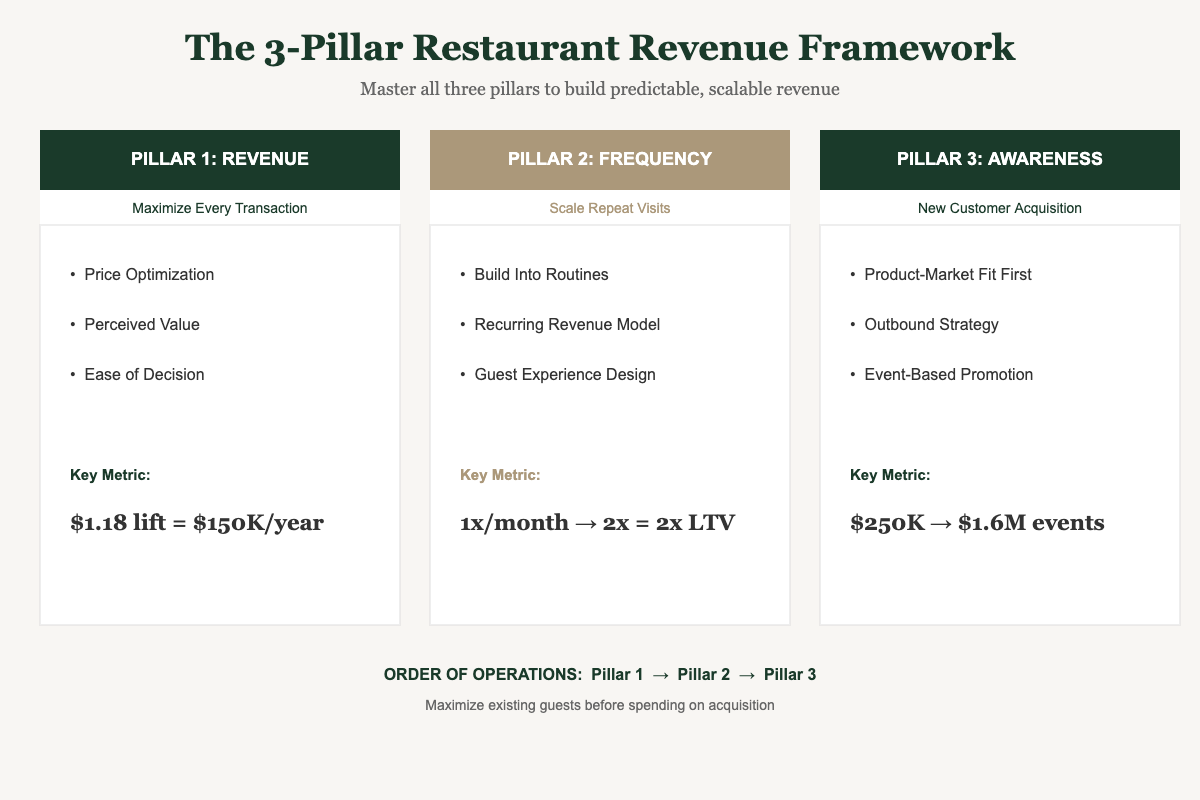
Every dollar of revenue growth in your restaurant flows through one of three channels. Master all three, and you build a business that generates money on demand. Here they are:

The 3-Pillar Restaurant Revenue Framework diagram showing Pillar 1 Revenue, Pillar 2 Frequency, and Pillar 3 Awareness with key metrics for each
The 3-Pillar Restaurant Revenue Framework – Revenue, Frequency, Awareness

Pillar 1: Revenue – Creating the Most Profitable Version of Your Restaurant Today

This is where most people get it backwards. They chase new customers before they’ve maximized the earning potential of the guests already sitting in their restaurant.

Think about it this way: if I can get you a 10% lift in average guest spend with a 10% increase in sales and no additional cash expended, isn’t that better than trying to drive strangers through your door?

This pillar is about internal marketing – using three specific tools to extract more revenue from every transaction:

  • Price: Your top 5-10 best sellers typically constitute 50-70% of your total item sales. A 10-15% price increase on just those items creates a massive tidal wave in net profit – and almost nobody notices because you’ve only changed 5-7 items on the entire menu.
  • Perceived Value: Value isn’t what people pay. Value is what people get. Shift your focus from discounting to enhancing the experience of every transaction.
  • Ease of Decision: Design every menu with purpose. The ideal is one thing – the thing you’re known for. In reality, you have multiple items, but you create intentional hierarchy so the customer’s path to ordering is frictionless.

One of my clients – a restaurant owner named Josh – used this pillar to increase his per-customer average spend by just $1.18. That’s it. A dollar and eighteen cents. But when you multiply that across every transaction, every day, every week, it translated to over $150,000 in additional annual revenue. No new marketing spend. No new customers. Just optimizing what was already there.

Pillar 2: Customer Frequency – Scaling Repeat Visits at High Margins

Once you’ve maximized each transaction, the next lever is getting those same customers to come back more often.

This isn’t about loyalty punch cards or generic email blasts. It’s about engineering your experience so that customers build you into their routine – the way people build their morning coffee shop into their commute.

The key insight here: if you’re not getting frequency, the problem isn’t rooted in price. It’s rooted in not having what they want. People return to restaurants that give them something they can’t get anywhere else, served in a way that respects their time and exceeds their expectations.

Frequency compounds. A customer who visits once a month at $50 per visit generates $600 a year. Get them to twice a month and you’ve doubled their lifetime value to $1,200 – without spending a dime on acquisition.

Pillar 3: Awareness – New Customer Acquisition Through Product-Market Fit

This is where most restaurant owners start, but it should be where you finish. Awareness – getting new people in the door – is the most expensive and least efficient pillar. It’s also the most important once you’ve optimized the first two.

The reason is simple: if your per-customer revenue is optimized (Pillar 1) and your repeat rate is strong (Pillar 2), then every new customer you acquire has a dramatically higher lifetime value. You’re not just filling seats – you’re filling seats with profitable, returning guests.

Without the first two pillars, new customer acquisition is like pouring water into a leaking bucket. You spend money to get them in the door, they spend less than they should, and they never come back. With the first two pillars locked in, every new customer becomes a compounding asset.

Case Study: From $250K to $1.6M in 12 Months

Let me show you what this looks like in practice with one of the most powerful revenue levers I’ve ever deployed: private events and catering.

At my own restaurants, we were doing about $250,000 a year in inbound events business. People would call, inquire, we’d respond – standard reactive approach.

When I applied the Three Pillars framework to our events business, here’s what happened:

  • Pillar 1 (Revenue): We restructured our event pricing into three-tier packages instead of individual menu items, with the middle option priced where we actually wanted clients to land. We stopped going back and forth over individual dishes and started selling experiences.
  • Pillar 2 (Frequency): We treated every event as annual recurring revenue. If someone booked their holiday party with us and we didn’t screw it up, they booked again the next year. That recurring base compounded every 12 months.
  • Pillar 3 (Awareness): We built an outbound strategy with hand-raising emails and proactive outreach to corporate decision-makers – instead of waiting for the phone to ring.

Year one: $250K grew to $1 million. Year two: $1.6 million – and it kept climbing.

The margins on events ran at 30%, compared to 10-12% for our in-house dining operations. By blending those revenue streams, our overall margin jumped to 15-20% without cutting a single cost.

It took the same effort to build a $1.6 million events business as it did to manage the $250K inbound version. Same team. Same hours. Different system.

Why Internal Marketing Beats New Customer Acquisition Every Time

I want to drive this home because it’s the mistake I see the most: restaurant owners spending thousands on social media, influencer partnerships, and advertising to drive strangers through the door – while leaving six figures on the table from the guests already in their seats.

Internal marketing is the highest-ROI activity in your business. Here’s why:

  • Zero acquisition cost. These customers are already in your restaurant. You don’t need to pay to reach them.
  • Immediate impact. Price changes, menu engineering, and staff selling techniques take effect the same day you implement them.
  • Compound returns. Every dollar you add to average check size multiplies across every customer, every day, for as long as you stay in business.

Start with Pillar 1. Always. Maximize the revenue from the guests you already have before you spend a dime trying to find new ones.

Your 30-Day Action Plan

Here’s exactly what I’d do if I were sitting in your restaurant right now:

Week 1: Audit your menu. Identify your top 5-10 best sellers. These items represent 50-70% of your total sales volume. Calculate the exact food cost and margin on each one.

Week 2: Increase prices strategically. Raise prices on your best sellers by 10-15%. Nobody’s tracking your pricing changes – and these items aren’t purchased for price. People buy them because you’re known for them. This is a two-way door: if it doesn’t work, you can change it back tomorrow.

Week 3: Implement the Perfect Check. Talk to your best salesperson. Understand what they’re doing differently. Track two metrics – their per-customer average spend and the impact on their tips. Then show every other team member: “This is how much more YOU would make if you did what Sarah did.” Motivation works through self-interest.

Week 4: Audit your bottlenecks. Walk through your restaurant during peak hours like a customer. Where do people hesitate? Where does your team hesitate? Where does your digital experience break down? Every hesitation is a hidden expense – and every bottleneck you eliminate adds capacity during the hours that matter most.

Money likes speed. Don’t plan this for next quarter. Do it this week.

Frequently Asked Questions

How much can I realistically increase restaurant revenue without spending more on marketing?

Based on my experience coaching 400+ restaurant owners, a 10% lift in average guest spend combined with basic menu engineering typically generates $50,000-$200,000 in additional annual revenue with zero additional marketing spend. The exact number depends on your volume, but the principle holds: internal marketing delivers the highest ROI before you invest in acquisition.

What’s the fastest way to increase restaurant revenue this week?

Identify your top 5 best-selling items and increase their prices by 10-15%. These items represent the majority of your sales volume, and customers buy them because you’re known for them – not because of the price. This change takes five minutes and the impact shows up immediately.

Does the Three Pillars framework work for all restaurant types?

Yes. I’ve applied this framework across fine dining, fast casual, QSR, bars, and catering operations. The specific tactics within each pillar change based on your business model, but the architecture – maximize transaction value first, then frequency, then acquisition – is universal.

How do I increase revenue without raising prices?

Focus on Ease of Decision and Perceived Value – two of the three internal marketing tools. Redesign your menu to guide customers toward higher-margin items. Train your staff using the Perfect Check method to recommend specific items rather than asking generic questions. Right-size portions to reduce waste. These approaches increase profitability per transaction without touching your price column.

What’s the difference between increasing revenue and increasing profitability?

Revenue is the total money coming in. Profitability is what you keep. The Three Pillars framework is designed for profitability because it optimizes at the transaction level. Instead of thinking “at $70K/month I’m profitable,” you think “every button on every seat generates profit.” This transaction-level thinking prevents the trap where expenses rise as revenues rise.

Free Live Training

Want Me to Walk You Through These Systems Live?

Join the free 5-Day Restaurant Marketing Masterclass. In 40 minutes a day, I’ll show you how to build a marketing system that actually makes you money.

JOIN THE FREE MASTERCLASS

★★★★★ Rated 5/5 by 1,000+ restaurant owners

Revenue Beyond the Dining Room: Sam Bernstein on Turning Superfans into Six Figures

What if the most valuable seats in your restaurant aren’t in your dining room, but in your database?

Samuel Bernstein has spent the last five years proving that loyalty isn’t a punch card. It’s a revenue model. As the founder of Table 22, Sam has helped more than 1,000 operators launch subscriptions, memberships, and bundled offers that routinely generate hundreds of thousands of dollars in high-margin revenue.

In this conversation, we get into why most “clubs” fail, how to design offers rooted in what guests actually care about, and how to pressure-test whether your concept has a five-figure upside or a six-figure one. We also break down his systems, marketing playbooks, and AI-powered insights that turn creativity into consistency.

If you’re serious about building revenue you can forecast, and fund real growth with, this episode is your blueprint.

To learn more about Table 22 and how they help restaurants build recurring revenue, visit table22.com.


_________________________________________________________


Today’s episode was brought to you by Square. If you want restaurant tech that actually supports how you run your restaurant, find out how Square can help at
square.com/goodstuff.

Free 5-Day Restaurant Marketing Masterclass – This is a live training where you’ll learn the exact campaigns Josh has built and tested in real restaurants to attract new guests, increase visit frequency, and generate sales on demand. Save your spot at restaurantbusinessschool.com

Leadership Is Emotional Labor: Ellen Bennett on the Personal Cost of Growth

The hardest part of ownership isn’t owning the business, it’s in owning the choices you’ve made and the impact they have on you and your team.

Today, we chat with multi-million dollar culinary clothing maven, Ellen Bennett. Ellen wrote a book that’s one part biography and one part action plan for aspiring entrepreneurs. 

In this conversation, we run though what the past 10 years has been like for Ellen, bringing to light the leadership lessons that have made her company so successful.

You can pick up Ellen’s new book Dreams First, Details Later at major retailers everywhere.

_________________________________________________________

Free 5-Day Restaurant Marketing Masterclass – This is a live training where you’ll learn the exact campaigns Josh has built and tested in real restaurants to attract new guests, increase visit frequency, and generate sales on demand. Save your spot at restaurantbusinessschool.com

Burn It Down: Alan Roth on Quitting, Clarity, and Building It Better the Second Time

What happens when you do achieve your goals but, over time, those goals don’t matter anymore? 

Most of us just stay the path. Alan Roth didn’t. He walked away at the height of his career, shut it all down, and spent years figuring out what actually mattered.

In this conversation, we get into the courage it takes to quit, what happens when you lose your identity as an operator, and how he found his way back to our industry with a completely different lens.

If you’re questioning your path—or just running on fumes—this conversation hits where it counts.

To learn more about his work with The Restaurant People and their growing portfolio of concepts, visit therestaurantpeople.com.

_________________________________________________________


Today’s episode was brought to you by Square. If you want restaurant tech that actually supports how you run your restaurant, find out how Square can help at
square.com/goodstuff.

Free 5-Day Restaurant Marketing Masterclass – This is a live training where you’ll learn the exact campaigns Josh has built and tested in real restaurants to attract new guests, increase visit frequency, and generate sales on demand. Save your spot at restaurantbusinessschool.com

Question Everything You Were Taught: Andrew Dana on Rewriting the Rules of Hospitality

For over a decade, I ran my restaurants the way I was taught to run other people’s restaurants. 

I led my teams the way others had led me and I never questioned it. But what if you never got that education?

Andrew Dana owns more than half a dozen successful restaurants and he began his journey as a restaurateur with absolutely no operational experience. He just did what he thought was right and followed his gut instincts. 

Today we go through how an industry outsider is challenging the way we look at our restaurants and our industry.

For more information on Call Your Mother, visit https://www.callyourmotherdeli.com.

_________________________________________________________

Free 5-Day Restaurant Marketing Masterclass – This is a live training where you’ll learn the exact campaigns Josh has built and tested in real restaurants to attract new guests, increase visit frequency, and generate sales on demand. Save your spot at restaurantbusinessschool.com

Ads Are Losing Power in Restaurants: Patrick Noone on Building a Content Engine Instead

What if the real reason your restaurant marketing isn’t working has nothing to do with your ads?

Patrick Noone thinks most brands are solving the wrong problem. As a marketing leader at Slim Chickens, he’s watched restaurants pour money into advertising, discounts, and promotions, only to discover they still can’t clearly explain who they are or why guests should care.

In this conversation, Patrick breaks down the shift from advertising to content, why most restaurants fall into the discount trap when they lack real attribution, and how strong brand positioning becomes the foundation for every campaign that actually drives traffic.

If your marketing feels like throwing spaghetti at the wall, this conversation will reset how you think about growth.

To learn more about Slim Chickens and how the brand is expanding its global footprint while rethinking restaurant marketing, visit slimchickens.com.

_________________________________________________________


Today’s episode was brought to you by Square. If you want restaurant tech that actually supports how you run your restaurant, find out how Square can help at
square.com/goodstuff.

Free 5-Day Restaurant Marketing Masterclass – This is a live training where you’ll learn the exact campaigns Josh has built and tested in real restaurants to attract new guests, increase visit frequency, and generate sales on demand. Save your spot at restaurantbusinessschool.com

Brand Clarity Wins Markets: Jeff Fenster on Turning Everbowl Into a Growth Machine

During our time in this industry we’ve watched countless healthy restaurant concepts go under. 

But today’s guest, Jeff Fenster, seems to have finally figured it out. His concept, Everbowl, has scaled massively over the last few years despite an economic downturn and a global pandemic. 

We sit down to discuss the strategy he used to become massively successful in a vertical that seemed destined for failure.

For more information on Everbowl, visit https://www.everbowl.com/.

_________________________________________________________

Free 5-Day Restaurant Marketing Masterclass – This is a live training where you’ll learn the exact campaigns Josh has built and tested in real restaurants to attract new guests, increase visit frequency, and generate sales on demand. Save your spot at restaurantbusinessschool.com

FREE DOWNLOAD

Leverage Digital Media to Drive Traffic to Your Restaurant

This free (and highly detailed) guide will outline how to tell your story in the most compelling way possible and how to share that story with the masses.

(Yep, even if you’re not a “tech” person!)

FREE DOWNLOAD

Lead Your Team Instead of Managing Them

This free (and highly detailed) guide will give you everything you need to know to build and lead a world class team from scratch, ensuring you work less and earn more. (Yep, even if you know nothing about leadership.)

FREE DOWNLOAD

Ready to Optimize, Manage and Grow Your Restaurant’s Profit Margin But Not Sure Where to Start?

This free (and highly detailed) cheat sheet will give you everything you need to know to set up your restaurant to maximize profitability. (Yep, even if you’re not a “business” person!)

Free 5-Day Marketing Masterclass

Join Now

5 Day Restaurant
Marketing Masterclass

100% Free

Get the tactics, tools, and strategies you need to scale your restaurant’s profits by 15% — in just five days.

See What You'll Learn

Free 5-Day Marketing Masterclass

Join Now

5 Day Restaurant
Marketing Masterclass

100% Free

Get the tactics, tools, and strategies you need to scale your restaurant’s profits by 15% — in just five days.

See What You'll Learn