
Skip to Main Content

Josh Kopel | Award Winning Restaurant Consultant

Why Restaurants Fail (It’s Almost Never the Food)

Expert Summary
  • The “why restaurants fail” diagnosis most operators reach for is almost always wrong.
  • Restaurants don’t fail on food. They fail on memorability, demand, alignment, focus, or repeatability.
  • Every restaurant has to answer five questions, and they have to be answered in order.
  • Most operators try to fix Growth when their actual problem is Question 1 or 2.
  • The new FULL COMP playbook breaks down each question with the operator who lived it.

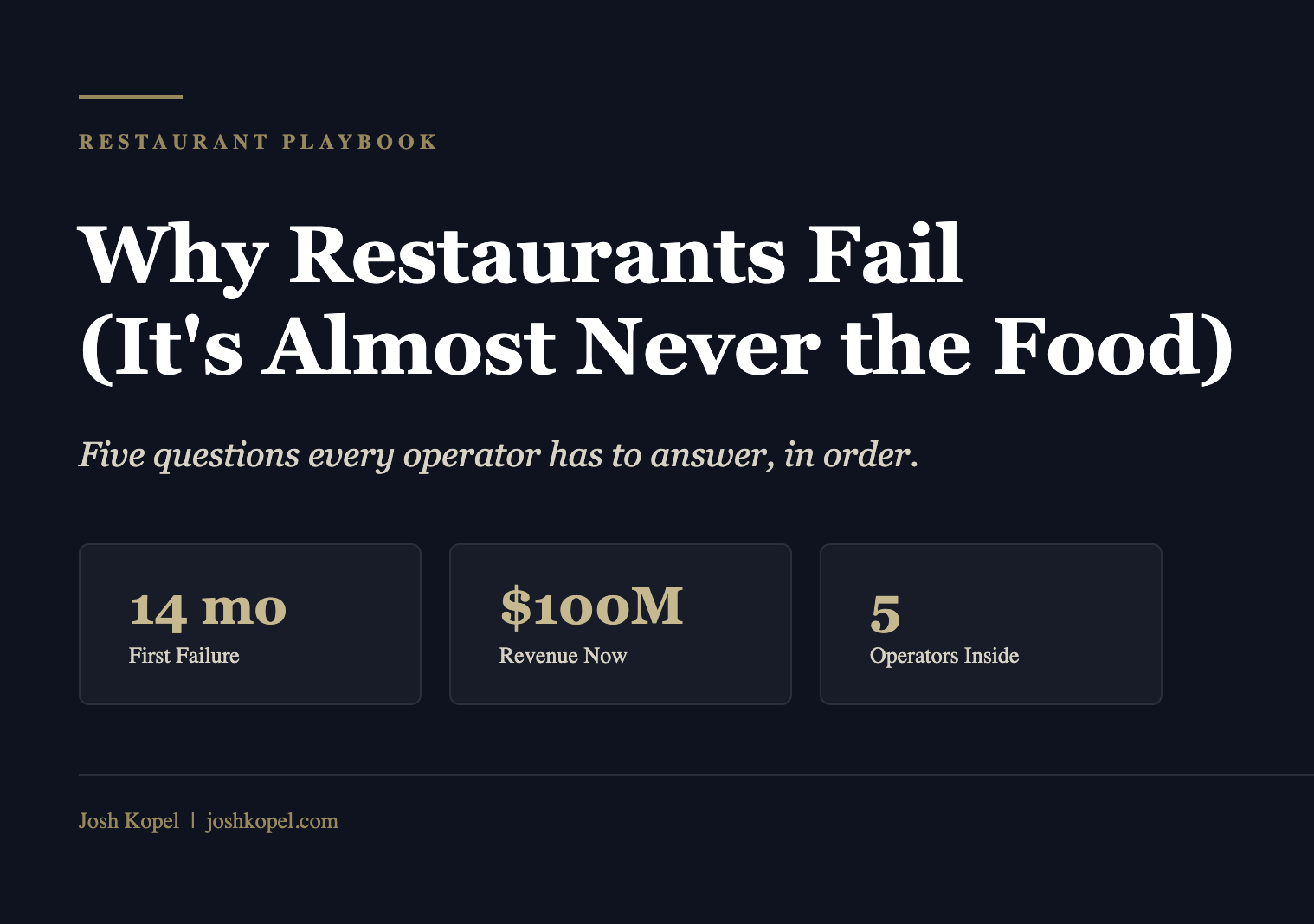
Dan Simons closed his first restaurant in 14 months.

He had the systems. Corporate training from TGI Fridays, Cheesecake Factory, Brinker. Operational discipline most independents would kill for.

Twenty years later, his next restaurant, Founding Farmers, does over $100M in annual revenue across eight locations with 1,500 employees.

When people ask why restaurants fail, they almost always reach for the wrong answer. They blame the menu, the chef, the location, the marketing budget. The food was fine both times for Dan. It’s almost never the food. It’s something further upstream.

Why restaurants really fail (and it’s not the food)

The myth that 90% of restaurants fail in their first year is exactly that. A myth.

The actual number, per Cornell’s landmark Parsa study on restaurant failure, sits closer to 26%. Still high. Not the apocalypse cable TV makes it out to be.

What’s more interesting is the why. Parsa’s qualitative research found the failures rarely came down to food quality. They came down to the operator’s relationship with the concept, the capital, and the customer. That tracks with everything I’ve heard sitting across from operators who built billion-dollar systems.

Here’s how Dan describes the failure of his first restaurant:

“We failed primarily because we were arrogant. We didn’t realize it, but I think that’s an important word to use. We thought we knew better for the customer.”

He didn’t ask the guest whether they actually wanted green beans that were actually green, or mac and cheese where they made the pasta from scratch. He built the restaurant he wanted to eat at.

And he and his partner ran out of capital before they found the right customer.

That’s not a food problem. That’s a strategy problem dressed up as a real estate problem.

Five questions every restaurant has to answer

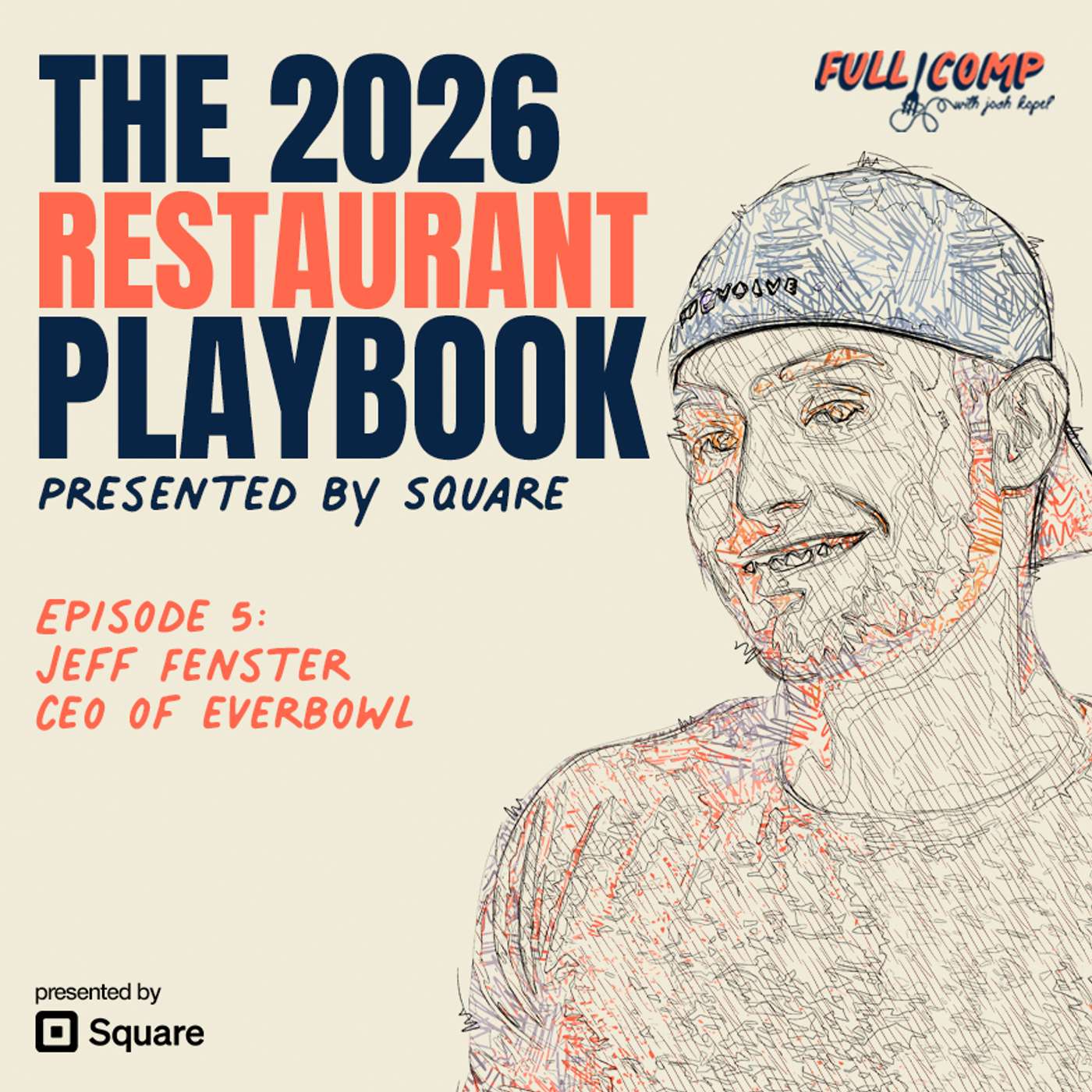
Over the last year I sat down with five operators who’ve walked every stage of building a restaurant business. Scott Snyder at Badass Coffee. Josh Halpern at Big Chicken and Craveworthy. Dan Simons at Founding Farmers. Randy Sharpe at Wahlburgers. Jeff Fenster at Everbowl.

Different segments, scales, and decades. The questions were always the same five.

1. Can people remember it?

Scott Snyder, Badass Coffee. He walked in as a consultant in late 2016 thinking he had a franchise sales problem. He didn’t. He had a brand recall problem.

His test for memorability is the one I keep stealing:

“If I saw it one time and I didn’t see it again for 30 days and someone brought it up, would I know what they were talking about?”

Badass passed it. What it didn’t have was what Scott calls a “unique and ownable truth,” the thing only that brand can say. Without it, in his words, “you may be dead where you stand.”

Scott’s framework for building one: three legs of the stool. The brand has to be memorable. The product has to validate the brand. The infrastructure (people, process, systems, training) has to deliver on the promise. Miss one leg and the stool falls. For Badass, the brand was strong (Jack the donkey, the 200-year-old Hawaiian coffee story). The product backed it up. The operational infrastructure had been missing for over a decade. Scott rebuilt that third leg before the first two could pay off.

Free Playbook   Get Scott Snyder’s Full Memorability Framework →

2. Do people actually want it?

Josh Halpern, Big Chicken and Craveworthy. Two units to nearly 50 in five years. Shaquille O’Neal owns the brand. Halpern is blunt about what that does and doesn’t do:

“He’s the biggest blessing and the biggest curse in the company. We have to pretend like he’s not a part of the brand to make sure that our operations are excellent.”

Celebrity drives trial. Operations bring people back.

Halpern’s framework for what actually drives return is something he learned at Clorox: three crucible moments. Point of Desire (your brand becomes the answer to “what should we eat tonight?”). Point of Decide (the register, the upsell, the milkshake add). Point of Delight (the bite of food itself). The restaurant industry owns Delight. It does an OK job at Decide. It mostly fails at Desire.

The brands that scale figure out which specific occasions they own. Halpern’s math: the average person eats out 26 times a month. He doesn’t need to be the answer 26 times. He needs to be the answer 4. So he hunts for 2 to 3 occasions where his brand is the obvious choice, then markets against those occasions on purpose.

Free Playbook

Get Halpern’s Full Demand Framework

The full three-crucible-moments breakdown, plus how to identify the 2–3 winnable occasions for your brand.

Download Free →

3. Can it survive?

Dan Simons, Founding Farmers. Systems aren’t enough. What matters is alignment between your capital, your team, your guests, and your concept.

Dan’s first restaurant had the systems. It still failed in 14 months. The lesson: when capital wants short-term returns and operators want long-term durability, the restaurant cracks under the strain. Both sides are doing their jobs. The alignment just isn’t there.

Dan structured Founding Farmers so the family farmers who supply the restaurants own more of the company than he and his partner do. The capital, the supply chain, and the operators all pull the same direction. That’s why, in his words:

“We’re still here at 18 years with 1,500 employees and $100 million in revenue.”

Alignment doesn’t replace systems. It outlasts them.

Free Playbook   Get Dan Simons’ Alignment Playbook →

4. Can it grow profitably?

Randy Sharpe, Wahlburgers. When Randy took the CEO chair, he found “17 menus in about 98 outlets. It was insanity.” On Mark Wahlberg’s celebrity, his read is the one to remember:

“It can’t be the engine, it has to be the fuel.”

So Randy cut. By store count, 70% of the outlets generated only 10% of the profit and 80% of the pain. He cut them. He cut the grocery-store partnership diluting the brand. Today the system runs on three menus instead of seventeen.

Randy treats every LTO as an audition for permanent menu space. Introduce, measure, promote. The ones that earn it stay. The ones that don’t get cut to make room for the next test. No emotional attachment to a recipe that isn’t pulling its weight.

His one line for the whole approach: be brilliant at the basics. The boring foundation compounds.

Free Playbook

Get Randy Sharpe’s Cut-To-Grow Playbook

How Wahlburgers went from 17 menus to 3, and the LTO audition system that keeps the menu lean.

Download Free →

5. Can it scale without breaking?

Jeff Fenster, Everbowl. His framing of how he scales:

“I don’t try to change behavior. I try to remove the things that I can’t and I’m not going to change.”

Cash has legs, so Everbowl is cashless. “If there’s no cash, there’s nothing to steal.” Staff form cliques when they know each other better than the guest, so Jeff hires only “friend-makers.” On slower shifts he engineers what he calls “curated boredom,” roughly five minutes of dead time between customers, where the team makes friends with the guest instead of each other.

Jeff also designed the kitchen so the dangerous variables don’t exist. No ovens. No hoods. No grease traps. No raw chicken. Everbowl makes bowls from three-gallon drums of pre-prepped ingredients in under 50 seconds. Less to break means less to manage.

On training, Jeff tells a story about his mentor David Cohn. Jeff was complaining about staff turnover. His exact question: “Why am I spending so much on training?” Cohn’s reply: “What if they stay?” That one question rewired how Everbowl trains. Train like everyone is staying. Then they do.

Free Playbook   Get Jeff Fenster’s Scale Playbook →

The order matters more than the answers

The questions aren’t parallel. They’re sequential. Each question builds on the one before it.

The questions stack:

  • You can’t build demand for a forgettable concept.
  • You can’t survive without demand.
  • You can’t grow profitably without surviving.
  • You can’t scale what isn’t profitable.

Skip a question, the next one collapses.

This sounds obvious written down. It’s not obvious in practice. Most operators I talk to try to fix Question 4 or 5 when their actual problem is Question 1 or 2.

They optimize labor costs and inventory shrink in a restaurant nobody can remember. They chase franchise sales for a brand without a clear answer to who it’s for.

The work is to find your lowest-numbered “no” and start there. Honestly, this is harder than it sounds. Most of us would rather work on the question we’re closer to answering than the one we know we haven’t.

Where most operators actually break

Most operators don’t break at the question they think they’re working on.

The ones who think they have a marketing problem usually have a Question 1 problem. Nobody can describe what makes the restaurant different in one sentence 30 days after visiting.

The ones who think they need more trial usually have a Question 2 problem. The trial they get isn’t converting, because they haven’t won a specific occasion.

If you’re sitting with those two questions and not sure which one is biting you, the playbook is built to help you figure it out. Grab the full PDF here. It’s the field notes from all five conversations, distilled.

The work that’s actually yours

What surprised me most across these conversations was how unromantic the answers are.

The operators who built durable restaurants didn’t out-cook anyone. They out-thought everyone. They asked harder questions earlier. They cut faster when something wasn’t working. They let go of the version of the restaurant they wanted to build in favor of the version their guests actually needed.

Dan’s signoff line at the end of our conversation stuck with me:

“Hold people, then write it down.”

That’s the whole job. See your employees as humans, take care of them. Then build the system that captures what’s working, so it survives the next 50 hires.

You can fix an average concept. You can’t fix an operator who can’t see the question they need to answer.

So here’s the real question. Which of those five questions are you actually stuck on? Not which one feels good to work on. Which one is the lowest-numbered “no” in your business right now?

That’s the chapter you need.

Presented by Square

Get The FULL COMP 2026
Restaurant Playbook — Free

Field notes from five conversations with operators who’ve answered each question at scale. No deck, no upsell, no fluff. Just the actual frameworks the people in the trenches use.

Download The Playbook
★ ★ ★ ★ ★   Square is the presenting partner for the series.

FAQs

Why do restaurants really fail?

Most restaurants don’t fail on bad food. They fail because they’re forgettable, undercapitalized, misaligned with their guest, or trying to grow before they’ve survived. The food is rarely the actual problem.

What is the actual restaurant failure rate?

The 90% first-year failure rate quoted on cable TV is a myth. Cornell’s Parsa study found the real first-year failure rate for independent restaurants sits around 26%. Cumulative three-year failure sits closer to 59%, similar to most other small business sectors.

What are the five questions every restaurant has to answer?

Can people remember it? Do people actually want it? Can it survive? Can it grow profitably? Can it scale without breaking? Each question builds on the one before it. You don’t get to the next question until you’ve answered the one before.

How do I know which question my restaurant is stuck on?

Find the lowest-numbered “no” you can honestly say. If a stranger couldn’t describe your restaurant in one sentence 30 days after visiting, you’re stuck at Question 1. If trial isn’t converting to repeat visits, you’re stuck at Question 2.

What’s in the FULL COMP 2026 Restaurant Playbook?

A breakdown of each of the five questions with the operator who built through it: Scott Snyder, Josh Halpern, Dan Simons, Randy Sharpe, and Jeff Fenster. Practical frameworks for memorability, demand, survival, profitable growth, and scale.

Is the playbook actually free?

Yes. It’s a free PDF download from offers.joshkopel.com. No paywall, no upsell inside. Square is the presenting partner for the series.

Kim Alter: Control Is the Growth Strategy

What if the smartest restaurant you could open wasn’t the biggest, busiest, or most celebrated, but the one you could control?

Kim Alter didn’t build Nightbird to chase stars. She built it to survive—and more importantly, to profit. In an industry obsessed with growth and recognition, she chose discipline: tight costs, small footprint, and total operational control.

In this conversation, we unpack how Kim turned a 20-seat restaurant into a high-margin business, why she was willing to run unsustainably in the short term to build long-term stability, and how consulting sharpened both her standards and her boundaries.

This is for operators ready to stop chasing validation and start building something that lasts.

To learn more about Nightbird, visit nightbirdrestaurant.com.

_________________________________________________________

Free 5-Day Restaurant Marketing Masterclass – This is a live training where you’ll learn the exact campaigns Josh has built and tested in real restaurants to attract new guests, increase visit frequency, and generate sales on demand. Save your spot at restaurantbusinessschool.com

How to Build a Restaurant Catering Business: The Outbound System That Took Me from $250K to $1.6 Million

Expert Summary

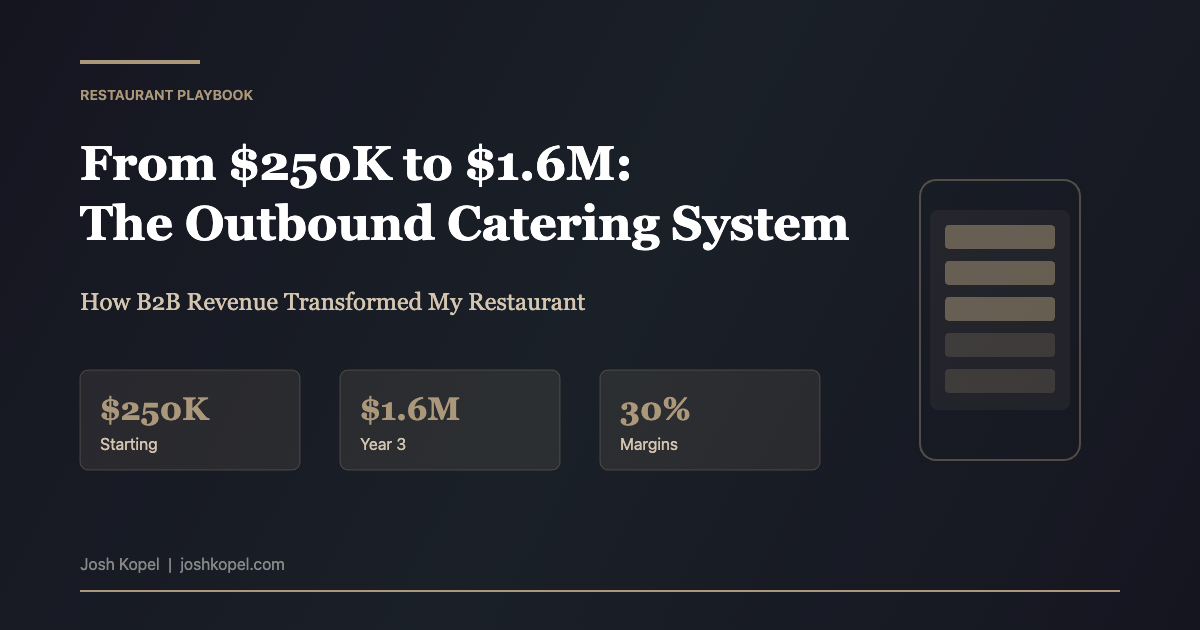
It takes the same amount of effort to sell a $16 fried chicken sandwich as it does to sell a $1,500 catering order or a $10,000 private event. Once I understood that, I stopped chasing small money and started dialing for dollars. My events and catering business went from $250,000 in inbound revenue to $1.6 million in under three years. A client in Miami sold $500,000 in events in 20 business days. A chef spent six hours on outreach and generated $1,500 per hour. The system is outbound, it’s math-driven, and it’s the fastest path to 15-20% net margins.

I’m going to share the paradigm shift that changed my entire business. It took the same level of effort to convince someone to come in and buy a fried chicken sandwich for $16 as it did to sell a $1,500 catering order. As it did to sell a $10,000 private event.

Read that again. Same effort. Same attention. Same 12 to 15 to 18 hour work days. The only difference was where I aimed.

Once I understood that, I stopped going after the small money. I started chasing the big money. I started dialing for dollars. And everything changed.

I had a decent events business at my restaurant. We were doing about $250,000 a year in inbound events. Within 12 months of switching to outbound, I grew it to a million dollars. The next year, we did $1.6 million. And it only grew from there.

Here’s the thing about private events and catering that most restaurant owners don’t realize: they’re annual occurring revenue when you do them the right way. If somebody has their holiday party with you and you don’t screw it up, why would they experiment? It becomes part of their tradition. It becomes part of their routine. It compounds over time.

Why B2B Is Where the Real Money Lives

One of the things I talk about with every client is hitting a 15 to 20% net margin. And people always ask, “How do you do it if we never talk about cost controls?”

The answer is a blended average. We work at 10 to 12% in-house, but then we supplement that with 30% margins on events, catering, and gift cards. That blended average puts you right at 20%.

Think about what you don’t carry with catering and events compared to in-house dining. You’re not paying for the full theater of a restaurant experience during those transactions. The margin structure is fundamentally different. And when you stack that on top of your existing infrastructure – same kitchen, same staff, same fixed overhead – the incremental cost is minimal.

My restaurants existed only to promote my catering and events business. Because that’s where the money was. That’s where the volume was. That’s where the margin was. The dining room was the marketing engine. The events and catering were the profit engine.

B2B is a more predictable sales cycle. You’re not trying to sell people something they don’t want. You’re trying to convince them to do something they’re already going to do – just do it with you. Companies are going to order catering. They’re going to throw holiday parties. They’re going to host client dinners. The only question is whether they do it with you or with someone else.

Understanding Who You’re Selling To

To sell anything effectively, you need to understand the people you’re selling to. And the people who professionally book catering and events are very nervous people.

Think about it. Imagine you’re setting up a holiday party for everybody at your company, and your overall performance review is going to be influenced by how it goes. The final sentiment at the close of the year is going to be rooted in the performance of someone that is not you – the restaurant or caterer you chose.

These people are not looking for you to give them a deal. They’re not trying to save money. More than anything, they’re looking to not get fired.

People only book for one of two use cases. Either they’re booking for people who give them money, or for people they’re directly related to. They don’t want to disappoint their boss, just like they don’t want to disappoint their mother-in-law.

What you’re selling isn’t food and beverage. It’s not events and catering. What you’re selling is confidence. And confidence comes from making the buyer feel like everything is handled, everything is going to be perfect, and they’re going to look great for choosing you.

Stop Waiting for the Phone to Ring

Here’s where most restaurants fail with catering and events. They wait for inbound inquiries. They put a “Private Events” tab on their website and hope someone fills out the form. Hoping for someone to fix your problems for you is not a great strategy.

I want you to think in terms of leverage. What are high-leverage activities you can do that will guarantee you more money? And the answer is outbound. Cold calling and cold emailing people who are more than likely going to do the thing you’re trying to sell them into.

Let me give you a quick example. I had a chef I work with in a very small metro. I told him to use our targeting system and reach out to as many people as he could, asking if they were hosting a holiday party that year. I didn’t hear from him for three weeks. Then he follows up and says, “Well, Josh, it didn’t work.”

I said, hold on. Tell me what you did, and then we’ll figure out what didn’t work.

He says he spent all this time on it and only brought in $9,000 in event sales. So I asked him how much time he actually spent. We went through the math. He spent about six hours on it. That’s $1,500 per hour.

A chef owner spent six hours doing outreach and generated $1,500 per hour for that effort. What else could he possibly be doing that’s worth $1,500 an hour? And if he were to 10x that effort, what would happen? A lot more money.

The Math of Outbound: Leading vs. Lagging Indicators

Most restaurant owners focus on lagging indicators – sales, revenue, event bookings. I don’t care about event sales as a metric. I worry about the things you do on the front end to get event sales. Those are leading indicators, and the best leading indicator is calls and emails.

Let me walk you through a real example. I work with a fine dining restaurant in Miami. She reaches out and says, “We need to sell $500,000 worth of events by the end of the year.” And it’s September.

Challenge accepted. Here’s the process we used.

For her to sell $500,000 in events at her tier, she needed to sell roughly 100 events at $5,000 each. We subtracted out her current events and the people she thought were going to book – all the fence-sitters, all the people we knew would ultimately close. That left us needing 75 new $5,000 events.

Then we looked at close rates. We assumed that if her targeting was right, one out of every 10 would close. Then I said, let’s make it worse. Let’s assume a 5% close rate – half that. At 5%, she’d need to reach out to 1,500 businesses to get those 75 bookings.

Based on the timeline from September, we had roughly 30 business days. So we agreed she would make 50 calls a day over those 30 business days.

Did she hit her target? She sold $500,000 worth of events in about 20 business days. Not 30. Twenty. Why? Because her targeting got better. Her close rate got better. Her pitch got better. She iterated over time. She didn’t stop. She actually stopped before reaching out to 1,500 businesses because she was already at capacity. She couldn’t take on any more business.

That’s what I want you to understand. You are in control of how much money you make. You just don’t know what you’re supposed to do with your time to make it.

Who to Target: The Law Firm Lesson

I worked at a law firm for about six months until I got fired. I’ve been fired from literally every job I’ve ever had, which is why I was forced into entrepreneurship at 24 years old. But when I worked for that law firm, the only thing I was qualified to do was order lunch for them.

Here’s what I found. Number one, they wanted variety. Number two, they had no budget – because they were always billing it back to the client.

So when I started South City fried chicken and began building our corporate catering strategy, I went straight to law firms. Then accounting firms. Then economics firms. Any large office where I knew they were billing catering back to the client.

Today, we use targeting systems to create prospecting lists based on proximity, industry, headcount, and then rank them by their perceived capacity to pay. Then we just reach out to those people.

Most law firms cater. They cater all the time. They can’t stop catering because they don’t have a budget – they bill it back. When I worked at that law firm, they ordered catering five days a week, and all they cared about was that it was delicious.

If you just started by making 20 calls a day, five days a week, you’d be making hundreds of calls a month. And it would directly translate to more money in your pocket.

Speed Kills the Competition

Here’s a question. When somebody reaches out to book on your website, how quickly do you get back to them? 24 hours? 48 hours?

The goal is one hour. But here’s the real statistic. If you reply to somebody within one minute of them filling out a form, you are 391% more likely to close that client.

One of the first things we do with all of our clients is replace the forms on their website with automation-backed forms. When somebody fills out a form, it immediately replies via text: “Hey, this is Josh. I want to let you know we got your inquiry and we’re working on it now. I’m going to follow up with you in less than five minutes with a couple of follow-up questions.”

Then four minutes later, an automated email goes out with specific questions we could have asked on the form but didn’t. Why didn’t we ask them on the form? Because we’re trying to engage in an authentic way.

Here’s what I figured out about my own business. When people reach out with an inquiry, they don’t want to book an event with you specifically. They just want to book an event. Period. Your goal is to stop their prospecting process. Make the inquiry they send you the last one they make, because you seem like you’re on top of it.

This works especially well in our industry because most restaurants aren’t aware of these automations. So it feels like a high level of service without tech getting in the way.

The Hand-Raising Email: Turn Your B2C List Into B2B Gold

Here’s a strategy that has generated massive results for my clients. How many people on your mailing list own businesses or work for businesses that could host a private event? How many of them work for companies that do catering all the time?

You don’t know. You can’t sort your list that way. So we use something called a hand-raising email to pull the B2B prospects out of your B2C list.

Instead of saying “Did you know we do corporate catering?” – which is talking about yourself with no benefit – we give it away. Here’s how it works.

We send an email to the entire list: “We are so excited about our new private events program. We’ve upgraded it this year, and to celebrate, we’re going to give away a complimentary holiday party to someone on this list for up to 250 people. To enter, reply with your name, business name, business website, total number of people, and the person who’ll be managing the event.”

Then we get a flood of responses. And I don’t know how this is possible, but it seems like every single time, the winner is the person with the fewest number of employees.

Then I send out a bulk message to everyone: “Congratulations to Lulu, she won, and we’re so happy to serve her. For those of you that didn’t win, I want you to feel like winners too. I’m going to be reaching out directly.”

Then I reach out to each person individually. “Hey Adam, you lost, but you’re not a loser. You’re a winner to me. And you still have this holiday party that you need to book for 150 people on December 19. I’d love to host it for you. Why don’t we connect, and I’ll go through all the things we can do. I assure you, I can plus up the event to the point where you feel like a winner too.”

It works. It works really well. Because they already opened your emails. They already know, like, and trust you. They already told you they have an event to plan. Now you’re just going to plan it together.

What It Looks Like When It Works

The Dundee Dell in Omaha, Nebraska – literally the oldest bar in Omaha – saw private events skyrocket by over 100% compared to the previous two years after implementing these strategies.

Marquise Steakhouse in Milton, Ontario increased the average price of their private events by 50% and doubled their event bookings.

These aren’t flukes. These are the predictable results of having best-in-class assets, an outbound system, and the discipline to make the calls.

And here’s what I’ll tell you from my own experience. When I ran a virtual reservationist service for hundreds of restaurants, I literally guaranteed complete strangers a 15% lift in top-line sales within two weeks. We hit it every time. Why? Because everyone was under-booked. The capacity was there. It just wasn’t being used.

Your 7-Day Catering and Events Outbound Action Plan

Day 1: Reach out to every past client. Contact every past event and catering client you’ve ever had. Invite them in for lunch or dinner. Say, “We appreciate you. Curious to know – do you have anything coming up on the horizon?” They’ve already given you money. They already know, like, and trust you. Bridge the gap and restart the conversation.

Day 2: Build your targeting list. Identify law firms, accounting firms, and large offices within your delivery radius. Focus on businesses that are billing catering back to clients. Create a list of at least 100 prospects to start.

Day 3: Set up automated response. Replace the forms on your website with automation-backed forms that send an immediate text response and a follow-up email within five minutes. Remember: responding within one minute makes you 391% more likely to close.

Day 4: Create your hand-raising email. Draft an email to your existing mailing list offering a complimentary event to one lucky winner. This pulls B2B prospects out of your B2C list without any hard selling.

Day 5: Start making calls. Commit to 20 outbound calls per day. That’s hundreds of calls per month. Track your leading indicators – calls made, emails sent – not just your lagging indicators like revenue.

Day 6: Audit your response speed. Time how long it takes your team to respond to an inbound event inquiry right now. If it’s more than an hour, fix it. The inquiry they make with you should be the last one they make.

Day 7: Do the math. Calculate what your business looks like with a blended margin. If in-house runs at 10-12% and events and catering run at 30%, what does your total margin look like when B2B represents 20% of your revenue? 30%? 40%? That number is your north star.

How much does all of this cost? Not a dime. It costs time and intention. And the ROI is the fastest money you’ll ever make in the restaurant business. Money likes speed. Start today.

Free Live Training

Want Me to Walk You Through These Systems Live?

Join the free 5-Day Restaurant Marketing Masterclass. In 40 minutes a day, I’ll show you how to build a marketing system that actually makes you money.

JOIN THE FREE MASTERCLASS

★★★★★ Rated 5/5 by 1,000+ restaurant owners

Frequently Asked Questions

How do I start a restaurant catering business with no existing clients?

Start with your mailing list. Use a hand-raising email to identify B2B prospects from your existing B2C audience. Then build a targeting list of law firms, accounting firms, and large offices near you – businesses that cater regularly and bill it back to clients. Make 20 outbound calls a day. A chef I worked with spent just six hours on outreach and generated $9,000 in event sales. That’s $1,500 per hour for his effort.

What margins should I expect from restaurant catering?

Events and catering typically run at 30% margins compared to 10-12% for in-house dining. When you blend those revenue streams together, your overall margin jumps to 15-20% without cutting a single cost. My events business went from $250K in inbound revenue to $1.6 million in under three years. Same kitchen. Same staff. Same fixed overhead.

How many outbound calls do I need to make to fill my events calendar?

It depends on your close rate and average event size. A client in Miami needed $500,000 in events. We assumed a 5% close rate and calculated she’d need to reach 1,500 businesses. She committed to 50 calls a day and hit her target in 20 business days – not because the math was wrong, but because her pitch improved with practice and she closed better than 5%.

How quickly should I respond to catering and event inquiries?

Within one hour at the absolute maximum. But the data shows that if you reply within one minute, you are 391% more likely to close. We use automation-backed forms that send an immediate text response and a follow-up email within five minutes. The goal is to stop their prospecting process. Make yours the last inquiry they send.

How do I make catering and event revenue recurring?

Private events are annual occurring revenue when you do them the right way. If a company has their holiday party with you and you don’t screw it up, it becomes tradition. They won’t experiment. The same applies to regular corporate catering – law firms I’ve worked with order catering five days a week. Once you’re their vendor, switching is friction they don’t need. The key is not screwing up the first one and following up consistently.

How to Build a Restaurant That Can Survive: Dan Simons of Founding Farmers

Dan Simons had the systems. He had the corporate restaurant training. He had the operational discipline. And his first independent restaurant still failed in 14 months.

That failure became the foundation for Founding Farmers.

In this episode, Dan breaks down the third question every operator has to answer: can this business actually survive?

We talk about why good food, good service, and even good systems are not enough if the concept is misaligned with the market, the business is undercapitalized, or the ownership structure is built for short-term pressure instead of long-term durability.

Dan explains how Founding Farmers was built around alignment between farmers, investors, employees, guests, and leadership, and why that alignment matters more than most operators realize. We also get into product-market fit, capital, team retention, sustainability, AI visibility, PR, and what it really takes to build a restaurant that is still here tomorrow.

This is the episode for operators trying to make it through the early years and build something durable.

To go deeper, download the free 2026 Restaurant Playbook at joshkopel.com/square

_________________________________________________________

Today’s episode was brought to you by Square. If you want restaurant tech that actually supports how you run your restaurant, find out how Square can help at square.com/goodstuff.

Free 5-Day Restaurant Marketing Masterclass – This is a live training where you’ll learn the exact campaigns Josh has built and tested in real restaurants to attract new guests, increase visit frequency, and generate sales on demand. Save your spot at restaurantbusinessschool.com 

Peter Wright: Stop Chasing New Customers

What if the biggest risk in scaling your restaurant isn’t the market, but the people you trust to grow it?

Peter Wright has spent decades inside brands like Starbucks, Panera, and now Jollibee, building systems that scale through people. But what he’s learned is simple: most operators focus on experience and capital, while the best brands optimize for something far less obvious.

In this conversation, we get into how to identify franchise partners who will actually protect and grow your brand, why humility beats track record, and how values move from posters on a wall to decisions on the floor.

If you’re thinking about scaling through people, this is the filter you didn’t know you needed.

To learn more about Jollibee Group North America and their expanding franchise program, visit jollibeefoods.com.

_________________________________________________________

Free 5-Day Restaurant Marketing Masterclass – This is a live training where you’ll learn the exact campaigns Josh has built and tested in real restaurants to attract new guests, increase visit frequency, and generate sales on demand. Save your spot at restaurantbusinessschool.com

Sales Is Service: How the Perfect Check Method Adds Six Figures Without Selling Harder

Expert Summary

Your team isn’t selling because sales feels dirty. But sales is service. 80% of the people in your restaurant every day are first-timers who have no idea what to order. The Perfect Check method engineers the ideal experience from the menu up, then uses your best server to pilot it across the team. One client projected a $3.39 per-customer lift and hit $3 within 30 days, translating to roughly $290,000 in additional annual revenue on flat covers. Another client’s menu engineering report identified over $300,000 in hidden revenue. None of this costs a dime to execute.

Let me ask you something. How much would it cost you to do everything I’m about to describe in this article?

Zero dollars. Not a penny. Everything we’re going to talk about requires time and intention, not money. And yet, the tactics in this post have generated hundreds of thousands of dollars in additional revenue for my clients. That gap between cost and return is the entire game.

Here’s the problem. Your team can’t sell. Or they won’t sell. Or they’re afraid to sell. And the reason is simple: sales feels dirty. Nobody likes being sold to. Nobody likes to sell. Your servers don’t want to feel like that greasy car salesman pushing the extended warranty.

But here’s the reframe that changes everything. What you call upselling, I call advocacy. And advocacy isn’t selling. It’s service. That distinction is worth six figures a year.

Sales Is Service: The Foundation

When a customer sits down in your restaurant, they have incomplete information. They don’t know what to order. They don’t know what pairs well. They don’t know what you’re known for. They don’t know how your menu works. They don’t know anything about you.

And here’s the statistic that should change how you think about this forever: 80% of the people sitting in your restaurant every single day are first-timers. They have no earthly idea what to order. They have no idea how to engage with you. They don’t know how you fit into their life.

But what they want, what we all want, is to have the best imaginable version of this particular experience. They’re already in your restaurant. They’re pot committed. They want you to help them order right. They just don’t know how to define “right.”

You have to define right for them.

That’s not upselling. That’s advocacy. When you advocate for a customer’s best experience, when you guide them toward the items that will make their meal memorable, that’s service. And it’s the highest form of service you can offer.

The Perfect Check: Engineering the Ideal Experience

Here’s the most powerful tool I can give you. It’s called the Perfect Check, and it’s the math behind a perfect experience.

Most restaurant owners think about per-customer average spend as an abstract number. “It’s at $32. I’d love it to be at $48.” But then when you look at what customers actually need to order to get there, the current menu makes it impossible. There’s a limited amount of space in a human stomach. The pricing doesn’t line up. The menu isn’t structured to guide them there.

The Perfect Check flips this. Instead of hoping customers spend more, you engineer the experience so that the best version of their meal naturally hits your target spend. It’s not about selling more. It’s about selling this.

Here’s how it works. Your Perfect Check is the most idealized version of your restaurant. It’s the combination of items that creates the best possible experience for the customer. And when that combination happens to hit the per-customer average you’re trying to achieve, you’ve aligned customer satisfaction with profitability.

The beautiful part? Your Perfect Check already exists in your restaurant. You already have a server or bartender who’s crushing it. They’re selling the specials. They’re selling the right things at the right time. They’re getting people into the limited-time offers. That server’s typical check is your Perfect Check. All we need to do is figure out what they’re doing and teach everyone else to do it.

The Hell’s Kitchen Case Study: From $85 to $125

I had a client with a fine dining Italian concept in Hell’s Kitchen. Their per-customer average spend was sitting at about $85. But their best customers were spending $125 a person.

The owner’s initial reaction was, “Most people won’t spend that.” But I looked at the data, and one server was hitting that number almost every time she got in front of a table. So the question wasn’t whether customers would spend $125. They already were. The question was why only one server was making it happen.

We re-engineered the entire menu around getting people to choose one item from each section. That’s it. Not pushing more food. Not adding expensive add-ons. Just structuring the menu so the natural path through it, one selection per section, landed at $125.

The result wasn’t just higher per-customer average. It was a better experience. Customers who followed that path left happier, tipped better, and came back more often. The Perfect Check isn’t just a revenue tool. It’s a frequency tool. When people have the idealized experience, they return.

Menu Design That Sells for You: The Farm Bar Example

Let me show you what this looks like in practice with a concept called Farm Bar.

When I got hold of their menu, 90% of the people coming in ordered the cheese curds. That’s a striking attachment rate. The cheese curds were located in a section called “Appetizers.” And here’s what was happening: customers would look at the appetizer section, see the cheese curds, check that box, and move on to the next section. Binary decision made. Done.

That’s not what I wanted. The binary decision shouldn’t be “are you getting an appetizer or not?” It should be “are you getting the cheese curds or not?” Because the cheese curds are their own thing.

So I created a new section called Farm Bar Famous. It contained one item: the cheese curds. Binary choice. Do you want them or don’t you? Once that decision was made, customers moved into a section called Quick Hits, which was the appetizer section. Now they were choosing the cheese curds AND an appetizer. Instead of one or the other.

But the bigger move was what I did with burgers. Farm Bar sold a ton of burgers. The burger section was called “Handhelds” and it appeared just before the Mains section. Customers would see the burger, decide on it, and then review the rest of the menu without changing their mind. There’s extensive data on this: once people make a decision, an egoic barrier prevents them from reversing it. They’d see the burger, choose the burger, and never get to the items that actually made Farm Bar a category of one.

I moved the burger section below the Mains and renamed it from “Handhelds” to “Sandwiches.”

Why? Because nobody goes out to dinner to have a sandwich. Children eat sandwiches for dinner. There’s nothing sexy about it. And I changed the description to something like “for when you’re keeping it casual or need a lunch classic done right.” In other words: don’t do this. This is not why you’re here. Choose better.

The result: burger sales plummeted. Main sales skyrocketed at four-to-one, five-to-one over the sandwiches. Appetizer sales doubled because people were now buying cheese curds AND a separate appetizer. Per-customer average spend climbed significantly. Same menu items. Just different architecture.

Menu Engineering: Finding $300,000 in Hidden Revenue

Menu design is how you architect the layout. Menu engineering is what your team says and how you optimize attachment rates. Both matter, but engineering is where the compounding happens.

For every client, we run a detailed menu engineering report. We scrape data, do benchmarking analysis, look at the numbers to determine attachment rates, and identify the gaps where people could buy a little bit more and have an exponentially better experience.

Let me walk you through a real example. We did this analysis for a client and found multiple levers:

Competitive benchmarking lift: We pushed his pricing to P90 (90th percentile in his market). Just that adjustment alone increased per-customer average spend by 42 cents. That’s nothing, right? But on flat covers over a year, the bump was significant.

Non-alcoholic beverage attach: Most of his customers were drinking water. Not because they didn’t want a drink, but because his menu wasn’t offering anything compelling in that category. We created a Boba Arnold Palmer, 16 ounces with ice in a 24-ounce Mason jar. It absolutely crushed. Scaled his lift by 64 cents per guest, which translated to over $60,000 a year in annual revenue. And the target attachment rate wasn’t aggressive at all. We were just trying to take it from awful to mediocre.

Sampler creation: We saw a hole where people were choosing between individual items. Generally speaking, if people have to choose between this, that, or everything, they’ll choose everything. The sampler alone estimated a lift of $48,000 annually.

Premium protein upgrade: Most people were ordering the noodles without the high-end proteins. All we told the team was: whenever anyone orders soup, offer the premium filet as an add-on. Simple ask. Meaningful lift.

Dessert as experience: The issue with dessert in most restaurants is that people treat it as an afterthought, just extra calories at the end of a meal. We repositioned dessert as the conclusion of the experience. It would be a mistake for you to not have dessert with us, because it’s part of what we’re selling here.

The headline: total model lift on flat covers was over $300,000 in the trailing 12 months. These are not crazy adjustments. This is not rocket science. We’re helping people make more informed buying decisions based on what the restaurant is best in the world at.

The Ramen Lab Result: $290,000 from a $3 Lift

Lewis owns Ramen Lab. We projected a $3.39 per-customer lift based on our engineering report. Within 30 days, he’d already hit $3. That projects out to roughly $290,000 in increased annual revenue on flat covers.

Let me say that again. No new customers. No new marketing spend. No new menu items. Just restructuring what already existed so that people had a better experience and spent a little more doing it.

That’s the power of engineering your menu instead of hoping your team will sell harder.

Pilot With Your Best, Then Roll to the Rest

Don’t try to roll a new selling system to your entire team at once. It won’t work. Instead, find your best server. The one who’s already crushing it. The one whose per-customer average is significantly higher than everyone else’s. Study what they’re doing.

Chances are, they have an intuitive system. They always recommend something to start with. They pair beverages with meals. They mention dessert as part of the experience, not as an afterthought. They guide rather than list.

Document what your best server does. Codify it. Test it with one other server. Refine it. Then roll it to the team. When you teach through the lens of your own best performer, it doesn’t feel like corporate training. It feels like sharing what works.

And here’s how you get buy-in: show them the money. When your best server’s per-customer average is significantly higher than everyone else’s, that means their tips are higher too. Show the team the correlation. “This is how much more Sarah makes because she guides customers through the Perfect Check.” Motivation works through self-interest. Always has. Always will.

Breaking Limiting Beliefs: The Dead Rabbit Example

I want to break the belief that there’s some sort of ceiling on what’s possible.

Jack McGarry owns the Dead Rabbit in New York. It’s about 3,600 square feet total, split across multiple floors. Not small, but not massive. It’s essentially an Irish pub that does food business.

Jack makes a million dollars a month from that single location.

A million dollars a month. From less than 4,000 square feet. Is he superhuman? No. Are you half as smart as Jack? Then you’ve got a half-million-dollar-a-month restaurant. A quarter as smart? That’s still $250K a month.

There is no ceiling on how much money you can make. I thought I was busy at $1.8 million. Then $2.3 million. Then $3.4 million. Then $4.6 million. It just kept growing. If you’re struggling, these systems will fix it. If you’re already scaling, know that there’s massive headroom above you.

Your 7-Day Perfect Check Action Plan

Day 1: Identify your Perfect Check. Look at your POS data. Find your best server. What does their average check look like? What items are their customers ordering? That’s your Perfect Check target.

Day 2: Map the experience. Write down what the ideal meal looks like at your restaurant, section by section. What should someone order to have the best possible experience? Does that combination hit your target per-customer average?

Day 3: Audit your menu architecture. Is your menu guiding people toward the Perfect Check, or is it sending them toward burgers and water? Look at the sequence of sections. Are your hero items positioned to be chosen first?

Day 4: Identify the gaps. Where are your attachment rates weak? Non-alcoholic beverages? Appetizers? Dessert? Premium upgrades? Each gap is an opportunity to improve the experience and the spend simultaneously.

Day 5: Create binary choices. Like the Farm Bar cheese curds, separate your hero items into their own sections. Make the decision simple: do you want this or not? Then let the rest of the menu build on top of that decision.

Day 6: Pilot with your best server. Share the Perfect Check framework with your top performer. Get their input. Refine the approach. Track their results for a week.

Day 7: Roll to the team. Show them your best server’s results. Show them the tip differential. Teach advocacy, not salesmanship. “This is what our best customers order. Let’s help everyone have that experience.”

None of this costs money. All of it makes money. Money likes speed. Start today.

Free Live Training

Want Me to Walk You Through These Systems Live?

Join the free 5-Day Restaurant Marketing Masterclass. In 40 minutes a day, I’ll show you how to build a marketing system that actually makes you money.

JOIN THE FREE MASTERCLASS

★★★★★ Rated 5/5 by 1,000+ restaurant owners

Frequently Asked Questions

How do I get my staff to upsell without being pushy?

Reframe it entirely. It’s not upselling. It’s advocacy. 80% of your customers are first-timers who have no idea what to order. When your server says “most guests start with our cheese curds while they look at the menu,” that’s service, not selling. Give your team permission to guide rather than push, and give them permission to accept “no” without guilt. That’s the difference between advocacy and salesmanship.

What’s a realistic increase in per-customer average spend?

A $3 to $5 lift per customer is realistic and achievable within 30 days. Lewis at Ramen Lab hit a $3 lift within 30 days, projecting to roughly $290,000 in additional annual revenue. Another client’s menu engineering report identified over $300,000 in hidden revenue through benchmarking, attachment rate optimization, and menu restructuring. The numbers compound because they apply to every single customer, every single day.

Should I change my entire menu to implement the Perfect Check?

No. Start with restructuring, not reinventing. Look at what your best customers already order and engineer the menu to guide everyone toward that experience. Sometimes it’s as simple as moving a section, renaming a category, or creating a new section for your hero item. At Farm Bar, we didn’t add or remove a single menu item. We just reorganized the architecture, and per-customer average climbed significantly.

How do I handle servers who resist the new approach?

Show them the money. When your best server’s average check is significantly higher than everyone else’s, their tips are higher too. Show the correlation. Motivation works through self-interest. Don’t ask them to adopt a new process because it’s good for the restaurant. Show them how it’s good for their wallet.

Does the Perfect Check method work for fast casual and quick service?

Absolutely. The principles are the same even without table service. At the counter or on the menu board, you’re still engineering the path through the menu. Binary choices, hero items positioned first, strategic sequencing, and clear signals about what you’re known for. The medium changes but the psychology is identical. Digital menu boards and kiosk ordering actually make this easier because you control the exact sequence customers see.

How to Build a Restaurant People Actually Want: Josh Halpern, Big Chicken & Craveworthy Brands

Celebrity can create trial. It cannot create loyalty.

Josh Halpern helped take Big Chicken from 2 units to nearly 50, but in this conversation he is clear about the trap behind celebrity-backed restaurant brands: people may come once because of the name, but they only return if the operations, service, product, and guest experience hold up.

In this episode, Josh breaks down the second question every operator has to answer: does the market already have a reason to choose this?

We talk about the difference between the shopper and the consumer, why operators confuse attention with demand, and how to build a restaurant around real guest occasions instead of wishful thinking. Josh also shares how Big Chicken thinks about LTOs, frequency, loyalty, craveability, value engineering, and the three moments that matter most in the guest journey: desire, decide, and delight.

This is the episode for operators who want to stop chasing generic traffic and start owning a specific role in their guests’ lives.

To go deeper, download the free 2026 Restaurant Playbook at joshkopel.com/square

_________________________________________________________

Today’s episode was brought to you by Square. If you want restaurant tech that actually supports how you run your restaurant, find out how Square can help at square.com/goodstuff.

Free 5-Day Restaurant Marketing Masterclass – This is a live training where you’ll learn the exact campaigns Josh has built and tested in real restaurants to attract new guests, increase visit frequency, and generate sales on demand. Save your spot at restaurantbusinessschool.com

FREE DOWNLOAD

Leverage Digital Media to Drive Traffic to Your Restaurant

This free (and highly detailed) guide will outline how to tell your story in the most compelling way possible and how to share that story with the masses.

(Yep, even if you’re not a “tech” person!)

FREE DOWNLOAD

Lead Your Team Instead of Managing Them

This free (and highly detailed) guide will give you everything you need to know to build and lead a world class team from scratch, ensuring you work less and earn more. (Yep, even if you know nothing about leadership.)

FREE DOWNLOAD

Ready to Optimize, Manage and Grow Your Restaurant’s Profit Margin But Not Sure Where to Start?

This free (and highly detailed) cheat sheet will give you everything you need to know to set up your restaurant to maximize profitability. (Yep, even if you’re not a “business” person!)

Free 5-Day Marketing Masterclass

Join Now

5 Day Restaurant
Marketing Masterclass

100% Free

Get the tactics, tools, and strategies you need to scale your restaurant’s profits by 15% — in just five days.

See What You'll Learn