Skip to Main Content Skip to main content

Josh Kopel | Award Winning Restaurant Consultant

You’re Offering Gift Cards. You Should Be Selling Them. Here’s the Difference.

Expert Summary

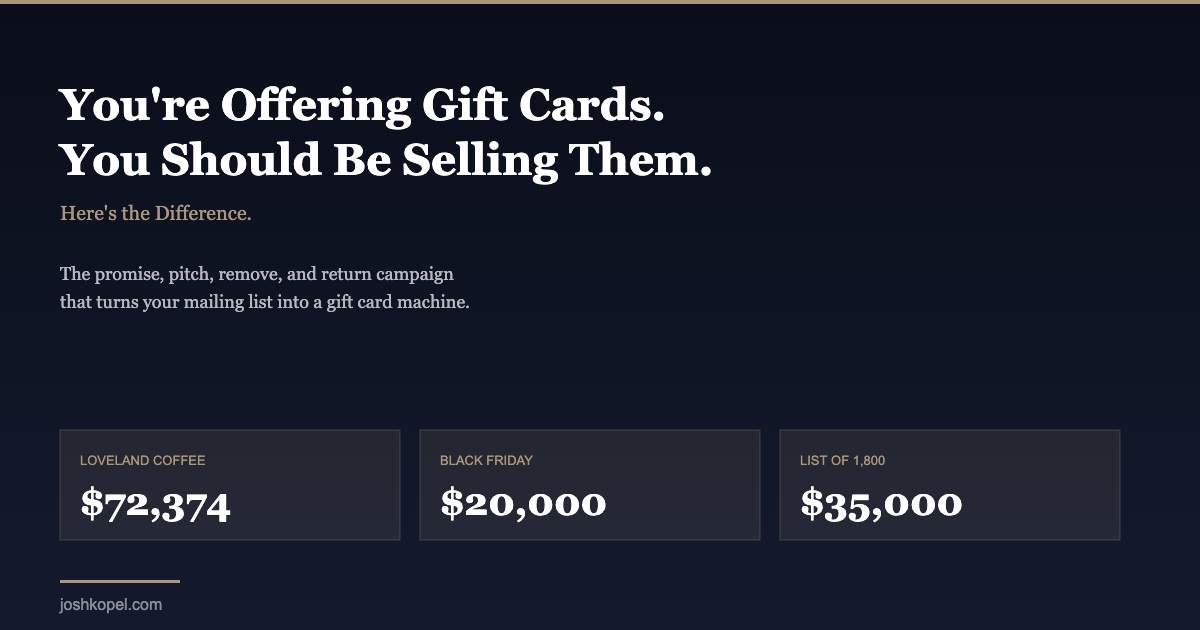
Are you offering gift cards, or are you selling them? Because there’s an entire business around selling gift cards. Gift cards statistically redeem at an 80% rate. That means you can offer a 20% discount and generally speaking, you’re at a flat margin. That feels like a really good deal. Loveland Coffee in Irmo, South Carolina sold $72,374.10 in gift cards in 2025. Black Flannel in Essex, Vermont sold $20,000 on Black Friday alone. Urban Omni in Whitefish, Montana sold $35,000 to a mailing list of 1,800. Here’s the system that makes it work.

There’s a question I ask every restaurant owner I work with about gift cards, and it changes the way they think about this entire revenue stream. Are you offering gift cards, or are you selling them?

Because I think there’s a whole business around selling gift cards. And what triggered that foundational realization for me was this: gift cards statistically redeem at an 80% rate. If that’s the case, that means I can offer a 20% discount, and generally speaking, I’m at a flat margin. That feels like a really good deal. That feels like I can use that to create a lot of perceived value.

So I started looking at the opportunities to do it. And what I found is that when you combine the right timing, the right offer, and the right audience, gift card sales become one of the most powerful revenue levers in your business. No new customers required. No new menu items. No new marketing spend. Just a strategic approach to something you’re probably already doing passively.

Sell When People Are Already Primed to Buy

The best time to sell is when people are primed to buy. That sounds obvious, but most restaurants completely ignore the timing component of gift card sales.

For me, it started with corporate gifting. If you were hosting a private event with me for a holiday party, I would say, “Hey John, wouldn’t it be cool if at the end of the event, we were able to hand out gift cards to everyone for $20, $30, $40? You know, if you buy them in bulk, I’ll give you a 20% discount.”

Or John comes to me and says, “Man, it’s been a really bad year. We’re not going to be doing a holiday party this year.” To which I would say, “Well, come on, Scrooge. Let’s give them something. Why don’t you order gift cards? We’ll do gift cards. They had a party last year. They’re totally going to expect something. And if you do it, I’ll give you 20% off.”

We sold tens of thousands of dollars in gift cards that way. Just by being strategic about when and how we offered them to people who were already in buying mode.

The other occasion-based opportunity that works incredibly well is Black Friday. People are already looking to spend money on Black Friday. Nobody says, “Will I spend money on Black Friday?” The question is, what are they going to spend money on? So I want to throw my hat in the ring, because the people on my mailing list already know, like, and trust me.

The Promise, Pitch, Remove, and Return Campaign

The strategy we use to sell gift cards is a multi-tier campaign built around four phases: promise, pitch, remove, and return. You’ve seen this in every other industry. Here’s how it works for restaurants.

Promise. I make the announcement. I let my mailing list know that something special is coming. Something exclusive to them. Something they’re going to want to get in on.

Pitch. The next day, I pitch. “This is the thing we’re doing. It’s only available to our list. Click here to redeem before it goes public.” It goes public the next day. This creates an early-access window that makes your best customers feel like insiders.

Remove. Then I pull it. It ends at midnight. The discount code doesn’t work. The website is down. They no longer get access to the thing.

Return. A couple of days later, we re-release it. “Hey, due to overwhelming demand, we are now bringing this thing back. You now have 12 hours to get the thing.”

Why would we structure it this way? Because consumer buying behavior works like this. People only buy on two days. They buy on the first day, and they buy on the last day. Urgency is a thing. And so what this campaign does is it gives you one first day, but it gives you two last days.

It works. It works very well.

The Numbers That Prove This Works

I want to show you what this looks like when it’s executed at scale, because these aren’t theoretical numbers. These are real restaurants using this exact system.

Loveland Coffee in Irmo, South Carolina. In 2025, they sold $72,374.10 worth of gift cards. A coffee shop. Seventy-two thousand dollars in gift cards.

Black Flannel in Essex, Vermont sold $20,000 on Black Friday alone. One day. Twenty thousand dollars.

Urban Omni in Whitefish, Montana sold $35,000 worth of gift cards to a mailing list of 1,800 people. That’s nearly $20 per person on the list. From a single campaign.

It works. It’s really compelling. If your list is primed to buy, this is how you sell.

The Corporate Gifting Lever

Beyond direct-to-consumer gift card campaigns, there’s another entire revenue stream hiding in corporate gifting that most restaurants completely ignore.

Companies need gifts for their employees. They need client appreciation gifts. They need year-end bonuses that feel personal. They need holiday gifts that don’t feel generic. Gift cards from a great local restaurant check every single one of those boxes.

The approach is simple. When someone is already booking a private event with you, the gift card conversation is natural. “While we’re putting this event together, would you like to send everyone home with a gift card? If you buy them in bulk, I’ll give you 20% off.” The 20% discount is not actually a discount – remember, gift cards redeem at 80%. You’re at flat margin. But it feels like a massive win for the buyer, and they get to be the hero who gives everyone something personal and local instead of another Amazon gift card.

Even companies that aren’t doing holiday parties need a gifting solution. That’s your opening. “I know you’re not doing an event this year, but let’s make sure your team still feels appreciated.” Gift cards solve that problem instantly, and at scale, the numbers add up fast.

Marketing Is Math, and the Key to Success Is Scale

Here’s what I’ll tell you about gift card sales, and really about everything we’ve covered in this entire series. Marketing is math, and the key to success is scale.

If you reach out to 10 people a day for three days and it doesn’t work, you’re not doing it right. What we have to do is 10x, 100x these efforts, because these are the things that create the biggest impact in your business.

The promise, pitch, remove, and return campaign works because it’s sent to your entire list. Not a segment. Not a test group. Your entire list. The corporate gifting pitch works because you’re embedding it into every event conversation, not just mentioning it once a year in December.

And the 20% discount works because the math supports it. Gift cards redeem at 80%. You’re not losing money on the discount. You’re creating perceived value at flat margin while simultaneously driving future visits from people who redeem those cards.

Every gift card redeemed is a person walking through your door. Many of them are first-timers who have never been to your restaurant. If you give them the best imaginable version of the experience – which is the whole point of everything I teach – they come back. And now that gift card has turned into a customer acquisition tool that paid for itself.

Insulate Yourself from the Volatility of the Industry

One of the core reasons I push gift card sales so hard is diversification. When we make money more than one way, what we do is insulate ourselves from the volatility of our industry.

In Los Angeles, when it drizzles, revenues go down by 20% for the day. That used to panic me. What I wanted to do was make sure I was guaranteed to make money no matter what, because I was in direct control of it. Diversification of revenues is the best way to do that.

I talk about hitting a 15 to 20% net margin with every client. How do I do it if we spend absolutely no time talking about cost controls? It’s a blended average. We work at 10 to 12% in-house, but then we supplement that with 30% margins on events, catering, and gift cards. That blended average puts you right at 20%.

Gift cards are part of that equation. They’re high-margin revenue that you control. They’re not subject to weather or foot traffic or whether your server calls in sick on a Saturday night. You sell them on your terms, on your timeline, to people who already love you.

Your 7-Day Gift Card Sales Action Plan

Day 1: Check your current gift card sales. Pull the data. How much did you sell in gift cards last year? If you don’t know, that’s your first problem. You can’t optimize what you don’t measure. Get the number.

Day 2: Build the promise, pitch, remove, and return campaign. Write the four emails. Promise announces it’s coming. Pitch delivers the offer with early access for your list. Remove pulls it at midnight. Return brings it back 48 hours later with a 12-hour window. Load them into your email system.

Day 3: Add a corporate gifting pitch to your event conversations. Train your team to ask one question during every event planning conversation: “Would you like to send everyone home with a gift card?” Offer the 20% bulk discount. Remember – at 80% redemption, you’re at flat margin.

Day 4: Plan your seasonal calendar. Identify every gifting occasion on the calendar – Black Friday, Christmas, Valentine’s Day, Mother’s Day, Father’s Day, graduation season. Each one gets its own campaign using the same four-phase structure.

Day 5: Create the “no party” pitch. For every company that tells you they’re not doing a holiday party this year, have a gift card counter-offer ready. “Let’s give them something anyway. Gift cards for the whole team, 20% off bulk orders.” Don’t let the conversation end at “no party.”

Day 6: Set your Black Friday target. Based on your mailing list size, what’s a realistic gift card sales goal for Black Friday? Black Flannel did $20,000 in one day. Urban Omni did $35,000 from a list of 1,800. Set your number and build backward from there.

Day 7: Launch your first campaign. Don’t wait for November. Your restaurant’s anniversary, a seasonal menu launch, a random Tuesday – any occasion works when the offer is compelling enough. The system works because the system works. Money likes speed. Start today.

Free Live Training

Want Me to Walk You Through These Systems Live?

Join the free 5-Day Restaurant Marketing Masterclass. In 40 minutes a day, I’ll show you how to build a marketing system that actually makes you money.

JOIN THE FREE MASTERCLASS

★★★★★ Rated 5/5 by 1,000+ restaurant owners

Frequently Asked Questions

Why can restaurants offer a 20% discount on gift cards and still make money?

Gift cards statistically redeem at an 80% rate. That means 20% of the money you collect never comes back as an expense. So when you offer a 20% bulk discount, you’re generally at a flat margin – the discount is covered by the non-redemption rate. It feels like a massive deal to the buyer, but the math works in your favor every time.

What is the promise, pitch, remove, and return campaign for gift card sales?

It’s a four-phase email campaign. Promise announces something special is coming. Pitch delivers the offer with exclusive early access for your mailing list. Remove pulls the offer at midnight – the code stops working, access ends. Return brings the offer back 48 hours later with a tight 12-hour window. It works because people buy on the first day and the last day, and this structure gives you one first day and two last days.

How much can a restaurant realistically sell in gift cards?

Loveland Coffee in Irmo, South Carolina sold $72,374.10 in gift cards in 2025. Black Flannel in Essex, Vermont sold $20,000 on Black Friday alone. Urban Omni in Whitefish, Montana sold $35,000 to a mailing list of just 1,800 people. The results depend on your list size, your offer strength, and your willingness to actually sell rather than passively offer.

How does corporate gift card sales work for restaurants?

When a company is hosting a private event with you, offer to provide gift cards for all attendees at a 20% bulk discount. For companies not doing events, pitch gift cards as an alternative way to appreciate their team. Companies need client gifts, employee bonuses, and holiday presents. Gift cards from a great local restaurant feel personal and premium, and at 80% redemption, your 20% discount costs you nothing.

Why should gift cards be part of a restaurant’s overall revenue strategy?

Gift cards help you hit a blended 15 to 20% net margin. In-house dining runs at 10 to 12%. Events, catering, and gift cards run at 30% margins. When you blend those revenue streams, the overall margin rises without cutting a single cost. Gift cards also insulate you from the volatility of the industry – they’re not subject to weather, foot traffic, or staffing issues. You sell them on your terms to people who already love you.

Ryan Volberg: Double Revenue Without New Guests

What if the new customers you keep chasing are the reason your restaurant isn’t growing?

Ryan Volberg has spent more than two decades building the tools restaurants actually needed, from the first cloud POS to earned wage access. Now, as founder of Guestologie, he’s attacking the most expensive blind spot in hospitality: the anonymous guest who walks in, gets seated, and leaves without anyone realizing they could have been a regular.

In this conversation, we get into why frequency beats acquisition every time, why status is the cheapest loyalty tool you own while discounts are the most expensive, and how to grow revenue from the guests already sitting in your dining room.

If you’re spending to fill seats instead of keeping the right ones, this one earns its time.

That’s Ryan Volberg. To learn more about Guestologie and how they help restaurants see and keep their highest-value guests, visit guestologie.com.


_________________________________________________________

Free 5-Day Restaurant Marketing Masterclass – This is a live training where you’ll learn the exact campaigns Josh has built and tested in real restaurants to attract new guests, increase visit frequency, and generate sales on demand. Save your spot at restaurantbusinessschool.com

Adam Weisblatt: How Smaller Restaurants Win

What if the smartest way to grow in a market full of closures is to keep every restaurant small?

Adam Weisblatt co-founded Last Word Hospitality and turned Found Oyster, a 777-square-foot oyster bar, into a seven-restaurant group that keeps expanding while famous names around it close.

In this conversation, we get into why a tiny footprint takes the pressure off your rent and your margins, why he builds every concept around talented people instead of clever ideas, and why making your operators owners is the only way to grow without burning out.

If you’re convinced you need a bigger room to make real money, this one will change how you think about scale.

That’s Adam Weisblatt. To pre-order his upcoming book, For the Love of Restaurants, visit https://a.co/d/0cGZmQ5t.


The Playbook Takeaways

  1. A small footprint is a margin strategy, not a compromise. Found Oyster is 777 square feet, and Adam grew that into a seven-restaurant group — because a tiny room keeps rent, and the margin pressure that comes with it, off the P&L.
  2. Build the concept around the person, not the clever idea. Adam starts with talented people and builds a restaurant around them, which is why the group keeps expanding while better-known names nearby are closing.
  3. Make your operators owners. His view is that handing operators real ownership is the only way to grow a group without burning out — the alternative is you personally holding every location together.

Want the systems behind ideas like these? Join the free 5-day Restaurant Marketing Masterclass.

Keep going: restaurant profitability · restaurant business plan · restaurant ideas and concepts

_________________________________________________________

Free 5-Day Restaurant Marketing Masterclass – This is a live training where you’ll learn the exact campaigns Josh has built and tested in real restaurants to attract new guests, increase visit frequency, and generate sales on demand. Save your spot at restaurantbusinessschool.com

About the Author: Josh Kopel is a Michelin-awarded restaurateur, coach, and host of the FULL COMP podcast. More about Josh · the podcast · learn with Josh.

You Can’t Stay Busy With Strangers: The Frameworks That Actually Grow a Restaurant

Expert Summary

Toast and Resy’s 2026 Regulars Report found that up to 50% of a restaurant’s order volume can come from just 7% of its guests. That one number reorders everything. Fix the money you already make, then earn attention, then drive frequency. Here are the seven frameworks I teach independent operators, and the data that now proves each one.

A special thanks to Toast for partnering with me on this article. This is the revenue-first system I teach independent operators, and the new Toast and Resy data that proves every piece of it works.

By Josh Kopel. Michelin-awarded restaurateur, host of the FULL COMP podcast, and founder of the Restaurant Scaling System.

Would you believe that 50% of your restaurant’s volume could be coming from as little as 7% of your guests? What if you’ve been looking at your business and our industry from the wrong angle all along?

Most restaurant owners are trying to cook their way out of a math problem.

They believe that if the food just gets a little better, everything else falls into place. So they pour their energy into the kitchen and their money into chasing strangers, and they wonder why the business still feels fragile.

I have spent my career teaching a different sequence, built from operating restaurants across every tier of dining in Los Angeles. It is not a theory. It is the order of operations that actually moves money. And for years my proof was my own results.

Now there is outside proof. Toast, in collaboration with Resy, published the 2026 Regulars Report, a data set drawn from Toast point-of-sale transactions, a Toast Loyalty impact study, a survey of 1,500 U.S. diners, and three years of Resy reservation data. I read all of it. And nearly every number lands on top of something I already teach.

So here are the frameworks, in order, with the data that validates each one. Be sure to read to the end. Framework 6 is going to change the way you think about loyalty forever.

Framework 1: Money first, attention second, frequency third

This is the master sequence. Fix the money you already make, then earn attention, then drive frequency. Most owners run it backwards. They chase new followers and new ads while ignoring the handful of guests already funding the whole operation.

Here is why that is a mistake. Toast platform data from Q1 2026 found that up to 50% of a restaurant’s total order volume can come from just 7% of its guests. Half the business is sitting in a tiny circle of seats.

If a small group of regulars drives half your volume, then optimizing what they spend and how often they return is not step three of your marketing. It is the highest-leverage work you can do. Attention is only worth buying once the model you are pouring it into stops leaking.

Framework 2: Great food is the cover charge

I say this with a Michelin award on the wall. Great food does not win the game. It buys you a seat at the table. It is the price of entry, not the differentiator.

The data says the same thing. In the Toast survey, food quality was the baseline requirement for 52% of guests. It is what gets you considered. But when Toast asked what actually makes guests feel valued enough to come back, 48% pointed to being remembered by name or order, more than double the 22% who chose a points-based reward. Feeling recognized was a main reason for returning for 32% of diners.

Then comes the number that should keep you up at night. While 48% of guests say recognition is what they want most, only 30% say they always receive it.

That gap is the opportunity. Your kitchen is doing its job. The system that turns a stranger into a name, the one that actually drives return visits, is the thing most restaurants have never built.

Framework 3: Get more money from every guest before you chase a new one

Before you spend a dollar on acquisition, sell the best version of the restaurant to the people already walking in. Price correctly. Engineer the menu. Build the perfect check. This is the cheapest revenue in your building.

The report shows exactly why regulars are the guests to optimize around. When a guest feels at home, the ordering anxiety that keeps checks small disappears. Toast found that 34% of regulars report spending more per check simply because they are comfortable, and regulars are 80% more likely to try a new menu item. That is where your high-margin specials live.

They also take better care of your staff. 77% of guests tip more at the restaurants where they are regulars, with 46% adding an extra 5% to 10% and 37% adding 10% to 15% or more.

Line it up. Your regulars visit more, spend more per visit, reach for the expensive items, and tip your team better. Every dollar of value you build into that relationship compounds. That is what “more money from every guest” looks like in the data.

Framework 4: Own your guests. Stop renting them from Google and Instagram.

I tell operators that anonymous transactions are the silent killer. If you cannot reach a guest again for free, you do not own the relationship. You are renting it from a platform that keeps raising the rent.

The Toast data draws the line clearly. Among restaurants using Toast Marketing tools in Q1 2026, 86% of orders driven by email and 83% driven by SMS came from people who had already dined there. Those are your owned channels, and they reach the guests most likely to come back. Compare that to search engines, where 83% of users were one-and-done. Gift cards leak too, with 57% of orders on the platform coming through anonymously, no name and no way to invite the guest back.

And when you do own the relationship, the return rate multiplies. In Q1 2026, guests in Toast’s loyalty ecosystem returned at roughly 4x the rate of a standard walk-in. At restaurants with active programs, members retained at about 2x the rate of new customers and 1.5x the rate of the general guest base.

Capture the name. End the anonymous transaction. Own the guest instead of renting them. The data says that single shift is a return-rate multiplier.

Framework 5: A reminder beats a reward. Build a club, not a loyalty program.

Owners try to manufacture loyalty with points and discounts. But guests do not want to be processed. They want to be known. So I teach operators to build a club, a relationship, not a transactional points scheme.

The data backs the reframe hard. Human recognition matters most to 48% of guests, against just 22% for a points-based reward. And more than half of diners have quit a loyalty program because the rewards were too hard to earn or simply not worth it. Points alone do not create loyalty. Being known does.

There is a sharp nuance here that matches something I preach constantly: match the offer to the concept. Toast Loyalty data from Q1 2026 found that cashback rewards drove the highest 90-day retention, 24% to 26%, for casual spots like pizzerias and cafes. But in fine dining, a cash rebate can feel cheap. In that segment an experience-based reward such as a complimentary course drove a 20% retention rate, compared to just 13% for cashback.

The lesson is not “run a discount.” The right gesture depends on the room. A cash reward works at the counter. A comped course works in the dining room. Recognition works everywhere.

Framework 6: Your regulars didn’t leave. They forgot you.

This is the reframe that changes how owners think about retention. Your lapsed guests are rarely disloyal. Life got loud, and you never reminded them you exist. People do not have a loyalty problem. They have a memory problem.

The data confirms it is a slow fade, not a blow-up. Toast found that 43% of diners who stopped visiting a favorite spot blamed gradual regressions rather than one bad night: a decline in food quality (31%), price increases (22%), and a drop in service warmth (15%). Quiet erosion, not a dramatic exit.

A guest who forgot you does not need 10% off. They need to hear from you. And the math on that reminder is the best in your building. A guest who visits once a month at $60 is worth $720 a year. Get them to twice a month, at zero acquisition cost, and they are worth $1,440. Run that across 100 regulars and one extra visit a month is $72,000 a year. That second visit comes from a reminder, not a discount.

Framework 7: Build a Preloaded Year

Stop inventing a new promotion twelve times a year. Plan the calendar once. When your best guests return on a rhythm, your revenue becomes something you can predict and plan around instead of something you hope for.

Regulars are what make that possible. According to Resy data, 83% of a Regular’s visits are booked in advance, while 52% of Non-Regular visits are walk-ins.1 The more Regulars you have, the more of your book you can see coming, which means smarter labor, tighter prep, and less reliance on the chaos of the walk-in.

They also engage with you like a relationship, not an app. Regulars are nearly 3x more likely than Non-Regulars to bypass the booking platforms and contact the restaurant directly2, and they buy 46% more event tickets3, treating you as a brand rather than a single meal. One practical planning note from the data: more than half of Regular reservations are for a party of two, followed by parties of three (16%), four (15%), five or more (12%), and solo diners (5%)4. Your highest-value guests arrive in pairs, so the two-top experience deserves real attention.

Predictability is a form of profit. The Preloaded Year is how you capture it.

Keep reading: the full playbook on restaurant marketing, and the channel-by-channel data in The State of Restaurant Marketing, 2026.

Putting It All Together

Every framework above is one idea in a single sequence. Money first: a small group of regulars drives up to half your volume, spends more, and tips better. Attention second, pointed at the surfaces that actually convert, because search and anonymous transactions bring strangers who leave while your owned channels bring back the people who pay you. Frequency third: a reminder beats a reward, recognition beats points, and one more visit a month from your regulars is the cheapest revenue you will ever earn.

The Toast and Resy 2026 Regulars Report did not teach me any of this. It confirmed it. You cannot stay busy with strangers. The most stable, most profitable part of your business is already sitting in your dining room. Your job is to price it right, own the relationship, and give them a reason to come back.

Free Live Training

Want Me to Walk You Through These Systems Live?

Join the free 5-Day Restaurant Marketing Masterclass. In 40 minutes a day, I’ll show you how to turn one-time guests into regulars you actually own.

JOIN THE FREE MASTERCLASS

★★★★★ Rated 5/5 by 1,000+ restaurant owners

Frequently Asked Questions

Should a restaurant focus on getting new customers or keeping regulars?

Regulars first. The sequence I teach is money first, attention second, frequency third, because the guests you already have are the cheapest revenue you own. Toast’s 2026 Regulars Report validates this: up to 50% of a restaurant’s total order volume can come from just 7% of its guests. Chasing new customers before you have optimized the value of your regulars is spending money to fill a model that leaks.

Why does Josh Kopel say restaurants don’t have a food problem?

Because great food is the cover charge, not the differentiator. It gets you considered but it does not drive return visits. In the Toast survey, food quality was the baseline for 52% of guests, but 48% said being remembered by name or order is what makes them feel most valued, and only 30% say they always receive that recognition. The real problem is usually a missing recognition and retention system, not the kitchen.

What is the fastest way to increase restaurant revenue without new customers?

Increase the value of the guests already walking in, then increase how often they return. Regulars spend more per check (34% report doing so) and are 80% more likely to try higher-margin menu items, per Toast. On top of that, getting a single guest to visit twice a month instead of once can double their annual value at zero acquisition cost. Optimize the check, then drive frequency.

Do loyalty points actually build customer loyalty?

Not on their own. Guests want to be known, not processed. Toast found that human recognition matters most to 48% of diners versus just 22% for a points-based reward, and more than half of diners have abandoned a loyalty program because the rewards were too hard to earn or not worth it. Build a club and a relationship first, and use rewards to support it, not replace it.

What is the best type of loyalty reward for a restaurant?

Match the reward to the concept. Toast Loyalty data from Q1 2026 found cashback drove the highest 90-day retention, 24% to 26%, for casual spots like pizzerias and cafes. In fine dining, an experience-based reward such as a complimentary course drove 20% retention versus 13% for cashback. A cash reward reads well at the counter; a comped course reads better in the dining room.

How much is one extra visit per month from a regular worth?

More than most owners realize. A guest who visits once a month at a $60 check is worth $720 a year. Move them to twice a month and, with no acquisition cost, they are worth $1,440. Across 100 regulars, one extra monthly visit is roughly $72,000 a year. This is why a reminder to a lapsed guest outperforms a discount to a stranger.

Why should a restaurant collect guest contact information?

Because you cannot bring a guest back if you cannot reach them. Toast found that 86% of email-driven orders and 83% of SMS-driven orders came from guests who had already dined there, while 83% of search-engine visitors were one-and-done and 57% of gift card orders were anonymous. Owning the guest’s contact information is what lets you turn a first visit into a habit instead of renting the relationship from Google or a delivery app.

How do you win back a regular who stopped coming in?

Usually you just have to remind them. Most lapsed regulars did not leave over a single bad night; Toast found 43% cited a gradual decline in food quality, price, or service warmth. Often the guest simply drifted and forgot. A personal, well-timed reminder from a channel you own, rather than a discount, is typically what brings them back.

About the Data

All figures cited in this article are drawn from the Toast and Resy 2026 Regulars Report. The report combines aggregated, anonymized Toast point-of-sale transaction data from Q1 2026, a Toast Loyalty impact analysis over a 90-day window (January to April 2026), a Pollfish consumer survey of 1,500 U.S. adults who dine out or order in at least twice a month (fielded April 2026). For all Resy Data in this report: A “Regular” in this data set is defined as a user with 3 or more visits to the same venue within 1/1/2023 and 12/31/2025. A “Non-Regular” in this data set is defined as a user with 2 or less visits to the same venue within 1/1/2023 and 12/31/2025. This data set includes only completed reservations in New York City, Los Angeles, San Francisco, Atlanta, Washington D.C., Chicago, and Miami for the given time period. All information is from Resy proprietary data.

  1. 1. Based on the percentage of Completed Reservations where Reservation Source equals “Walk- In”, when comparing Completed Reservations for “Regular” vs. “Non-Regular” users at restaurants where the user is considered a “Regular” or “Non-Regular”, according to Resy proprietary data.
  2. 2. Based on the percentage of Completed Reservations where Reservation Source equals “Resy OS (iPad)”, when comparing Completed Reservations for “Regular” vs. “Non-Regular” users at restaurants where the user is considered a “Regular” or “Non-Regular”, according to Resy proprietary data.
  3. 3. Based on the percentage of Event Tickets Purchased by “Regular” vs. “Non-Regular” users at restaurants where the user is considered a “Regular” or “Non-Regular”, according to Resy proprietary data.
  4. 4. Based on the percentage of Completed Reservations by Party Size at restaurants where the user is considered a “Regular”, according to Resy proprietary data.

For the full data set, methodology, and every chart, read the complete report from Toast here: The Regulars Report 2026, by Toast and Resy.

Josh Kopel is a Michelin-awarded restaurateur, the former President of the California Restaurant Association, and the host of the FULL COMP podcast. Through the Restaurant Scaling System, he helps independent restaurant owners build revenue-first demand systems that turn one-time guests into regulars and regulars into revenue. His work is grounded in decades of operating restaurants across every tier of dining in Los Angeles.

Your Event Proposal Is Selling to the Wrong Person. That’s Why You Can’t Close.

Expert Summary

Here’s what I figured out about selling events. You’re pitching to the wrong person. John books an event for his office. You meet John. You send John some menus. But John isn’t the one who approves the expense – his boss is. And you never meet his boss. So John goes back and says, “Josh doesn’t seem like an idiot. It’ll probably be okay.” That’s why your close rate is terrible. The solution is best-in-class assets that sell for you when you’re not in the room. At Preux & Proper, my close rate was about 80% – and it wasn’t because I was a better salesman. It was because my proposal did the selling. Here’s how to build one that closes.

Let me tell you about the biggest paradigm shift in my events business. It took me years to figure this out, and when I did, it changed everything.

I think you’re selling to the wrong person.

Here’s what it looks like. John’s booking an event for his office. So you talk. You send him some menus. He comes in, you chit chat for a little bit. He walks the site. But John’s not the one that’s going to approve it. His boss is going to approve it. And you never meet his boss.

So John goes back to his boss, and he goes, “I met with Josh. These are the menus. This is what we can order. Josh doesn’t seem like an idiot. It’ll probably be okay.” How does that sound?

The reason you’re failing at conversion is that the person you think you’re selling to, you’re not. The person who walks your space and hears your pitch is rarely the person who signs the check. And if that’s the case, how do you help the person who’s selling sell for you?

You give them better assets.

Your ability to close is limited by your ability to give them what they need to properly create the vision in the mind of someone who has never spoken to you and never walked within the four walls of your restaurant. That’s the game. And best-in-class assets are how you win it.

What Best-in-Class Assets Actually Look Like

I used the same event proposal to sell millions and millions of dollars worth of events at Preux & Proper. Let me walk you through what made it work, because every single page was intentional.

Page one. What do you see? You see effort. You don’t see a finished drink – you see someone making a drink. You see artisans at work. There is a singular call to action. The entire first impression is rooted in craft and care, because the first thing a prospect has to decide is whether they want to do business with you or not. So I dedicated an entire page to that decision.

The first section is rooted in what we do as an organization – the positioning around the business itself. The second is our perspective on catering and events, the effort that goes into it, why we think we’re best in the world at what we do. Will the person you’re going to tour read all of this? Probably not. But the person that has never been in – the one that’s going to approve the expense – absolutely will.

By page two, I need to have convinced them they should do business with me. And then the next question they would ask is, “Okay, where are we going to have it?”

Create the Vision They Can’t See on Their Own

Here’s where most restaurants lose the deal. You provide section-by-section options for where to host the event. But here’s the question – is this how your dining room is normally set up? Of course not. So why do you set it up differently for the photos in your proposal?

Because they’ll never see the vision on their own.

The reason you’re a business owner, the reason you sit on top of the mountain, is because you were able to envision a world that did not otherwise exist. But most of the people you’re selling to are just trying to not get fired. They can’t envision what their event will look like in your space because they’ve never done it before.

So you show them. You chop your room into sections. At Preux & Proper, we had the North semi-private dining hall and the South semi-private dining hall. Internally, we called those the left and right side of the room. We carved the space into sections so that I could take care of a party of 25 to 250 in the same space without disrupting day-to-day operations.

Everybody’s trying to get a full buyout. I’ll take a full buyout, but I’m not a cheap date. I like partial buyouts – because I can sell out half the room for a 50-top on a Saturday night and still run a busy dinner service on the other side.

Tiny Food and the Art of Priming

When you look at the group menus in my proposal, what do you see? Individual bites. Tiny food. Fancy tiny food.

Why would I show tiny food? Because I’m always selling an experience. I’m always trying to sell an expectation. The prospect is already thinking buffet. They’re already thinking plated. So why don’t I try to pitch them on tray pass as we go through this process? I’m priming them from the very first page.

And I don’t call it tray pass. I call it Butler style tray pass hors d’oeuvres. Why? Because every word matters. Have you ever been to an event where the hors d’oeuvres technically qualify as tray pass, but they just drop the trays on a bar top? That’s not what we’re building here. All of my language is evocative because people are paying for a level of service. Butler style. That word alone changes the perception of what you’re getting.

The Illusion of Choice: Three-Tier Package Strategy

One of the things I figured out early on is that people don’t want choice. They want the illusion of choice. They want to be told what to do, but they still need some level of autonomy.

How many of you go back and forth for 38 emails on whether they’re going to do the brussels sprouts or the asparagus? Before it’s even sold. Before you even have a deposit. I got tired of that because it was a waste of time.

So I don’t sell individual food items. I sell experiences. And it starts with packages. We create a broad offering rooted in our existing menu, but all we’re talking about with the client is the three options at the top. For a family-style dinner at Preux & Proper, you had three choices. The three options were priced so that the greatest value was in the middle tier. Why? Because that’s the thing I want you to buy.

There’s been $50 and $60 – that’s nothing. There’s been $60 and $75 – that’s a little scary. But I want you at $66, and then I’m going to sell you a bunch of other things too. The second option is always the one that makes the most sense. That’s intentional.

“All Dishes Replenished as Needed” – The Line That Closes Deals

Here’s the single most important line in my entire event proposal. Can you guess the number one concern of somebody booking an event? Running out of food.

One hundred percent of event bookers agree on this. It’s the one problem that keeps them up at night. So do you even have a conversation about it? I don’t. I eliminate it out the gate.

Every package in my proposal says: all dishes replenished as needed.

Here’s what I hate about most event and catering menus. They sell shrimp by the piece. How many shrimp do I need? Would I rather get just enough shrimp? That’s less fun. But what if the boss goes to grab the last shrimp and there are no shrimp? We should not set the expectation that we don’t understand how to run an event.

And the great news? You can say “all dishes replenished as needed” because if you’ve ever hosted a corporate event, they don’t eat. They don’t eat and they don’t drink. Nobody is going to a corporate event to get plowed and stuff themselves. They’re going so they don’t get fired. So you can feign generosity because you already know how the consumption plays out.

The Beverage Package Upgrade: Where Your Real Margin Lives

Let me walk you through the beverage strategy, because this is where I wheel and deal. This is where my margin is.

Beer and wine package: $20 per person per hour. Call bar: $30. Premium: $35. Select: $45. And I don’t even offer a no-beverage option on the menu. I’m not trying to sell that.

Why is it so expensive? Because I know nobody’s going to drink. Of the years that we did this and millions of dollars in events we sold, we never sold a beer and wine package once. Not once. And the reason is simple – if people selected the beer and wine package, we immediately upgraded them to the call bar package.

Why? Because what I’m able to do is increase perceived value while simultaneously improving my margin. Nobody wants to buy a $5,000 thing for $5,000. What they want to buy is a $6,000 thing for $5,000.

So when I upgrade the package, I invoice them at full freight, and then I discount it back. Now the person setting up the event has a win they can take credit for. “We were able to convince them to upgrade us from beer and wine to the call bar package, which ultimately makes this thing worth thousands more than they’re actually charging us for it.”

That is a holistic win for every stakeholder involved – for me as the restaurant, for the client, and for the person planning the event.

Dessert Is Not an Add-On. It’s a Separate Experience.

One detail most people miss. In my proposal, coffee, tea, and dessert service are grouped together as a separate experience. It’s not part of dinner. I’m going to make you pay for it.

What if someone comes to me and says, “We don’t really need dessert. We just want coffee and tea”? You can have it. It’s only $14.50 a person. But it’s actually a better deal to get dessert, coffee, and tea together, because it’s only 50 cents more.

I do not split these things up, and the reason is I’m advocating for myself and I’m advocating for the guests. This is a better experience for them, and I need to celebrate experience, because there are 150 people coming to this event, and 149 of them have probably never been to my restaurant. This is my chance to convert them.

What It Looks Like in the Mind of the Buyer

When the proposal works, this is the thought process in the buyer’s mind. “Ooh, this looks fancy. I like what they’re doing here. I’m probably going to do business with them. This is where we’re going to sit. This is what we’re going to eat. This is the menu we chose. We don’t have to worry about running out of food. We’ll do an hour of tray pass. They threw in an hour of bubbles. We’re getting coffee, tea, and dessert service that creates a layered, amazing experience. And they upgraded us from the call bar to premium for less than we expected.”

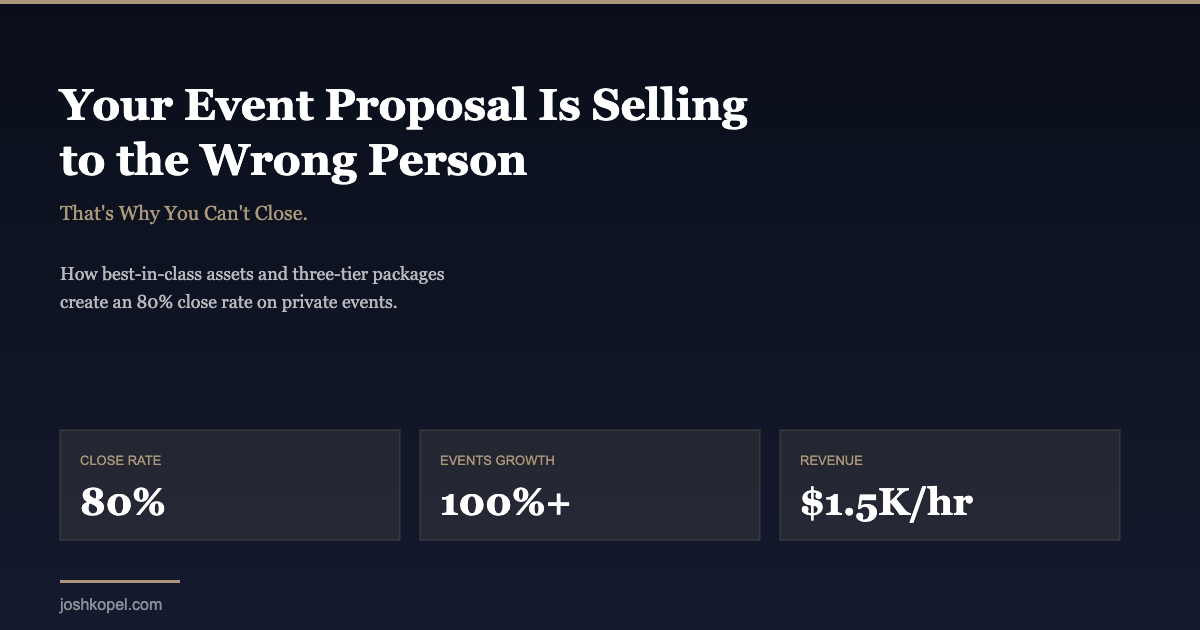
If you guessed that my close rate was through the roof, you’d be right. On average, I closed about 80% of everything I pitched.

Think about your close rate right now. If we got you up to 80%, what does that do to your business?

Keep reading: the wider playbook on restaurant marketing, and how events fit into restaurant profitability.

Marketing Is Best-in-Class Assets

Here’s what all of this comes down to. Marketing, when it comes to events and catering, is about best-in-class assets that create the illusion of choice while mitigating decision fatigue, while painting a picture of the benefit that the buyer wants.

I’m not selling cogs. I’m not selling features. I’m selling benefits. When you drive by a gym, you don’t see banners outside that say “18 treadmills, 32 stationary bikes.” They say “rock hard abs” and “the life you’ve always wanted.” We sell the benefit, not the feature.

And these results are not flukes. The Dundee Dell in Omaha, Nebraska – literally the oldest bar in Omaha – saw private events skyrocket by over 100% compared to the previous two years after implementing these asset strategies. Marquise Steakhouse in Milton, Ontario increased the average price of their private events by 50% and doubled their event bookings.

I had a chef-owner in a small metro who spent six hours doing outbound with best-in-class assets and generated $9,000 in event sales. He thought it didn’t work. I did the math for him – he generated $1,500 per hour for the six hours he worked on it. What else could he possibly do that generates $1,500 an hour? Now imagine if he 10x’d that effort.

Your 7-Day Event Proposal Action Plan

Day 1: Audit your current proposal. Pull up whatever you’re sending to event inquiries right now. Does it answer the first question – should they do business with you? If the first thing a prospect sees is a menu and prices, you’ve already lost. Lead with who you are and why you’re best in the world at this.

Day 2: Shoot your space for events. Set up your room the way it would look for a 50-person event. Not how it looks on a Tuesday night. Take professional photos of the space configured for private events. Show them the vision they can’t see on their own.

Day 3: Build three-tier packages. Stop selling individual food items. Create three package tiers where the middle tier is the clear winner in perceived value. Price so the greatest value sits in the middle. Stop going back and forth over brussels sprouts.

Day 4: Add “all dishes replenished as needed.” Eliminate the number one fear before it comes up. You can afford to make this promise because corporate guests don’t eat and drink the way you think they will. Feign generosity with confidence.

Day 5: Restructure your beverage packages. Price them so the upgrade makes obvious sense. Invoice at full freight and discount back. Give the event planner a win they can take credit for. This is where your margin lives.

Day 6: Bundle dessert, coffee, and tea. Make it a separate experience, not an afterthought. Price the coffee-only option so close to the full bundle that dessert becomes a no-brainer. Every guest at that event is a potential future customer – give them the full experience.

Day 7: Test the proposal. Send your new proposal to one prospect. Track what happens. If you’re doing it right, the proposal does the selling for you – even when you’re not in the room. That’s the whole point. Money likes speed. Start today.

Free Live Training

Want Me to Walk You Through These Systems Live?

Join the free 5-Day Restaurant Marketing Masterclass. In 40 minutes a day, I’ll show you how to build a marketing system that actually makes you money.

JOIN THE FREE MASTERCLASS

★★★★★ Rated 5/5 by 1,000+ restaurant owners

Frequently Asked Questions

Why does the event proposal matter more than the sales pitch?

Because you’re selling to the wrong person. The person you pitch isn’t usually the person who approves the expense. John meets with you and walks the space, but his boss approves the budget. Your proposal has to create the vision in the mind of someone who has never spoken to you and never been in your restaurant. Best-in-class assets sell for you when you’re not in the room.

How do three-tier event packages improve close rates?

Three-tier packages eliminate decision fatigue by giving buyers the illusion of choice without overwhelming them. People don’t want unlimited options – they want to be told what to do with some level of autonomy. Price the tiers so the middle option has the greatest perceived value. That’s the one you want them to buy. It ends the 38-email back-and-forth over side dishes and lets buyers make one simple decision.

What does “all dishes replenished as needed” actually mean for food costs?

It means less than you think. Corporate event guests don’t eat and drink the way regular diners do. Nobody goes to a work event to get stuffed and hammered – they go so they don’t get fired. You can promise replenishment because consumption at corporate events is predictable and moderate. The line eliminates the number one buyer fear – running out of food – at minimal actual cost to you.

How does the beverage package upgrade strategy work?

Price your beer and wine package at a level that makes the next tier up an obvious value upgrade. When someone selects beer and wine, immediately upgrade them to the call bar package. Invoice at full freight for the higher package, then discount it back to the original price. The buyer feels like they got a deal, you improve your margin because nobody drinks anyway, and the event planner gets a win they can take credit for with their boss.

What close rate should I expect with best-in-class event assets?

At Preux & Proper, the close rate averaged about 80% using this exact proposal system. That’s not because I was a better salesman – it’s because the assets did the selling. The proposal created the illusion of choice, mitigated decision fatigue, eliminated the biggest buyer fear, and painted a picture of the benefit. When you pair great assets with an outbound strategy and speed of response, event sales become predictable and scalable.

Jon Murray: Get More Profit From Your People

What if spending more on your staff is the fastest path to a more profitable restaurant?

Jon Murray washed dishes at Applebee’s and spent six years in music before rising to Chief Restaurant Officer at Indigo Road, running more than 20 concepts on someone else’s terms. Then he walked away to build Noko and Kase in East Nashville on a people-over-profit model most operators would call reckless.

In this conversation, we get into why he hands 5.5% of sales back to his team, how four-day workweeks and free therapy dropped his turnover to 15% in an 80% industry, and why he believes loving your people is the real driver of margin.

If you think you can’t afford to treat your people well, this one will change the math.

That’s Jon Murray. To learn more about Noko and Kase, visit nokonashville.com.

The Playbook Takeaways

  1. Share the revenue, not just the tips. Jon hands 5.5% of sales back to his team — a real cost he treats as an investment in margin rather than a line to cut.
  2. Retention is the cheapest margin lever you have. Four-day workweeks and free therapy took his turnover to 15% in an industry running near 80%, which removes the constant drag of hiring and retraining.
  3. You do not need a group behind you to run the people-first model. Jon rose to Chief Restaurant Officer at Indigo Road running more than 20 concepts on someone else’s terms, then left to prove the model himself at Noko and Kase in East Nashville.

Want the systems behind ideas like these? Join the free 5-day Restaurant Marketing Masterclass.

Keep going: restaurant profitability · restaurant consulting · restaurant business plan

_________________________________________________________

Free 5-Day Restaurant Marketing Masterclass – This is a live training where you’ll learn the exact campaigns Josh has built and tested in real restaurants to attract new guests, increase visit frequency, and generate sales on demand. Save your spot at restaurantbusinessschool.com

About the Author: Josh Kopel is a Michelin-awarded restaurateur, coach, and host of the FULL COMP podcast. More about Josh · the podcast · learn with Josh.

FREE DOWNLOAD

Leverage Digital Media to Drive Traffic to Your Restaurant

This free (and highly detailed) guide will outline how to tell your story in the most compelling way possible and how to share that story with the masses.

(Yep, even if you’re not a “tech” person!)

FREE DOWNLOAD

Lead Your Team Instead of Managing Them

This free (and highly detailed) guide will give you everything you need to know to build and lead a world class team from scratch, ensuring you work less and earn more. (Yep, even if you know nothing about leadership.)

FREE DOWNLOAD

Ready to Optimize, Manage and Grow Your Restaurant’s Profit Margin But Not Sure Where to Start?

This free (and highly detailed) cheat sheet will give you everything you need to know to set up your restaurant to maximize profitability. (Yep, even if you’re not a “business” person!)

Free 5-Day Marketing Masterclass

Join Now

5 Day Restaurant
Marketing Masterclass

100% Free

Get the tactics, tools, and strategies you need to scale your restaurant’s profits by 15% — in just five days.

See What You'll Learn